
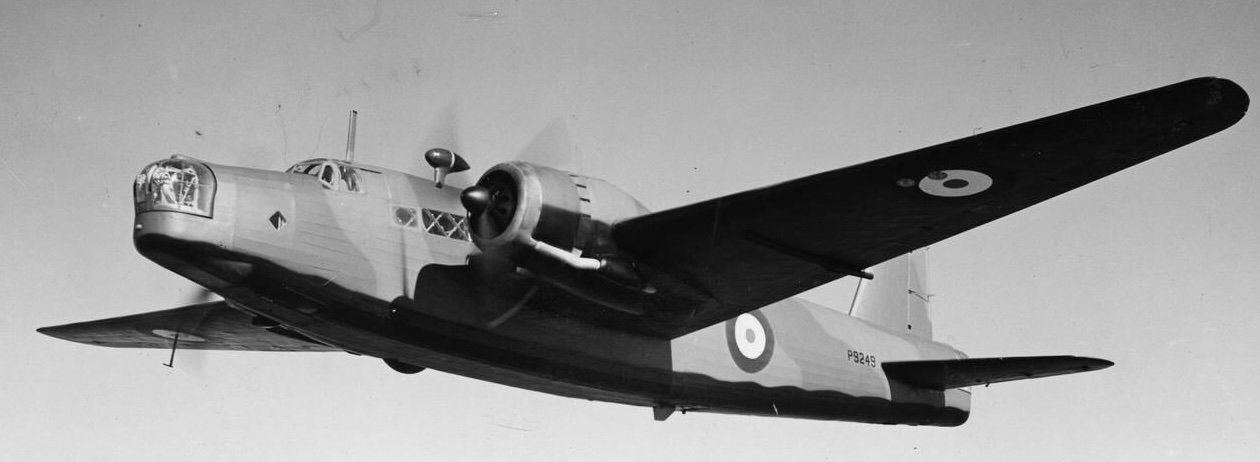
The Vickers-Armstrongs Vickers Wellington was a twin-engined, long-range medium bomber that became one of the most produced British aircraft of the Second World War. Developed in response to Air Ministry Specification B.9/32 issued in 1932, the aircraft evolved from the single-engined Vickers Wellesley. The Wellington was designed at Brooklands under Chief Designer Rex Pierson, with its most distinctive feature being the geodetic construction method developed by engineer Barnes Wallis. This revolutionary airframe utilized a criss-cross lattice of duralumin covered in fabric, providing a high strength-to-weight ratio and exceptional damage tolerance that allowed aircraft to remain flyable even after sustaining severe structural damage.
The prototype, serial K4049, first flew on 15 June 1936, piloted by Joseph “Mutt” Summers. Production ran from 1936 to 1945, with a total of 11,461 aircraft built. Manufacturing took place at plants in Blackpool, Chester (Broughton), and Weybridge (Brooklands), the latter of which produced 2,515 airframes. The original manufacturer, Vickers-Armstrongs Ltd, was formed on 1 January 1928 through a merger of Vickers Limited and the shipbuilding and armaments interests of Armstrong Whitworth. This lineage eventually led to the formation of the British Aircraft Corporation (BAC) in 1960, which merged into British Aerospace in 1977 and became BAE Systems plc in 1999.
Technically, early versions like the Mk IA were powered by two Bristol Pegasus Mk XVIII air-cooled radial piston engines, each producing 1,050 hp. These aircraft typically carried a crew of six and could deliver an internal bomb load of up to 4,500 lb. Performance figures for the Mk I series included a maximum speed of 235 mph at 15,500 ft, a service ceiling of 18,000 ft, and a travel range of 2,220 nautical miles. Armament consisted of four 0.303 in Browning machine guns in nose and tail turrets, with provisions for two additional guns in a ventral turret.
During the Second World War, the Wellington served in diverse roles for the Royal Air Force (RAF). In Bomber Command, it was a primary night bomber and constituted approximately 60% of the aircraft used in the first 1,000-bomber raid on Cologne on 30/31 May 1942. However, a daylight raid on the Heligoland Bight on 18 December 1939, where over half of the 22 dispatched Wellingtons were shot down, prompted a shift toward night operations. Beyond strategic bombing, the Wellington was extensively used by Coastal Command for anti-submarine warfare and maritime reconnaissance in the Atlantic. It also served as a torpedo bomber, air ambulance, and transport. Post-war, it functioned as an experimental testbed for early turboprop and turbo-jet engines and influenced the design of the Vickers VC.1 Viking airliner. The RAF retired the final Wellingtons in March 1953.
Today, the most notable survivor is the Wellington Mk IA N2980, preserved at the Brooklands Museum. Known as “R for Robert,” it is the only surviving Wellington to have seen active service during the war, having participated in the Heligoland Bight raid before ditching in Loch Ness on 31 December 1940.