
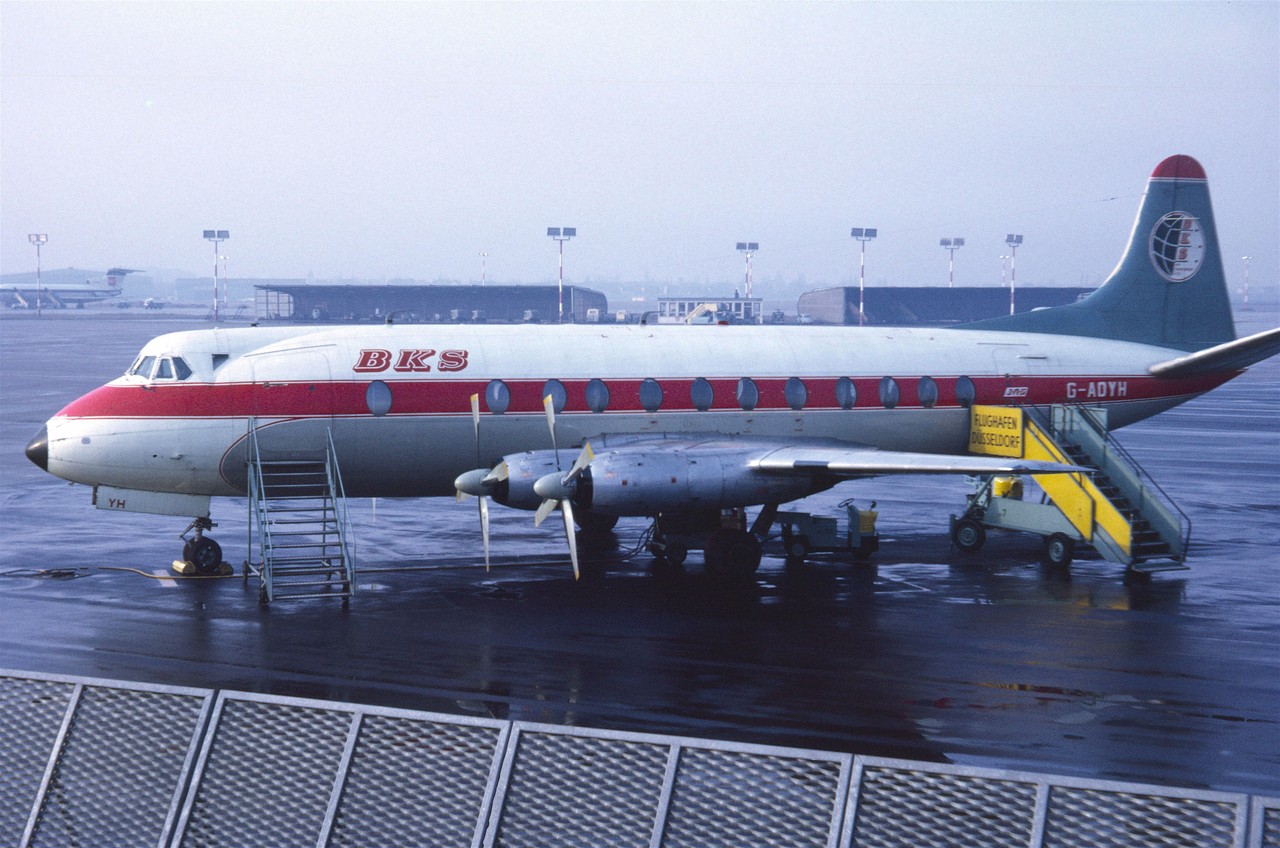
Commercial Aviation Revolution
The Viscount's entry into service with British European Airways in April 1953 marked a pivotal moment in aviation history. At a time when most airlines operated noisy, vibrating piston-engine aircraft, the Viscount offered passengers an entirely new experience with its smooth turboprop engines and pressurized cabin. The aircraft's success was immediate and dramatic - it became one of Britain's most successful export aircraft, with orders pouring in from airlines worldwide.
By the late 1950s, the Viscount had captured markets across Europe, North America, and the Commonwealth. Trans-Canada Air Lines operated the type extensively on domestic routes, while Capital Airlines in the United States became the largest operator with 60 aircraft. The Viscount's appeal lay not just in passenger comfort, but in its operational economics - it consumed less fuel than comparable piston aircraft while offering higher speeds and greater reliability.
The Manufacturer's Achievement
Vickers-Armstrongs (Aircraft) Ltd, established in Weybridge, Surrey, had built a reputation on military aircraft including the Wellington bomber during World War II. The Viscount project represented the company's bold entry into the post-war commercial market. Under the leadership of chief designer Rex Pierson and his team, Vickers created an aircraft that would define a new category of regional airliners.
The company's expertise in stressed-skin construction and aerodynamics, honed during wartime production, proved invaluable in developing the Viscount's clean, efficient design. Vickers later became part of the British Aircraft Corporation and eventually BAE Systems, which continues as a major aerospace manufacturer today.
Technical Innovation and Performance
The heart of the Viscount's success lay in its Rolls-Royce Dart engines, which delivered 1,990 horsepower each in the most common production variant. These turboprops provided the reliability of jet engines with the fuel efficiency needed for short to medium-haul routes. The aircraft typically operated with a crew of three - two pilots and a flight engineer - though later variants could operate with just two pilots.
The Viscount cruised at 300 mph at altitudes up to 25,000 feet, with a range of approximately 1,750 miles. These performance figures allowed airlines to offer schedules competitive with larger aircraft while serving smaller airports that couldn't handle jets. The aircraft's relatively short takeoff distance of 4,100 feet opened routes to airfields previously accessible only to smaller, slower aircraft.
Production Variants and Evolution
Production began with the Type 700 series, featuring the distinctive circular passenger doors and seating for 40 to 53 passengers. The later Type 800 series, stretched by 3 feet 10 inches, could accommodate up to 65 passengers and featured square doors for easier boarding. This larger variant proved especially popular with airlines seeking higher capacity on dense routes.
A total of 445 Viscounts rolled off the production line between 1948 and 1963, including three prototypes. Each aircraft was individually constructed using traditional British manufacturing methods, with extensive hand-fitting and attention to detail that contributed to the type's legendary build quality and longevity.
Operator Experience and Legacy
Pilots praised the Viscount for its stable handling characteristics and forgiving nature. The aircraft's tricycle landing gear made ground handling straightforward, while the turboprop engines provided excellent single-engine performance - a critical safety factor for operations over water and mountainous terrain.
British Midland Airways became synonymous with Viscount operations, operating 29 different aircraft throughout the 1960s and 1970s. The airline's experience demonstrated the type's durability, with many aircraft accumulating over 50,000 flight hours during their service lives.
Enduring Impact
The Viscount's commercial success validated the turboprop concept and directly influenced the development of subsequent aircraft including the Fokker F27 and Hawker Siddeley 748. Its introduction of large oval windows, individual passenger reading lights, and reduced cabin noise set new standards that became industry expectations.
Today, fewer than a dozen Viscounts remain airworthy worldwide, with most serving as corporate transports or historical aircraft. Museums including the Imperial War Museum Duxford and the National Museum of Flight in Scotland preserve examples of this pioneering airliner. The Viscount's legacy lives on in modern turboprop airliners that continue to serve regional routes using the same fundamental principles it established over 70 years ago.