
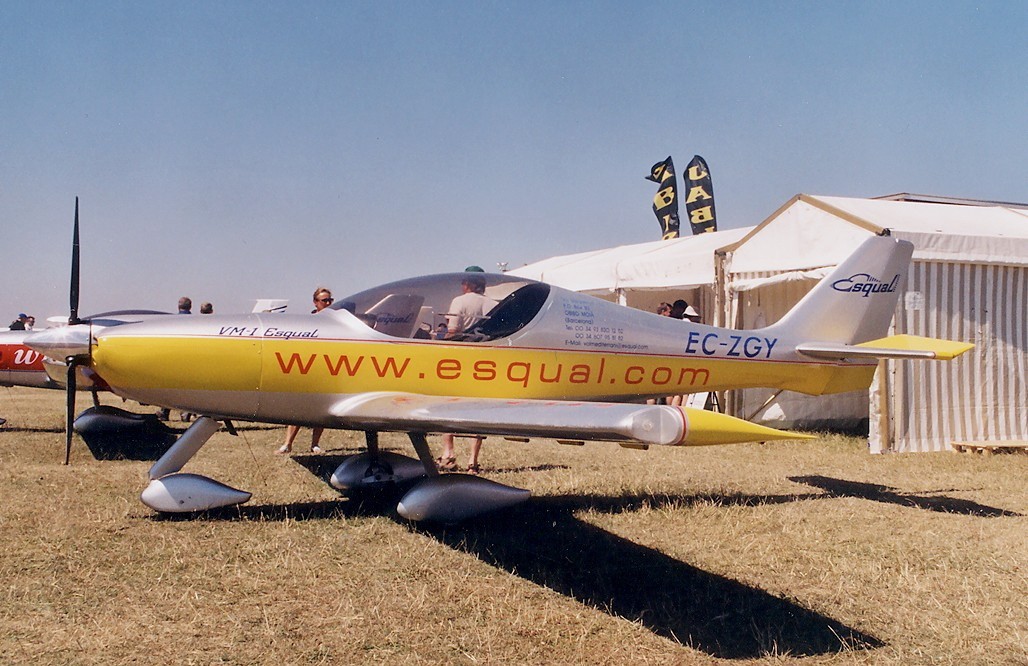
International Production Success
The VM-1 Esqual achieved remarkable international market penetration for an ultralight aircraft, with Vol Mediterrani selling at least 57 units by late 2002 alone. Production expanded beyond Spain to include completed aircraft in Portugal, France, the United States, Australia, and Italy during the mid-2000s. This widespread manufacturing base demonstrated the design's adaptability to different regulatory environments and builder capabilities across multiple continents.
Manufacturing Evolution
Vol Mediterrani SL ceased operations around 2004-2005 after developing the Esqual 2 prototype, which featured longer-span wings and retractable landing gear. Belgium's Limair acquired production rights in 2006, planning both kit and ready-to-fly versions, but closed without producing any aircraft in 2007. Sweden's Aerocomp AB successfully revived the program around 2008, with their first aircraft flying on July 8, 2009. The Swedish operation evolved through Aerocomp Esqual i Sverige AB before becoming Arsi AB of Alingsås, which continued marketing the aircraft as late as 2014.
Advanced Composite Construction
The Esqual pioneered several innovative features in ultralight design, utilizing high-density PVC foam core with epoxy resin construction throughout the airframe. The standard VM-1 featured an all-glass fiber fuselage, while the VM-1C variant incorporated carbon fiber construction that reduced weight by 10 kilograms compared to glass fiber wing spars. Builders received kits requiring no composite work, with all complex fabrication completed at the factory level.
Technical Innovations
Engineering refinements included electrically-actuated flaps that deflected upward for cruise flight, enhancing performance across the speed envelope. The aircraft featured variable-incidence electric tailplane trim and optional ballistic parachute systems for enhanced safety. Fixed tricycle landing gear used aluminum 7175-T6 construction with hydraulic brakes and castering nosewheel, while the Esqual 2 variant incorporated retractable main gear that retracted into the wing structure.
Engine Options and Performance
Primary powerplant options included the Austrian Rotax 912ULS producing 101 horsepower and the Australian Jabiru 3300 generating 120 horsepower. Additional choices encompassed the Jabiru 2200 at 85 horsepower and ULPower UL260i at 95 horsepower. All engines drove two or three-blade fixed-pitch propellers, with fuel capacity ranging from 70 to 100 liters stored in wing tanks. The Rotax 912 series, entering production around 1994, established exceptional reliability records across millions of engines produced.
Performance Capabilities
The Esqual achieved impressive performance figures for its ultralight category, cruising at 140 mph with a never-exceed speed of 200 mph. Stall speed remained remarkably low at 39 mph, providing excellent short-field capabilities. The aircraft's 9.0 square meter wing area supported a maximum gross weight of 450 kilograms, with an empty weight of just 265 kilograms allowing substantial payload capacity.
International Service Record
Operational examples spread globally, including Spanish prototypes EC-YZZ, EC-ZFF, and EC-ZFX, with the UK debut occurring at the PFA Rally, Cranfield in June 2002. Australian aircraft included registration 19-4406 (constructor number E1800-57) first registered on August 8, 2005, and 19-3980 operating at Clifton. American builder Larry Mitchell completed his aircraft receiving its Certificate of Airworthiness on February 21, 2007. A notable incident occurred on January 13, 2009, when Dutch-registered PH-GCJ experienced landing gear damage at Ludham airfield, though the pilot with 1,675 total hours remained uninjured.
Design Legacy and Continuing Production
The Esqual contributed to related aircraft development, with its wing structure tested on the "Frankensqual" prototype for the Arion Lightning in 2005. Current production status remains active under Sweden's Arsi AB, with recent sightings including Australian aircraft 19-3980 photographed in June 2025. The design's emphasis on high-performance composite construction influenced subsequent ultralight development, establishing manufacturing techniques now standard throughout the industry.