
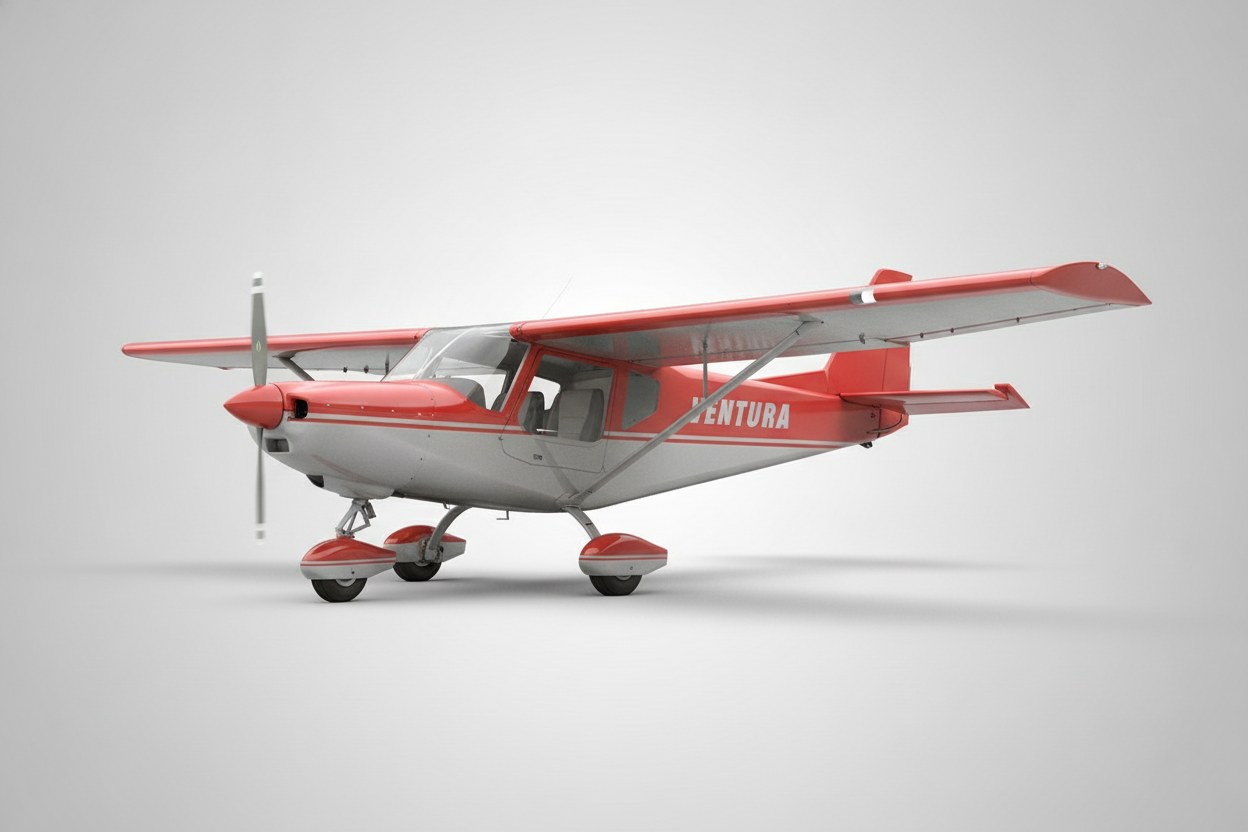
Development and Design Philosophy
The ICP Ventura emerged from ICP Srl's research and development department in response to market demand for a larger aircraft offering greater space and load capacity than their successful Savannah series. Building upon the foundation of over 2,500 Savannah aircraft produced, ICP's engineering team set ambitious design objectives: versatility across 2-4 seat configurations, compatibility with engines from 100-180 horsepower, extremely low landing speeds of 80 kilometers per hour at maximum weight, and the ability to operate from semi-prepared runways under 250 meters in length.
The aircraft incorporated several innovative features for its time, including Junkers-type flaperons that combine aileron and flap functions with electric actuation, all-metal load-bearing panels, and the specialized Riblet GA 35-418 wing profile optimized for short takeoff and landing performance. This state-of-the-art metallic construction delivered both structural integrity and the brisk roll response essential for STOL operations.
The Manufacturer's Evolution
ICP Srl traces its origins to 1980 when Tancredi "Edi" Razzano founded Industria Componenti Piovà, initially focusing on automotive wiring harnesses. The company's aviation journey began in 1988 with ultralight aircraft imports, progressed to Zenair production under license from 1990, and achieved original aircraft design capabilities by 1996. Operating from their facility in Castelnuovo Don Bosco, Italy, complete with an adjacent 750-meter airfield inaugurated in 2009, ICP pioneered the use of CNC machining technology in the late 1990s to produce low-cost aircraft kits, beginning with their Bingo and Savannah models.
The company's innovative approach extended to powerplant development, culminating in their ICP M09 engine that achieved first flight on December 18, 2014, aboard a Savannah S. This vertical integration strategy positioned ICP uniquely in the light sport aircraft market, combining airframe manufacturing expertise with engine development capabilities.
Engine Options and Performance
The Ventura's large engine compartment accommodates a range of powerplants from 100 to 180 horsepower, with primary options including the Austrian Rotax 912 and 915 iS series, and the American Lycoming IO-360. The Rotax 915 iS variant, producing 141 horsepower, enables a substantial payload capacity of 415 kilograms, while the more powerful Lycoming IO-360 at 180 horsepower supports a 320-kilogram payload when equipped with either GT or MT propellers.
This engine flexibility allows operators to optimize their aircraft for specific mission requirements, whether prioritizing fuel efficiency and reliability with the Rotax installation or maximum performance with the Lycoming powerplant. The fuel system incorporates two 36-liter wing tanks plus an 18-liter sump tank, providing adequate range for the aircraft's intended roles.
Operational Characteristics
The Ventura demonstrates impressive performance specifications that fulfill its STOL design mandate. With a cruise speed of 200 kilometers per hour and a stall speed of just 75 kilometers per hour without flaps deployed, the aircraft offers both efficiency and low-speed handling characteristics essential for operations from confined airstrips. The never-exceed speed of 260 kilometers per hour provides adequate margin for varied flight conditions, while the approach speed of 80 kilometers per hour ensures manageable landing characteristics even for relatively inexperienced pilots.
Takeoff performance proves exceptional, requiring less than 60 meters with pilot only at the maximum takeoff weight of 800 kilograms. This capability, combined with landing approach speeds that permit runway operations under 250 meters, opens access to airstrips unavailable to conventional light aircraft.
Production Variants and Certification
ICP launched three distinct Ventura variants in 2016, each targeting different market segments and regulatory categories. The 2-seat S-LSA version received factory-built Light Sport Aircraft certification, appealing to buyers seeking turn-key aircraft delivery. The 3-seat CS-VLA variant achieved EASA CS-VLA certification with increased maximum takeoff weight, expanding utility for small commercial operations or larger families.
The 4-seat Ventura 4, available exclusively as an experimental kit requiring 51 percent amateur construction, received approvals from the FAA, ENAC, and IAA. This variant represents the ultimate expression of the Ventura concept, maximizing passenger capacity while maintaining the aircraft's fundamental STOL characteristics.
Current Status and Legacy
Production of the original Ventura models concluded by 2016, though ICP continues manufacturing the Ventura 2 light sport aircraft and Ventura 4 experimental kits. Notable examples include I-AICP, the first Ventura 4 Experimental powered by a Lycoming IO-360 with GT propeller, and I-DIOT, the second example featuring a Rotax 915 iS with MT propeller.
The Ventura's significance in aviation history lies in its advancement of affordable, high-performance STOL capabilities within the light sport and experimental aircraft markets. Building upon the commercial success of ICP's Savannah series, the Ventura demonstrated that sophisticated aerodynamic design and modern manufacturing techniques could deliver airline-like reliability and performance in aircraft accessible to private owners and small operators.