
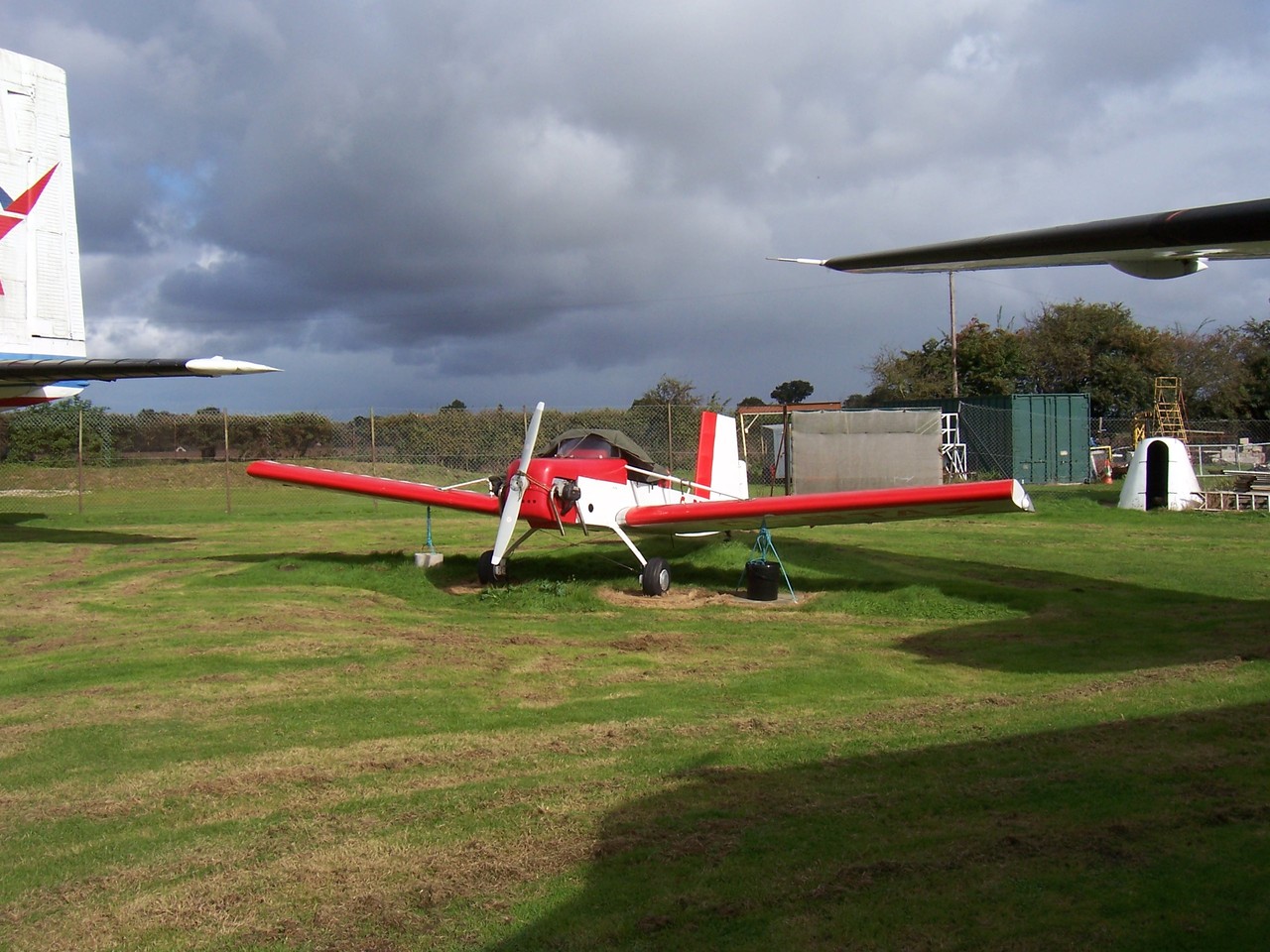
Design Philosophy and Engineering Excellence
The VP-2 emerged from the brilliant mind of William Samuel "Bud" Evans, an accomplished aeronautical engineer whose career spanned prestigious companies including Convair, Ryan Aircraft, and General Dynamics. Working from La Jolla, California, Evans assembled a formidable design team including Bill Beatty, Walt Mooney, and Charlie Ackerman—collectively bringing over 100 years of aircraft design experience to the project. Their mission was audacious yet simple: create an aircraft that was "dirt simple and incredibly cheap" while maintaining rigorous professional engineering standards.
The VP-2 evolved from Evans' earlier VP-1 Volksplane, which first flew in September 1968 after design work completed between 1966 and 1968. The two-seat VP-2 variant represented a significant leap forward, engineered to meet normal category structural limits of 3.8 positive and 1.9 negative g-forces—substantially more robust than many contemporary homebuilts.
Revolutionary Construction Methods
What truly distinguished the VP-2 was its ingenious simplicity. The entire fuselage consisted of just plywood skins, three bulkheads, and longerons with only a single metal fitting—one pulley. The wings employed construction techniques borrowed from model aircraft, featuring ribs stack-cut and bandsawed from quarter-inch marine plywood, spruce spars, and birch dowels serving as compression members. Remarkably, welding was required for only three components: the control stick, wing struts, and elevator horn.
The powerplant installation epitomized this elegant simplicity—the Volkswagen engine bolted directly to the firewall with no traditional motor mount required. This approach eliminated complex fabrication while maintaining structural integrity, a testament to Evans' engineering prowess.
Volkswagen Power and Performance
The VP-2's use of converted Volkswagen air-cooled engines was revolutionary for its era. The aircraft accommodated any Volkswagen flat-four engine from 1,834 to 2,100 cc displacement, though the standard installation featured a 60-horsepower unit. This automotive adaptation provided reliable, affordable power while parts remained readily available through Volkswagen dealers worldwide.
Performance figures were impressive for such a modest powerplant. The VP-2 achieved a maximum speed of 100 mph, cruised at 75 mph, and stalled at just 40 mph. With pilot only, the aircraft climbed at 700 feet per minute, reducing to 500 feet per minute with a passenger aboard. The service ceiling reached 10,000 feet, while range extended to 200 miles on 14 gallons of fuel. Takeoff required just 700 feet, with landing rolls of only 400 feet.
Operational Categories and Safety
Evans designed the VP-2 with clear operational limitations that prioritized safety. With a passenger, the aircraft operated in normal category, permitting all maneuvers incident to normal flying but prohibiting aerobatics. Solo flight allowed utility category operations, including stalls, lazy eights, chandelles, and steep turns exceeding 60-degree bank angles. Aerobatics remained strictly prohibited in both configurations, reflecting Evans' conservative approach to amateur-built aircraft certification.
Market Impact and Production
The Evans Aircraft Company never manufactured complete aircraft, instead selling detailed construction plans to homebuilders. Several hundred VP-2 plan sets found buyers, while the single-seat VP-1 achieved remarkable success with over 5,000 plan sets sold. This demonstrated the massive pent-up demand for affordable homebuilt aircraft in the 1970s.
However, liability concerns ultimately forced Evans Aircraft Company to cease VP-2 marketing and discontinue technical support. The company's withdrawal from two-seat aircraft reflected the increasingly litigious environment facing kit aircraft manufacturers. Despite this setback, modified VP-2 plans continued circulating through unofficial channels, though without Evans Aircraft Company authorization or approval.
Physical Characteristics
Compared to its single-seat predecessor, the VP-2 featured significant dimensional increases to accommodate two occupants. The fuselage grew one foot wider, while overall length increased by one foot to 19 feet 3 inches. Wingspan expanded by three feet to 27 feet, creating 130 square feet of wing area using the NACA 4415 airfoil section. Empty weight reached 640 pounds, with gross weight of 1,040 pounds.
Legacy and Preservation
The VP-2's influence on homebuilt aviation cannot be overstated. It proved that professional engineering principles could create aircraft accessible to amateur builders using basic tools and readily available materials. The design's elegant simplicity inspired countless subsequent homebuilt projects and demonstrated that effective aircraft need not be complex.
Today, the City of Norwich Aviation Museum in Norfolk, England, preserves a VP-2 example, ensuring future generations can study this pioneering homebuilt design. While many VP-2s have been retired—with documented aircraft losing airworthiness certificates as recent as 2015—the type's contribution to democratizing aviation remains its lasting legacy.
The Evans VP-2 Volksplane stands as a testament to innovative engineering applied to the grassroots aviation movement, proving that thoughtful design could make aircraft ownership achievable for ordinary enthusiasts willing to invest their labor and dedication.