
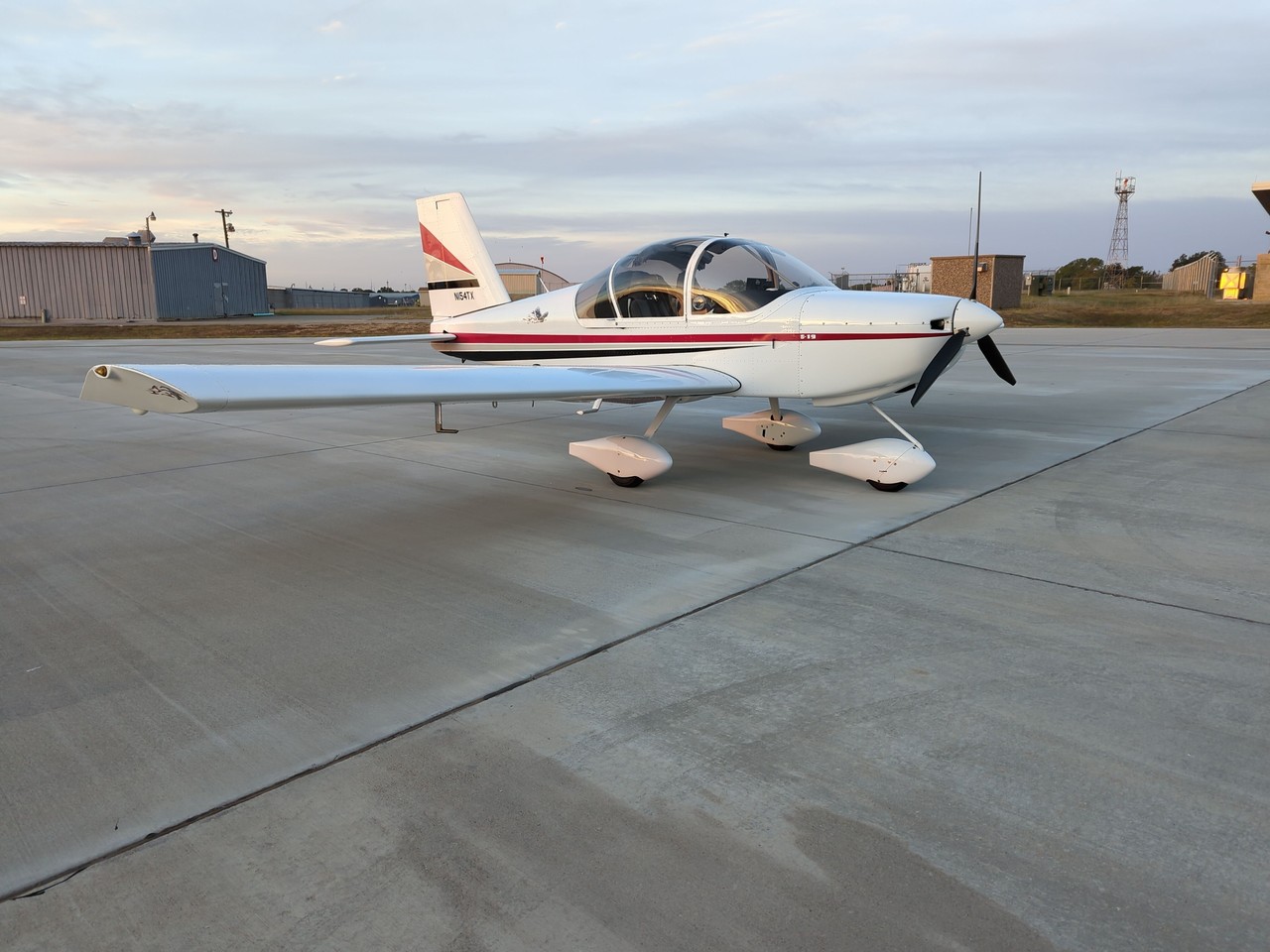
Design Philosophy and Development
Randy Schlitter's S-19 Venterra marked a revolutionary shift in RANS aircraft construction when it debuted in 2007. Unlike the company's traditional welded 4130 steel tube fuselage designs, Schlitter opted for aluminum semi-monocoque construction with stressed skin supported by bulkheads, formers, and stringers. This departure represented RANS' commitment to creating a purpose-built aircraft specifically for the emerging Light Sport Aircraft market.
The aircraft's name itself reflects practical considerations. Originally designated simply as "S-19," Schlitter added "Venterra" after early air traffic control communications proved confusing. "With 19 designs it has become a challenge to create names that are original," Schlitter explained, "we like the sound of Venterra over the radio, it is easy to say, and should satisfy ATC."
Technical Innovation
The S-19 stands alone among RANS aircraft as the only model featuring aerodynamic landing gear fairings and represents the company's sole low-wing design currently in production. The aircraft's wing and tail surfaces are covered in sheet aluminum, with the wings equipped with flaps for enhanced short-field performance. This construction method, while more complex than traditional tube-and-fabric designs, provides the sleek appearance and performance characteristics demanded by modern sport pilots.
Powered by the reliable Rotax 912ULS engine producing 100 horsepower, the Venterra achieves a cruise speed of 128 mph while maintaining a gentle stall speed of just 45 mph with flaps deployed. The four-cylinder horizontally-opposed, liquid-and-air-cooled powerplant drives a two-bladed composite ground-adjustable propeller measuring 5 feet 8 inches in diameter.
Performance Characteristics
The Venterra's performance envelope reflects its dual nature as both a capable cross-country tourer and forgiving trainer. With an empty weight of 750 pounds and maximum gross weight of 1,320 pounds, the aircraft offers a useful load of 570 pounds. Its impressive rate of climb of 900 feet per minute and service ceiling of 14,500 feet provide access to higher altitudes for weather avoidance and favorable winds.
Range capabilities extend to 580 miles with 5.1 hours of endurance, supported by a 20-gallon fuel capacity. The aircraft's wing loading of 10.4 pounds per square foot contributes to its stable flight characteristics, while G-limits of +4.4/-2 at maximum gross weight demonstrate its robust construction suitable for sport flying.
Production and Market Response
RANS offered the S-19 in two configurations: as a factory-built Special Light Sport Aircraft (SLSA) for pilots seeking ready-to-fly convenience, and as a kit for experimental amateur-built category registration. The aircraft's reception proved so enthusiastic that production demand exceeded the company's capacity, leading RANS to limit availability to parts and kit completion sales only.
By March 2017, 41 S-19s were registered in the United States, with one additional aircraft registered in the United Kingdom. No Canadian registrations were recorded during this period, reflecting the aircraft's primary market concentration in the United States.
Safety Considerations
The Venterra's safety record includes a significant incident that led to design modifications. On June 25, 2017, a RANS S-19 registered ZK-MBX crashed near Hyde, Central Otago, New Zealand, resulting in one fatality and one serious injury. The Civil Aviation Authority of New Zealand investigation identified deficiencies in the stabilator anti-servo tab trim control design that resulted in inadvertent activation and sudden departure from controlled flight. This finding prompted the issuance of a Continuing Airworthiness Notice addressing stick grip design concerns.
Legacy and Current Status
The S-19 Venterra maintains its position as RANS' only low-wing aircraft design, representing the company's successful adaptation to the Light Sport Aircraft market. While production has been limited due to high demand for other RANS models, the Venterra continues to serve as an important bridge between traditional amateur-built aircraft and modern factory-produced light sport aircraft.
The aircraft's aluminum construction methodology has influenced subsequent light sport aircraft designs throughout the industry, demonstrating that kit aircraft can successfully incorporate sophisticated manufacturing techniques while remaining accessible to amateur builders. Today, the Venterra remains a sought-after design among sport pilots seeking the performance and aesthetics of a low-wing aircraft with the reliability and support of an established manufacturer.