
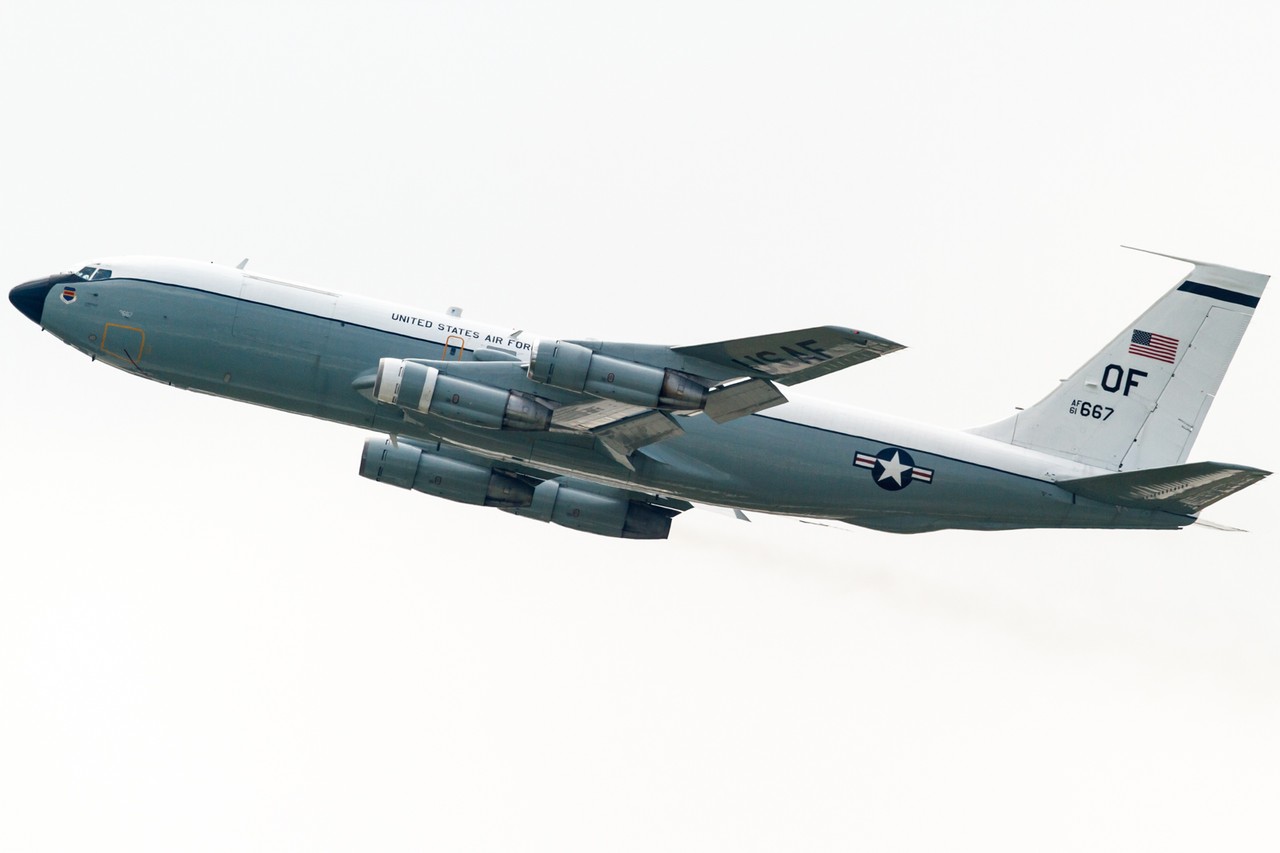
Service History
The WC-135R entered service in July 2022 as the Air Force's most advanced nuclear detection platform, operated exclusively by the 45th Reconnaissance Squadron at Offutt Air Force Base, Nebraska. Only three aircraft comprise the entire fleet, converted from KC-135R tankers between 2022 and 2023 to replace aging WC-135W variants that had served since the 1960s. These specialized aircraft monitor global atmospheric conditions for radionuclide detection, supporting nuclear treaty verification and emergency response missions without requiring overflight of sensitive territories.
The WC-135 series has maintained America's atmospheric sampling capability since December 1965, when ten WC-135B aircraft replaced the obsolete WB-50 Superfortress fleet. Originally assigned to the 55th Weather Reconnaissance Squadron at McClellan Air Force Base under Military Airlift Command, these aircraft transitioned from weather reconnaissance to dedicated nuclear sampling duties in the early 1990s.
Operational History
While carrying no armament, the WC-135 family has conducted critical intelligence missions throughout the Cold War and beyond. Notable deployments included monitoring atmospheric fallout from North Korea's 2017 nuclear test, collecting samples following the 1986 Chernobyl disaster, and analyzing radioactive particles after the 2011 Fukushima incident. The aircraft's "Doom Phoenix" nickname reflects its ominous mission of detecting nuclear weapons activity through trace atmospheric analysis.
Each mission typically involves a crew of four flight personnel plus specialized mission operators who manage the sophisticated collection equipment. The aircraft can extend its approximately 3,900-mile range through aerial refueling, enabling global reach for time-sensitive sampling operations.
The Manufacturer
The Boeing Company traces its origins to 1916 when William E. Boeing founded Pacific Aero Products Company, renamed Boeing Airplane Company in 1917. The manufacturer pioneered both military and commercial aviation with groundbreaking designs including the Model 247 airliner in 1933, the B-17 Flying Fortress bomber in 1935, and the B-29 Superfortress in 1944.
Boeing's corporate structure expanded significantly through major acquisitions, including Rockwell North American in 1996 and McDonnell Douglas in 1997. Today, The Boeing Company operates from Arlington, Virginia headquarters, continuing as one of the world's largest aerospace manufacturers alongside its commercial airliner and defense contracting divisions.
Engine and Technical Innovations
The WC-135R's most significant advancement over previous variants lies in its powerplant upgrade to four CFM International F108-CF-100 turbofan engines. These military versions of the proven CFM56 series produce 21,600 pounds of thrust each, compared to the 16,050 pounds generated by the earlier Pratt & Whitney TF33 engines. CFM International, a joint venture between GE Aerospace and Safran Aircraft Engines established in 1974, has produced over 33,000 CFM56 family engines since 1982.
The new engines provide exceptional reliability with incident rates of only one per 1.5 million flight hours, while their 5.5:1 bypass ratio delivers superior fuel efficiency. Additional modernizations include a completely digitized cockpit system replacing 1960s-era analog instrumentation, addressing airframe fatigue issues that plagued earlier conversions.
Performance Characteristics
Pilots benefit from the WC-135R's improved performance envelope, with maximum speeds reaching 530 mph at operational altitudes up to 40,000 feet. The aircraft's maximum takeoff weight of 322,500 pounds includes substantial fuel capacity of 130,000 pounds, supporting extended missions critical for atmospheric sampling operations. Its 2,433 square feet of wing area provides stable flight characteristics essential for precision instrument operation during collection phases.
The enhanced thrust-to-weight ratio improves climb performance and operational flexibility compared to the TF33-powered predecessors, while reduced maintenance requirements increase mission availability rates.
Production and Legacy
With only three WC-135R aircraft converted at Boeing facilities between 2022 and 2023, this variant represents one of the most exclusive military aircraft programs in service. The conversions, announced in 2018 and funded through the FY19 budget request, delivered aircraft with serial numbers 64-14836, 64-14831, and 64-14829 to maintain America's unique atmospheric sampling capability.
As of 2023, these three WC-135R aircraft constitute the primary nuclear detection fleet alongside one remaining WC-135W, following the November 2020 retirement of WC-135C tail number 62-3582 after accumulating 29,689 flight hours. The program's legacy extends beyond mere aircraft numbers to encompass six decades of continuous atmospheric monitoring, establishing the foundation for modern nuclear forensics and treaty verification protocols that remain essential to global security.