
Service History
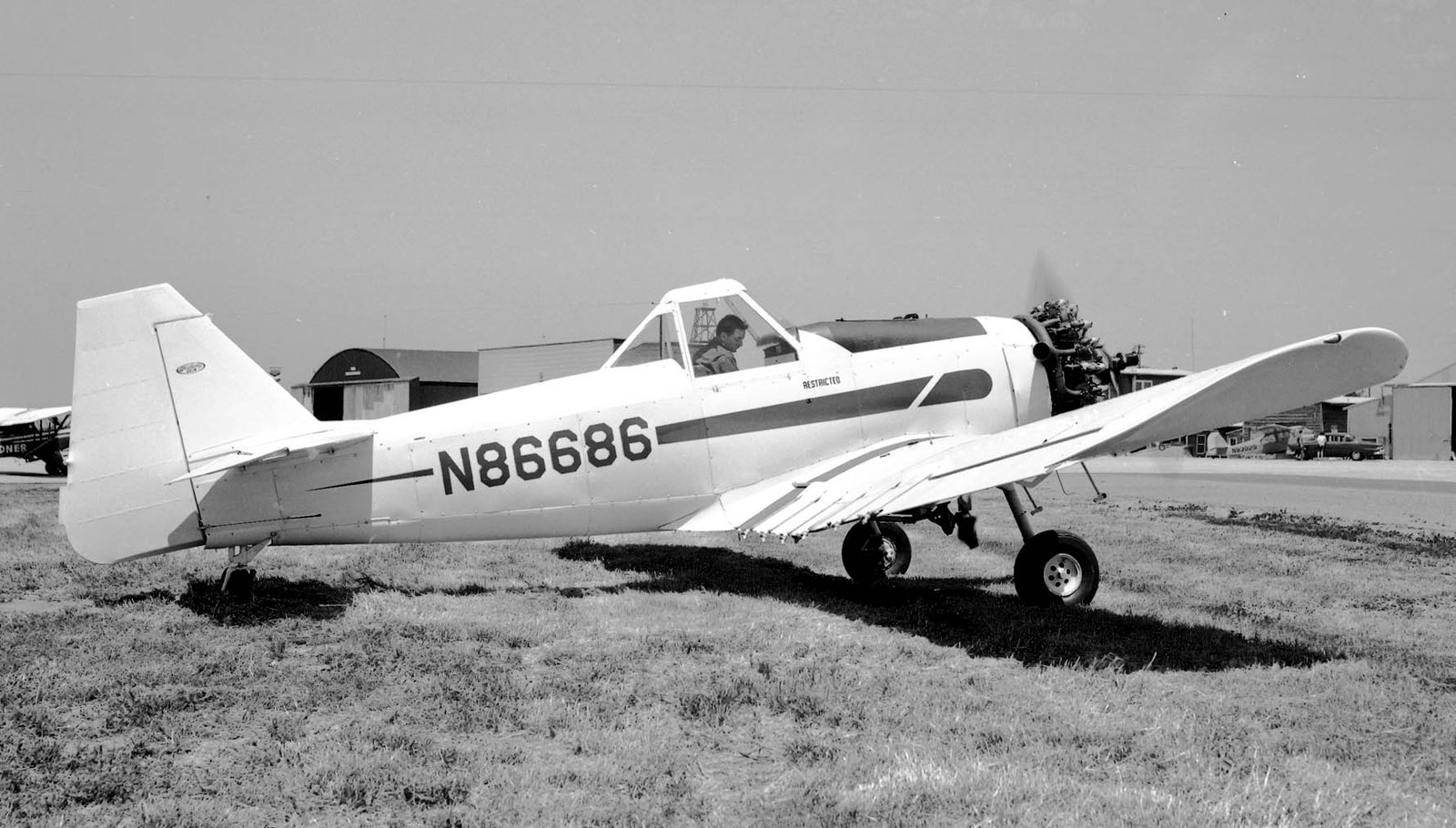
The Weatherly 201 filled a critical gap in agricultural aviation during the late 1960s, when crop dusters were primarily relying on converted World War II trainers that were becoming increasingly scarce and expensive to maintain. From 1967 to 1979, the aircraft established itself as a reliable workhorse for agricultural operators across the United States, with exactly 90 aircraft built across four variants: 2 Model 201s, 5 Model 201As, 45 Model 201Bs, and 38 Model 201Cs. The aircraft's purpose-built design provided superior performance compared to converted military aircraft, offering consistent chemical application capabilities that were essential for small-grain crop operations.
The Manufacturer
Weatherly Aviation Company was founded by John C. Weatherly in the early 1960s in Hollister, California, initially focusing on converting 19 Fairchild M-62s (PT-23s) into WM-62C agricultural sprayers. Weatherly recognized that the supply of surplus World War II trainers suitable for agricultural conversion was finite, prompting him to develop an original design specifically for crop dusting applications. This foresight led directly to the development of the Model 201, which became the company's first clean-sheet aircraft design. The company continues operations today as Weatherly Aircraft Company, maintaining its focus on agricultural aviation with ongoing production of aircraft, parts, and services.
Engine & Technical Details
The Weatherly 201 was powered by a single Pratt & Whitney R-985 nine-cylinder air-cooled radial engine producing 450 horsepower. This powerplant, a proven design from the World War II era, provided the reliability and power characteristics essential for agricultural operations, where aircraft routinely operate at low altitudes with heavy chemical loads. The engine's robust construction and field-proven durability made it an ideal choice for the demanding agricultural environment.
The aircraft featured an all-metal construction with a steel-tube fuselage covered by aluminum panels and cantilever aluminum wings incorporating 6 degrees of dihedral. The low-wing configuration provided excellent stability for precise chemical application, while the fixed tailwheel landing gear simplified maintenance and reduced operational costs. The enclosed cockpit protected the pilot from chemical exposure, a significant safety improvement over earlier open-cockpit agricultural aircraft.
Design Innovation
John Weatherly's design incorporated several innovations specifically tailored for agricultural operations. The aircraft's 270-gallon fiberglass chemical hopper was optimized for efficient loading and distribution, while the airframe was engineered to handle the stress of repeated low-level maneuvering with varying load weights. The unswept wing design provided predictable handling characteristics essential for precise application work, and the robust landing gear was designed to operate from unprepared airstrips commonly found at agricultural facilities.
Performance Specifications
The Weatherly 201 had an empty weight of 2,550 pounds and a maximum takeoff weight of 4,800 pounds, allowing for substantial chemical loads while maintaining safe operating margins. With a wing area of 248 square feet and fuel capacity of 98 gallons, the aircraft provided sufficient range and endurance for typical agricultural missions. The aircraft's dimensions - 26 feet 7 inches in length, 39-foot wingspan, and 7 feet 11 inches in height - were optimized for hangar storage while providing adequate wing area for safe low-speed operations.
Production Legacy
Production of the Weatherly 201 ceased in 1979 when the company introduced the successor Weatherly 620, which incorporated lessons learned from the 201's operational history. The 620 series proved even more successful, with over 200 units built and aircraft operating in 13 countries worldwide. Many Weatherly 201s remained in service well into the 21st century, testament to the aircraft's durable construction and reliable performance.
The 201's significance in aviation history extends beyond its production numbers. It represented a crucial transition in agricultural aviation from converted military surplus aircraft to purpose-designed civilian aircraft optimized for specific roles. This design philosophy influenced the entire agricultural aviation industry and established Weatherly Aviation as a major player in the specialized agricultural aircraft market. The aircraft's successful operation helped demonstrate the viability of purpose-built agricultural aircraft, paving the way for modern turbine-powered crop dusters that dominate the industry today.