
Development and Design Origins
The W-3 project originated in the mid-1970s when PZL-Świdnik engineers embarked on designing Poland's first completely indigenous helicopter. Moving beyond their previous experience with Soviet-licensed aircraft, the design team began construction of five prototypes in 1978, establishing an ambitious timeline for this groundbreaking aircraft.
The prototype testing program extended over five years, with the first aircraft (SP-PSA) taking flight on November 16, 1979. Four additional prototypes followed: SP-PSB on May 6, 1982, SP-PSD on June 4, 1984, SP-PSC on July 24, 1984, and SP-PSE on November 26, 1984. This extensive prototype program allowed engineers to refine the design for Poland's diverse operational requirements.
Certification and Production Launch
The W-3 achieved provisional Polish certification on September 26, 1988, followed by full certification on April 10, 1990. International recognition came with Russian NLGW-1/-2 certification on December 17, 1992, opening Eastern European markets. The aircraft demonstrated exceptional environmental capabilities during certification trials, operating in temperatures ranging from -60°C to +50°C and proving its resilience in heavy icing conditions.
Serial production commenced in 1985, with the first production aircraft (SP-PSF, factory number 310201) completing its maiden flight in 1987. By early 2001, PZL-Świdnik had completed 143 aircraft, excluding the five flying prototypes and four static test airframes. Production milestones included the 100th example delivered in 1996, when 85 aircraft had been built excluding prototypes.
The Anakonda Naval Variant
The W-3RM Anakonda emerged as the naval search and rescue variant, with one prototype and eight production aircraft manufactured between 1991 and 2002. This specialized version addressed the Polish Navy's requirement for maritime operations, incorporating equipment modifications for over-water missions.
The Polish Navy introduced the W-3 series with two W-3T transport variants in 1989, assigned to the 18th Liaison Aviation Squadron at Gdynia Babie Doły. Subsequently, five aircraft were upgraded to W-3WARM standard between 2017 and 2020 under a contract signed in 2014, adding defensive capabilities including a 12.7mm WKM-Bz machine gun with 350 rounds of ammunition.
International Operations
The W-3 series achieved notable export success despite originating from Eastern Europe during the Cold War era. Aeroflot received 20 W-3A aircraft beginning August 10, 1988, though these were later returned and reallocated to Spanish firefighting operations through Heliseco. Myanmar acquired 12 aircraft, while the Philippine Air Force received its first four W-3A helicopters on February 16, 2012.
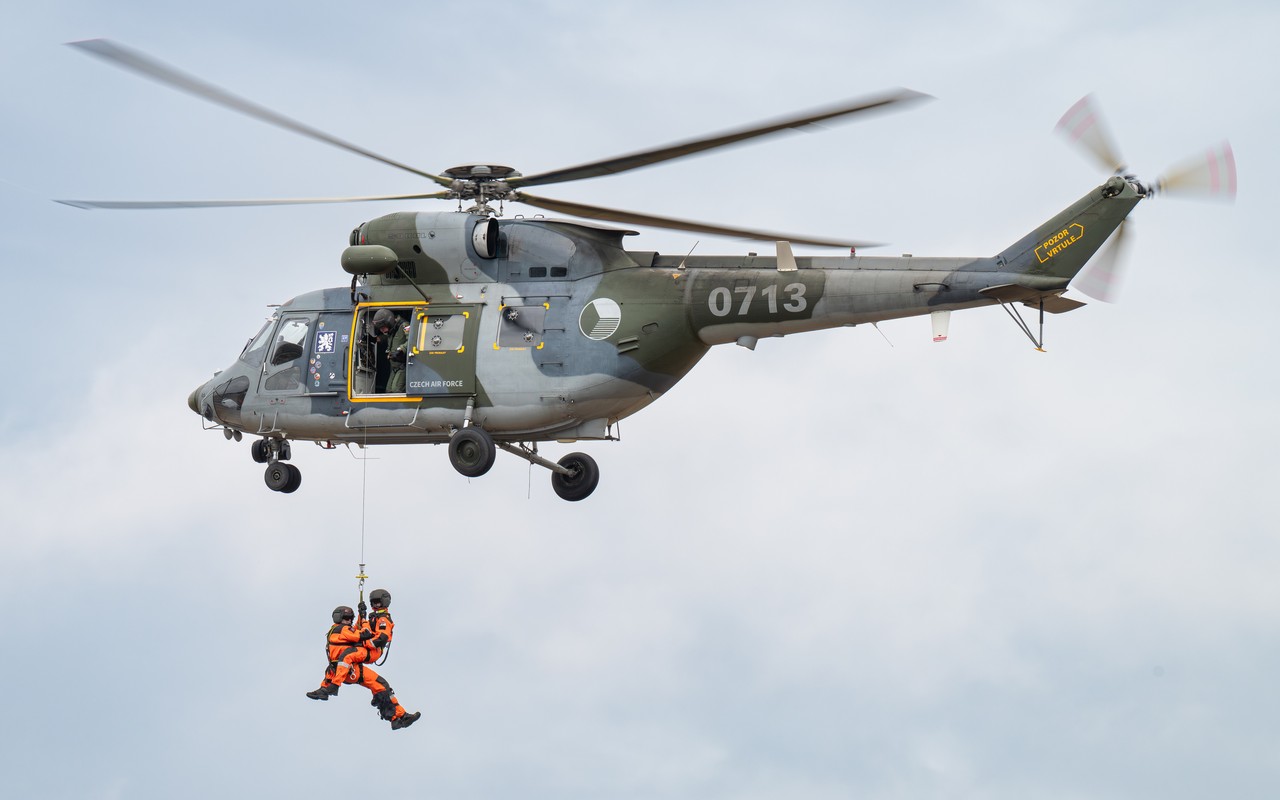
Other operators included the Czech Armed Forces and Ukraine Border Guard, which purchased three aircraft in early 2002. The diversity of operators demonstrated the W-3's adaptability to various operational environments and mission requirements.
Engine and Technical Innovation
The W-3 utilizes twin PZL-10W turboshaft engines manufactured by WSK "PZL-Kalisz" under license from Pratt & Whitney Canada's PT6T Twin Pac series. Each engine produces 870 kW (1,167 shaft horsepower), providing reliable power for the aircraft's multi-role capabilities. The powerplant selection proved particularly effective for high-altitude operations and adverse weather conditions.
The main rotor system features a diameter of 15.7 meters with NACA 23012M blade profiles, creating a total rotor disc area of 193.6 square meters. This configuration enables the helicopter to accommodate up to 12 passengers in commercial configuration or equivalent cargo loads in utility roles.
Military Variants and Capabilities
Beyond the Anakonda, PZL-Świdnik developed several military variants addressing specific operational requirements. The W-3U Salamandra prototype (serial number 360317) first flew on March 17, 1990, featuring proposed armament including Mars-2 and B8-10 rocket pods, ZR-8 rockets, 9M114 missiles, and a GSz-23L cannon system.
The W-3WA Huzar variant focused on combat search and rescue missions, with the prototype (serial number 360901) undergoing testing in 2009. Eight aircraft were planned for upgrade to this standard, though production records indicate limited implementation of this variant.
Manufacturing Legacy
PZL-Świdnik's ownership evolved significantly during the W-3's production run. The company signed cooperation agreements including one with Euromissile in September 1998 for armament integration and a Memorandum of Understanding with Daewoo (later Korea Aerospace Industries) on April 13, 1996, covering 35 aircraft with Asian marketing rights.
AgustaWestland acquired PZL-Świdnik, which now operates as PZL-Świdnik S.A., a Leonardo company. This acquisition ensured continued support for existing W-3 operators while integrating Polish helicopter expertise into the broader European aerospace industry.
Current Status and Remaining Aircraft
Production concluded after early 2001, with no new construction reported beyond 2003. However, numerous aircraft remain operational across various operators. The Polish Navy continues operating upgraded W-3WARM aircraft, while the Polish Army maintains W-3WA variants. Private operators also continue flying W-3A aircraft in commercial roles.
The W-3 Anakonda's significance extends beyond its production numbers, representing Poland's successful entry into indigenous helicopter design and manufacturing during a period of significant political and economic transition in Eastern Europe.