
Development and Design Innovation
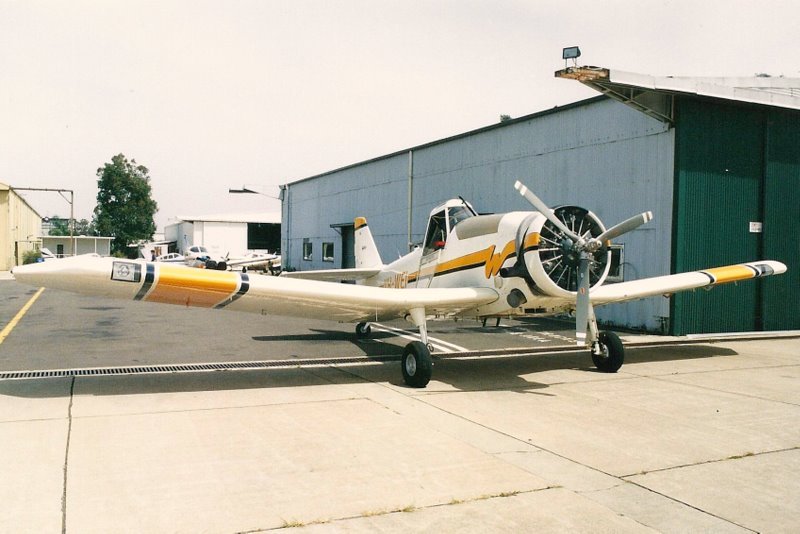
The Weatherly 620TP emerged from John C. Weatherly's systematic approach to agricultural aircraft design, building upon decades of experience that began with converting 19 Fairchild M-62 trainers in the early 1960s. By 1979, Weatherly had refined his design philosophy through the successful Weatherly 201 series, producing over 100 units by 1978. The 620 series represented a complete redesign focused on small-grain agricultural applications, with the turboprop-powered 620TP variant introduced in 1980 to offer operators enhanced performance and reliability.
The aircraft's design prioritized practical agricultural operations over raw capacity. Engineers enlarged the chemical hopper to 355 US gallons while maintaining optimal weight distribution, and extended the wingspan beyond the earlier 201 model to improve spray pattern coverage. Innovative wingtip vanes increased effective swath width while reducing chemical drift, with folding capability for hangar storage. The low-wing cantilever configuration provided structural strength for the demanding low-altitude agricultural environment.
Powerplant and Performance
The 620TP's defining characteristic was its Pratt & Whitney Canada PT6A-11AG turboprop engine, chosen specifically for agricultural applications. This powerplant offered significant advantages over the Pratt & Whitney R-985 radial engine used in piston variants, providing more consistent power delivery and reduced maintenance requirements. The PT6A's proven reliability in harsh operating conditions made it ideal for the demanding agricultural spraying environment, where aircraft often operate at extremely low altitudes in dusty, chemical-laden atmospheres.
The turboprop configuration allowed for more precise power management during critical spraying operations, while the three-bladed tractor propeller provided efficient thrust characteristics for the aircraft's operational profile. Fuel capacity ranged from 65 to 88 US gallons depending on specific configuration, balancing operational range with maximum chemical payload.
Manufacturing and Production
Weatherly Aviation Company initially manufactured the 620 series at their Hollister, California facility before relocating operations. In 1991, Hal Weatherly, nephew of founder John C. Weatherly, assumed control and moved production to Lincoln, California. This transition marked continued refinement of the design, leading to the 620B variant in 1992 with further improvements.
By 1999, manufacturers had completed 155 Weatherly 620s across all variants, with production continuing through at least 2003 when the 158th aircraft was registered. The entire 620 series ultimately exceeded 200 units, demonstrating sustained market demand for the specialized agricultural aircraft. Later corporate restructuring saw Weatherly Aircraft Nevada, Inc. become a subsidiary of MP2 Technologies, Inc. in 2009, with facilities relocated to a 50,000 square foot facility adjacent to Bogalusa, Louisiana airport.
Operational Service and Global Reach
The 620TP found operators across 13 countries, serving agricultural operations from the American Midwest to Argentina. Unlike large-capacity agricultural aircraft designed for extensive farming operations, the Weatherly 620TP excelled in small-grain applications where precision and maneuverability outweighed raw chemical capacity. Agricultural service providers like Benson Aviation, West River Aerial, and Bruton Aerial Spraying operated these aircraft for specialized crop protection missions.
The aircraft's single-seat configuration reflected its role as a specialized tool requiring skilled pilot operation. The ergonomic cockpit design prioritized pilot safety and operational efficiency during the repetitive, low-altitude flight patterns typical of agricultural spraying. Enhanced pilot protection features addressed the unique hazards of agricultural aviation, where chemical exposure and obstacle clearance present constant challenges.
Technical Legacy and Continuing Operations
The 620TP represented a successful adaptation of turboprop technology to agricultural aviation, proving that smaller, specialized aircraft could compete effectively with larger designs through superior efficiency and operational flexibility. The aircraft's ability to retrofit different engine types, including the later Honeywell TPE331 series, demonstrated forward-thinking design adaptability.
Production records indicate continued interest in the design, with plans for renewed manufacturing announced as late as 2019. The aircraft's longevity stems from its purpose-built agricultural focus rather than adaptation from other roles, resulting in optimized performance characteristics that remain relevant to modern agricultural operations. Many examples continue flying today, testament to both the robust design and ongoing demand for specialized agricultural aircraft in global farming operations.