
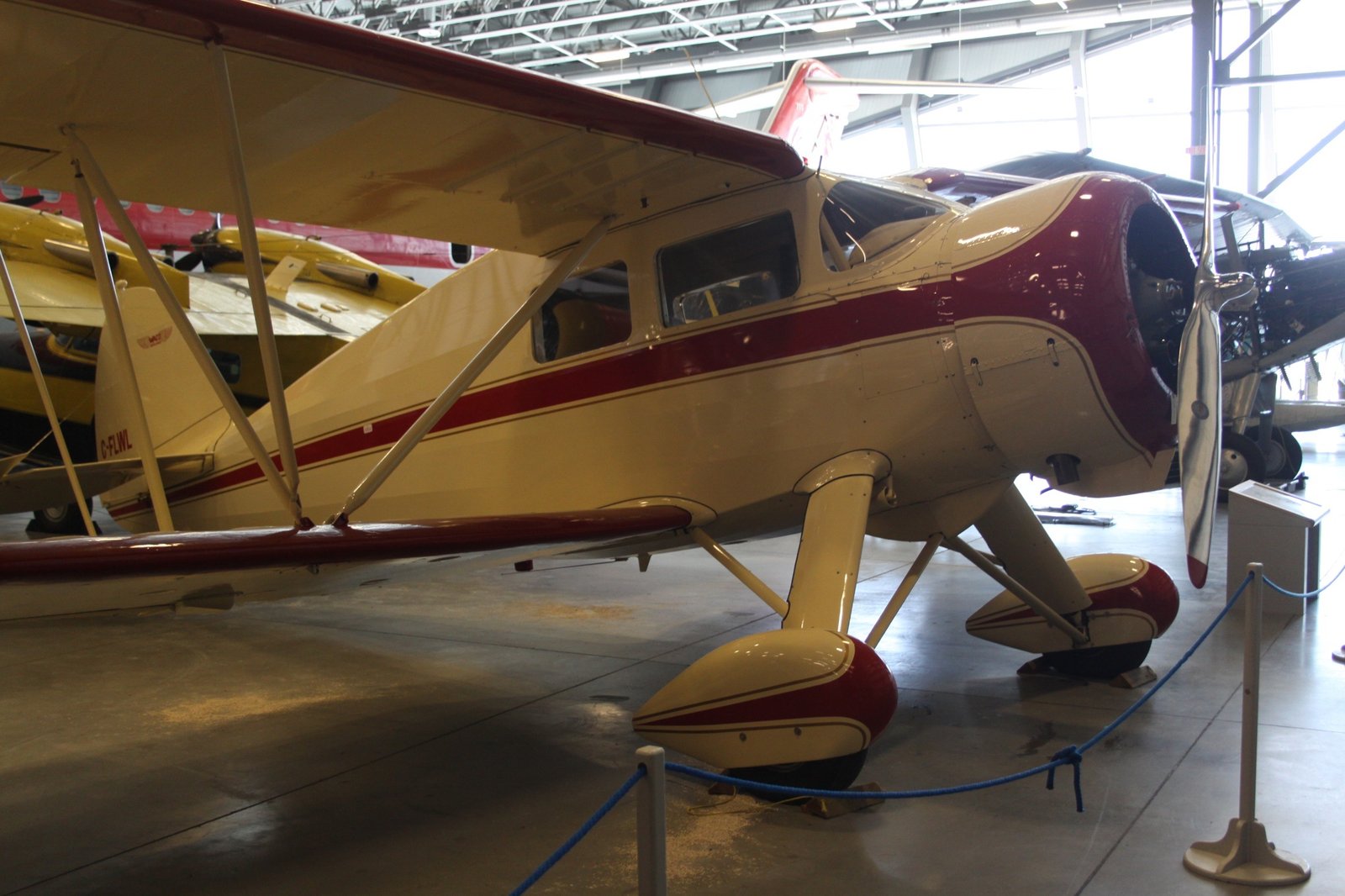
Market Dominance
During the late 1930s, WACO Custom Cabin aircraft commanded the American touring aircraft market with unprecedented success. The series proved so popular with commercial operators that small aviation firms across thirty-five countries operated WACO aircraft at the peak of their distribution. The 1936 QC Series alone accounted for 120 aircraft deliveries, making it the most successful variant in the Custom Cabin lineup. Commercial operators valued the aircraft's enclosed cabin design, which provided weather protection and passenger comfort previously unavailable in open-cockpit designs.
Wartime Service
When World War II erupted, the United States Army Air Forces impressed nine Custom Cabin aircraft into military service under the UC-72 designation. The variants included one YOC-1 as UC-72N, one CUC-1 as UC-72F, four EGC-8 aircraft as UC-72B, one ARE Aristocrat as UC-72A, and two HRE Aristocrats as UC-72C. In the Pacific theater, aircraft VH-UAX served with No. 3 Communications Flight in Australia from September 1942 until April 1944, when military authorities released it back to civilian operations. These military assignments demonstrated the aircraft's reliability and versatility beyond its original touring mission.
The Weaver Aircraft Company Legacy
The Weaver Aircraft Company, founded in 1920 by mechanics Clayton Brukner and Elwood Junkin alongside barnstorming pilots Buck Weaver and Charles Weaver, established its reputation through innovative design and consistent production quality. Operating from Troy, Ohio, the company produced approximately 4,150 airplanes across 62 different models between 1920 and 1946. During World War II, WACO devoted its entire manufacturing capacity to military glider production, suspending civilian aircraft development. The postwar aviation market collapse and high development costs for new designs forced the company to cease aircraft manufacturing in June 1947, ending 27 years of continuous production.
Engine Specifications and Performance
The Custom Cabin series showcased remarkable engine diversity, offering customers powerplant options tailored to specific mission requirements. The entry-level UOC variant utilized Continental R-670-A or R-670-B radial engines producing 210 to 225 horsepower, while the premium HRE Aristocrat featured a 300-horsepower Lycoming R-680-E3. Wright R-760 engines powered several variants, including the CUC-2 with 320 horsepower from its R-760-E2 powerplant. The most powerful configuration, the ARE Aristocrat, employed a 330-horsepower Jacobs L-6 radial engine, delivering exceptional performance for its era.
Design Innovation
The 1935 introduction of elliptical wings marked a significant advancement over WACO's previous constant-chord wing designs, improving both aerodynamic efficiency and aesthetic appeal. This design refinement contributed to enhanced performance characteristics that attracted commercial operators seeking competitive advantages in passenger comfort and operational economics. The enclosed cabin configuration represented a departure from traditional open-cockpit designs, positioning WACO aircraft as premium touring machines suitable for business and pleasure flying.
Production Timeline and Variants
WACO's systematic approach to variant development reflected careful market analysis and customer feedback. The 1935 production year included 54 OC Series and 30 UC Series aircraft, establishing the Custom Cabin foundation. The 1936 QC Series (C-6 designation) achieved peak production with 120 units delivered. The 1937-38 GC Series (C-7 and C-8 variants) contributed 96 aircraft, while the specialized 1938 AGC-8 variant reached 17 units. The final 1939 RE Series concluded Custom Cabin production with 30 aircraft, bringing the total to approximately 300 units across all variants.
Current Status and Preservation
Today, fewer than 300 WACO aircraft of all types remain airworthy from the original 756 still listed in Federal Aviation Administration registration certificates. At least one AGC-8 variant (construction number 5073) arrived in Melbourne, Australia, in late 2012 and continues participating in aviation events throughout Victoria. This survival rate reflects both the aircraft's robust construction and the dedication of vintage aircraft enthusiasts who maintain these Depression-era touring machines in flying condition.
The Custom Cabin series represented WACO's engineering maturity and market understanding during the company's most successful period. These aircraft bridged the gap between barnstorming-era open-cockpit designs and modern enclosed-cabin aircraft, establishing performance and comfort standards that influenced general aviation development for decades.