
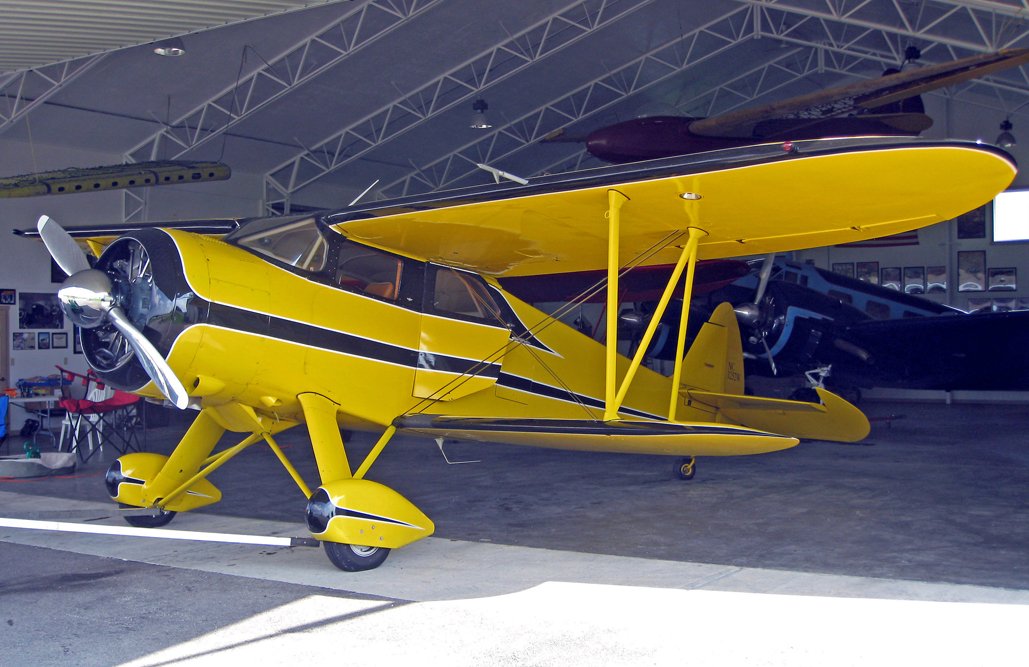
The Ultimate Prewar Biplane
The WACO E series emerged at a crucial moment in aviation history when monoplanes were rapidly displacing biplanes in both military and civilian roles. Despite this trend, Waco's engineers created what would become the fastest production biplane ever built, achieving performance that rivaled contemporary monoplanes while maintaining the structural advantages and aesthetic appeal that wealthy pilots still demanded from cabin biplanes.
Engineering Excellence
The E series represented a dramatic departure from earlier Waco designs. Engineers abandoned the solid interplane struts used on previous models in favor of wire cross-bracing between plywood-skinned wings of unequal span. This innovation, combined with a slimmer fuselage profile and rounded wingtips, reduced drag sufficiently to achieve the remarkable 195 mph cruise speed that made the SRE variant the fastest biplane of its era.
The heavily staggered wing configuration used parallel-chord geometry rather than the tapered wings becoming common on monoplanes. This design choice maintained the structural efficiency that allowed the aircraft to handle the stresses of high-speed flight while preserving the docile handling characteristics that made biplanes popular with private owners.
Three Variants for Different Missions
Waco offered the Aristocrat series with three different powerplants to match varying customer requirements and budgets. The ARE variant, powered by the 300-horsepower Jacobs L-6 radial engine, served as the entry-level model with four examples completed. The HRE stepped up to the 285-horsepower Lycoming R-680, achieving a 175 mph cruise speed and impressive 1,280-mile range that made it suitable for cross-country travel.
The flagship SRE variant mounted the 450-horsepower Pratt & Whitney R-985 Wasp Junior, the same reliable engine that powered numerous military trainers and light transports. With 21 examples built, the SRE became the most popular variant, offering the ultimate in biplane performance. Waco also proposed a WRE variant with the 420-horsepower Wright R-975, but no examples were constructed before production ceased.
Wartime Service and Military Utility
The outbreak of World War II dramatically altered the Aristocrat's destiny. In 1941, the United States Army Air Forces impressed 15 civilian examples into military service as utility transports. The military designated the impressed aircraft as UC-72 variants, with the single ARE becoming UC-72A, two HRE aircraft designated UC-72C, and twelve SRE examples serving as UC-72.
These impressed aircraft performed communications and light transport duties within the continental United States, roles that took advantage of their speed, range, and four-seat capacity. The military service validated the type's reliability and performance, though the small numbers meant the UC-72 variants never achieved the prominence of larger transport aircraft.
The Waco Aircraft Company Legacy
The Waco Aircraft Company had established itself as America's premier builder of cabin biplanes since beginning aircraft production in 1922. From their Troy, Ohio facility, Waco had mass-produced successful designs like the Waco 10, with 1,623 examples built between 1927 and 1933. The company pioneered steel-tube fuselage construction with the Waco 9 and consistently delivered aircraft that balanced performance with the comfort demanded by wealthy private owners.
The E series marked the company's final prewar design and represented 26 years of accumulated expertise in biplane construction. However, wartime priorities and the post-war shift to all-metal monoplanes left no market for luxury biplanes. Waco Aircraft Company struggled through the immediate postwar period, attempting to establish European aircraft reassembly operations in Syracuse, New York, but filed for bankruptcy in 1946. The company's final aircraft, the unrelated Aristo-Craft Model W, emerged in 1947 before Waco permanently ceased operations.
Performance and Pilot Experience
Pilots praised the Aristocrat series for combining exceptional performance with the forgiving handling characteristics inherent to well-designed biplanes. The type's 57 mph stall speed provided a comfortable safety margin during approach and landing, while the high cruise speeds allowed efficient cross-country travel that competed favorably with contemporary monoplanes.
The enclosed cabin provided weather protection and noise reduction that made long flights comfortable for all four occupants. This combination of speed, comfort, and capacity attracted customers willing to pay premium prices for what represented the ultimate expression of 1930s biplane technology.
Survival and Museum Preservation
By 2001, at least five Aristocrat examples remained airworthy, a remarkable survival rate for an aircraft with only 30 examples produced. The type's robust construction and quality materials contributed to long-term durability that allowed properly maintained examples to continue flying decades after production ended.
The EAA Museum preserves 1939 ARE Aristocrat NC20953, originally delivered to the Daily News on December 16, 1939. This aircraft represents not only the technical achievement of the E series but also the era when wealthy individuals and corporations commonly owned sophisticated aircraft for business and personal travel.
One SRE variant, N1252W, remained active at Prescott Municipal Airport in Arizona until crashing on January 10, 2003, marking the loss of one of the type's final flying examples. These surviving aircraft serve as tangible reminders of an era when biplane technology reached its absolute zenith before yielding to the inevitable progress of aviation technology.