
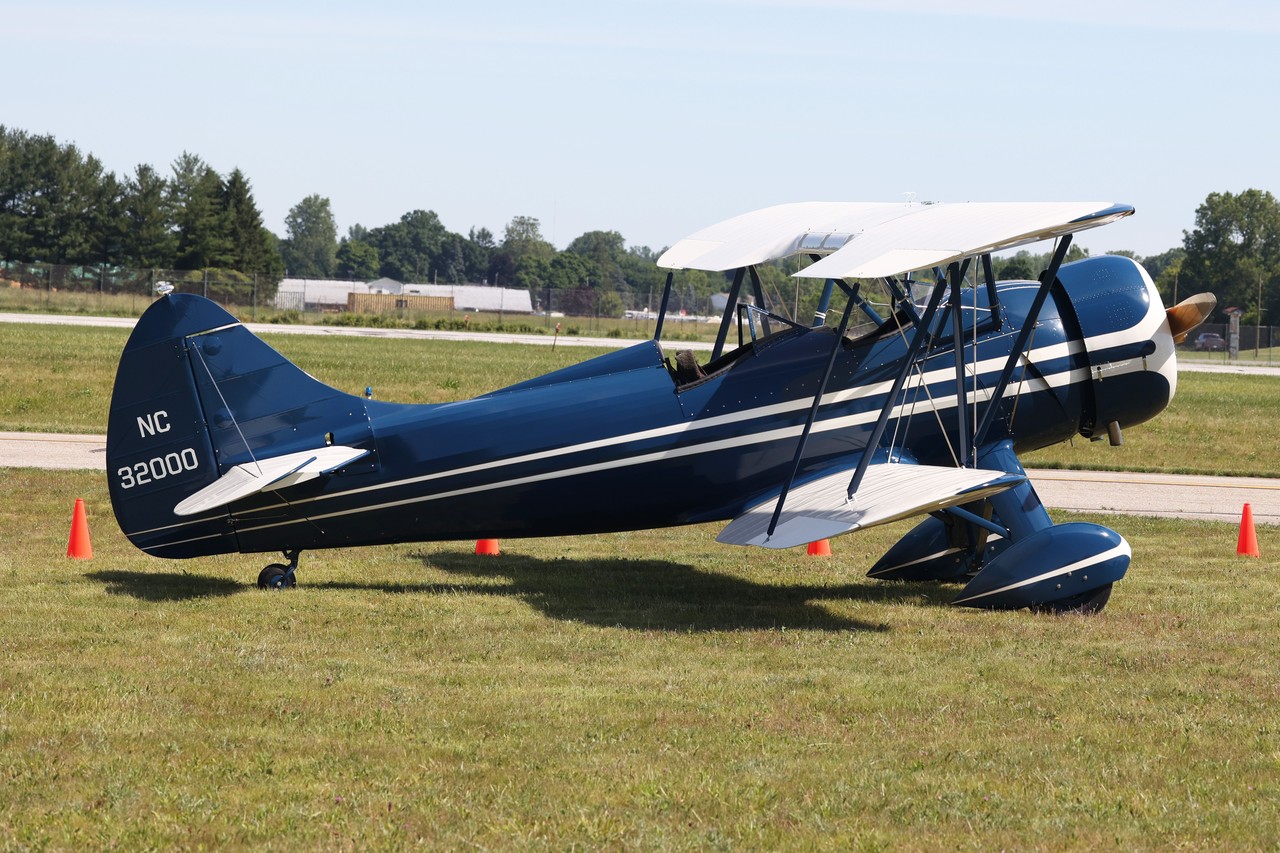
Revolutionary Depression-Era Design
The F series emerged as Waco's answer to the economic devastation of the Great Depression, when aviation manufacturers desperately needed aircraft that delivered maximum performance at minimum cost. Where other manufacturers struggled or failed entirely after the 1929 stock market crash, Waco's engineering team created a masterpiece of efficiency that was 450 pounds lighter than the previous O series while delivering comparable performance on smaller, less expensive engines. This breakthrough enabled the company to offer high-performance biplanes at half the price and operating cost of 1920s designs.
Dominating the Training Market
The F series became the backbone of American pilot training during the late 1930s and early 1940s. More than 600 UPF-7 variants alone were built, making it the second-most produced variant in Waco's history. The type proved invaluable to the Civilian Pilot Training Program (CPTP) from 1939 to 1944, with over 600 UPF-7s and 21 VKS-7F aircraft serving to prepare pilots for World War II. The aircraft's popularity extended internationally, with F series aircraft operating in 35 countries worldwide.
Limited Military Service
While primarily a civilian aircraft, the F series saw modest military use during World War II. The U.S. Army Air Forces impressed 42 privately-owned F series aircraft of 16 different variants into service as C-72 and UC-72 light transports and utility aircraft. Fourteen UPF-7s were evaluated as YPT-14 trainers, though the military ultimately chose not to adopt the type for widespread service. The U.S. Coast Guard operated three EQC-6 variants designated J2W-1, representing the extent of the type's military career.
The Waco Aircraft Company Legacy
Founded in 1920 by George "Buck" Weaver and Elwood "Sam" Junkin in Lorain, Ohio, the Waco Aircraft Company relocated to Troy, Ohio, where it would produce 62 different aircraft models over 27 years. The F series proved crucial to the company's survival, enabling Waco to weather the Great Depression when many competitors failed. During World War II, the company shifted focus to producing CG-4A gliders before ceasing aircraft production in June 1947.
Engine Versatility and Variants
The F series utilized Waco's innovative designation system where the first letter indicated the engine manufacturer: R for Warner, I for Kinner, M for Menasco, U for Continental R-670, and Y for Jacobs. The most successful variant, the UPF-7, was powered by the Continental W-670 radial engine producing 220 horsepower. Other notable configurations included the YMF-3 with its 225-horsepower Jacobs L-4 engine (18 built), the QCF with a 165-horsepower Continental A-70 (31 built), and the UMF-3/UMF-5 variants featuring 210-horsepower Continental R-670 engines (18 built).
Performance and Handling
Pilots praised the F series for its responsive handling and economical operation. The tandem open-cockpit configuration provided excellent visibility and communication between instructor and student, making it ideal for training purposes. The aircraft's smaller airframe and efficient radial engines delivered performance matching much larger biplanes while consuming significantly less fuel and requiring lower maintenance costs.
Modern Revival and Preservation
The F series legacy continues through WACO Classic Aircraft (founded as Classic Aircraft Corporation in Lansing, Michigan, in 1983), which produces modern interpretations of classic Waco designs. The company has built over 150 YMF-5 aircraft since certification in 1986, incorporating more than 300 improvements while maintaining the vintage appeal. Three MF replicas were completed by 2011, demonstrating continued demand for the classic Waco experience.
Museum Examples and Cultural Impact
Original F series aircraft remain preserved in prominent aviation museums, including a 1930 Waco RNF at the Kelch Aviation Museum and a Waco INF at the Canadian Museum of Flight. These examples represent the type's significance as an iconic 1930s biplane that enabled mass pilot training and helped establish general aviation as a viable industry. The F series proved that efficient design could overcome economic adversity, establishing principles that would influence light aircraft development for decades to come.