
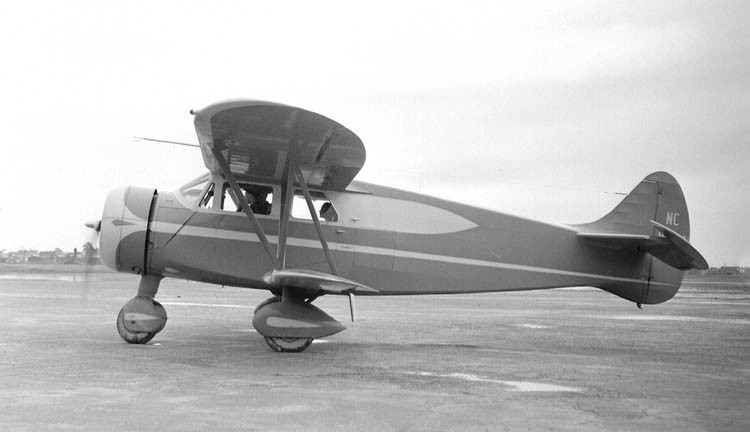
Revolutionary Landing Gear Design
The WACO AVN shocked the aviation community when it appeared in 1937 with its revolutionary tricycle landing gear configuration. At a time when conventional taildragger aircraft dominated both military and civilian aviation, WACO engineers boldly implemented a nosewheel system that dramatically improved ground handling characteristics. The tricycle gear made crosswind landings significantly easier and virtually eliminated the ground loops that plagued tailwheel aircraft, giving pilots unprecedented confidence during taxi, takeoff, and landing operations.
Development and Variants
The N series began development in 1937 as an evolution of WACO's successful Custom Cabin line, which had already produced approximately 300 aircraft between 1935 and 1939. The prototype ZVN-7, powered by a 285-horsepower Jacobs L-5 radial engine, conducted its maiden flight in 1937 and proved the viability of the tricycle gear concept. This led to production variants including the AVN-8 with the more powerful 300-horsepower Jacobs L-6 engine, and the ZVN-8 which retained the L-5 powerplant.
Production remained limited, with only 15 AVN-8 aircraft and 6 ZVN-7/ZVN-8 variants completed before the series ended in 1938. The sesquiplane configuration, featuring lower wings with half the area of the upper wings, provided improved aerodynamic efficiency while maintaining the structural benefits of the biplane design.
The WACO Aircraft Company Legacy
The WACO Aircraft Company, originally founded as the Weaver Aircraft Company in 1919, had established itself as America's premier builder of civilian biplanes by the time the AVN entered production. Operating from their Troy, Ohio facility, WACO had achieved remarkable success in the general aviation market, at one point producing 400 aircraft annually compared to Boeing's 25 aircraft per year during the same period.
Over its 28-year operational life from 1919 to 1947, the original company produced 62 different models, with the WACO 10 becoming their most successful design with 1,623 examples built between 1927 and 1933. The company's innovative approach to aircraft design made them a leader in registered aircraft numbers during the golden age of aviation.
Engine and Performance
The Jacobs radial engines that powered the AVN series represented reliable, high-performance powerplants manufactured by the Jacobs Aircraft Engine Company from the 1920s through the 1950s. The L-5 and L-6 engines provided the AVN with superior speed and load capacity compared to earlier WACO cabin models. The sesquiplane design, combined with improved streamlining and the longer, wider fuselage, delivered enhanced performance that appealed to private owners and small commercial operators seeking modern cabin aircraft.
The tricycle landing gear system not only improved ground handling but also allowed for better aerodynamic cleanup, as the gear could be designed with reduced drag compared to the fixed tailwheel configurations common to the era.
Civil Operations and Market
The AVN found its primary market among private owners, small commercial firms, and non-aviation businesses requiring reliable 4-6 place transportation. The aircraft served executive transport roles, barnstorming operations, and light commercial duties where its advanced landing gear system provided operational advantages over conventional tailwheel competitors.
During this period, WACO's Custom Cabin series had established a strong reputation in the civilian market, and the AVN represented the company's push toward more advanced configurations. However, the limited production run of approximately 21 aircraft suggests that the tricycle gear innovation, while technically successful, may have been ahead of its market acceptance.
Wartime Transition
While the AVN itself saw no military service, WACO redirected its engineering expertise toward wartime production following America's entry into World War II. The company became a major manufacturer of CG-4A Hadrian gliders, producing thousands of these critical aircraft for airborne operations including D-Day and Operation Market Garden. WACO also delivered more than 600 UPF-7 trainers and 42 impressed C-72/UC-72 utility aircraft for military service.
Legacy and Modern WACO
No airworthy examples of the AVN are known to exist today, reflecting the limited production and the passage of more than eight decades since manufacture. The original WACO Aircraft Company ceased operations in 1947, unable to compete in the post-war aviation market despite their innovative designs and manufacturing expertise.
The WACO name returned to aviation in 1983 when Classic Aircraft Corporation began producing the YMF-5 biplane series. Operating as WACO Aircraft Corporation, this modern company delivered over 100 YMF-5C aircraft by 2007 and continues production of YMF-5D and Great Lakes biplanes, maintaining the WACO tradition of high-quality biplane construction.
The AVN's primary historical significance lies in its pioneering implementation of tricycle landing gear on biplane aircraft, demonstrating advanced engineering concepts that would become standard in post-war aviation design.