
Service History
The WACO Model O entered service during the golden age of civilian aviation when WACO Aircraft Company held over 40 percent of United States small aircraft sales by 1927. As part of WACO's systematic approach to aircraft development, the Model O served the growing market of private pilots, flight schools, and commercial operators engaged in barnstorming, crop dusting, and passenger carrying services. The aircraft contributed to WACO's dominance in registered aircraft numbers, where the company consistently led competitors throughout the late 1920s and early 1930s.
During the Great Depression, WACO's efficient designs like those in the 'F' series, which included variants related to the Model O lineage, sustained the company when other manufacturers failed. These aircraft sold at roughly half the cost and weight of earlier 1920s biplanes while maintaining superior performance characteristics.
The Manufacturer
The WACO Aircraft Company originated as the Weaver Aircraft Company in November 1919, founded by George "Buck" Weaver, Elwood "Sam" Junkin, Clayton "Clayt" Bruckner, and Charles "Charlie" William Meyers in Lorain, Ohio. Initially operating as the Advance Aircraft Company, the organization relocated to Troy, Ohio in 1923 and officially adopted the WACO Aircraft Company name in 1929.
Under Junkin's design leadership, WACO produced 62 different aircraft models between 1919 and 1947, establishing itself as the premier civilian aircraft manufacturer. The company's success stemmed from its focus on practical, reliable designs that met the specific needs of civilian operators. WACO survived the 1929 stock market crash through innovative engineering and cost-effective production methods, while many competitors disappeared from the market.
During World War II, WACO shifted production to military contracts, manufacturing UPF-7 trainers and CG-4A assault gliders. The company demonstrated remarkable production capability by building 100 UPF-7 aircraft in just 99 days at their Troy facility. However, post-war civilian aircraft demand collapsed, and WACO ceased aircraft production in June 1947 due to market conditions and high manufacturing costs.
Engine & Technical Details
The WACO Model O utilized various powerplants depending on specific variant and customer requirements, reflecting WACO's practice of offering multiple engine options across their product line. Common installations included Wright Aeronautical radial engines, particularly variants of the reliable J-6 series that produced 225 horsepower, and various inline engines including the popular OX-5 that powered many 1920s aircraft.
Junkin's design philosophy emphasized practical flying characteristics over pure performance, incorporating innovations such as larger wing surfaces for improved handling, shock-absorbing landing gear systems first introduced on the Model 10 in 1927, and efficient structural arrangements that reduced manufacturing costs while maintaining durability.
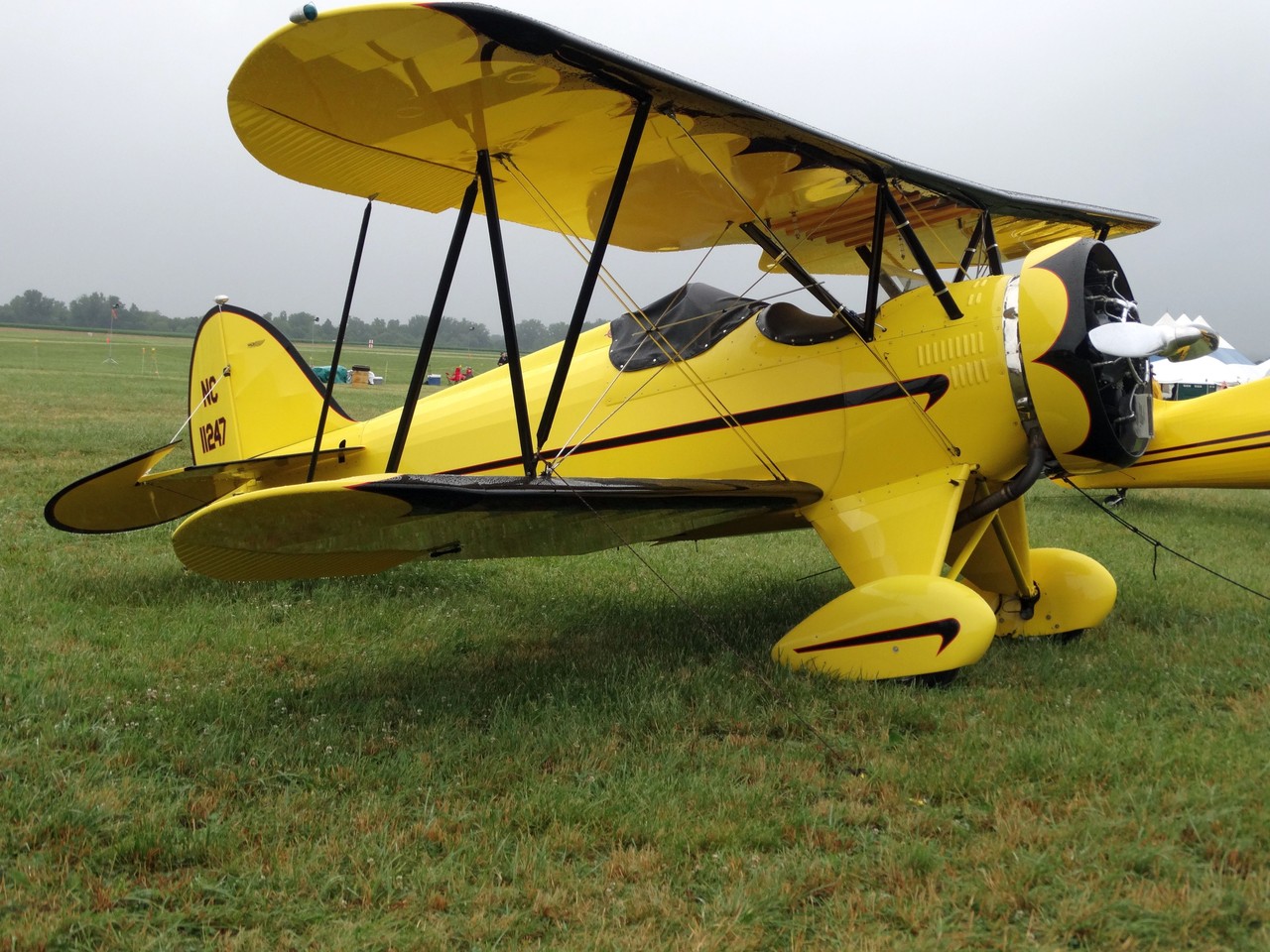
The aircraft featured conventional biplane configuration with fabric-covered wooden framework, providing the rugged construction necessary for the demanding civilian market. Open cockpits accommodated one or two occupants depending on variant, with dual controls available for training applications.
Pilot Perspective
WACO aircraft earned reputations for reliable handling characteristics and forgiving flight behavior that made them popular with both experienced pilots and students. The Model O shared the design philosophy that made WACO's larger production models successful - predictable stall characteristics, stable cruising flight, and responsive controls that built pilot confidence.
The aircraft's performance capabilities suited the diverse civilian market, offering sufficient speed and range for cross-country touring while maintaining the low-speed handling necessary for training operations and short-field capabilities required by barnstormers and agricultural operators.
Production & Legacy
While specific production numbers for the Model O variant remain unclear in available records, the aircraft contributed to WACO's overall success that saw models like the Waco 10 achieve sales exceeding 1,200 units and the 'F' series reach over 600 aircraft during the Depression era.
WACO's success fundamentally changed American aviation by proving civilian aircraft could achieve commercial viability and creating the foundation for general aviation as a distinct market segment. The company's systematic approach to variant development and customer-focused engineering established patterns that influenced aircraft manufacturing for decades.
Today, surviving WACO aircraft remain highly prized by vintage aviation enthusiasts, with examples displayed at institutions including the WACO Air Museum in Troy, Ohio, which preserves company records and representative aircraft. The Kelch Aviation Museum houses a restored 1930 WACO RNF, while the Canadian Museum of Flight displays a WACO INF, demonstrating the enduring appeal of these classic designs.
The original company's legacy continues through the modern WACO Aircraft Company, established in 1983 and currently operating from Battle Creek, Michigan. This organization maintains the WACO tradition by producing updated versions of classic biplane designs, ensuring that the engineering principles and flying characteristics that made the original Model O and its contemporaries successful remain available to new generations of pilots.