
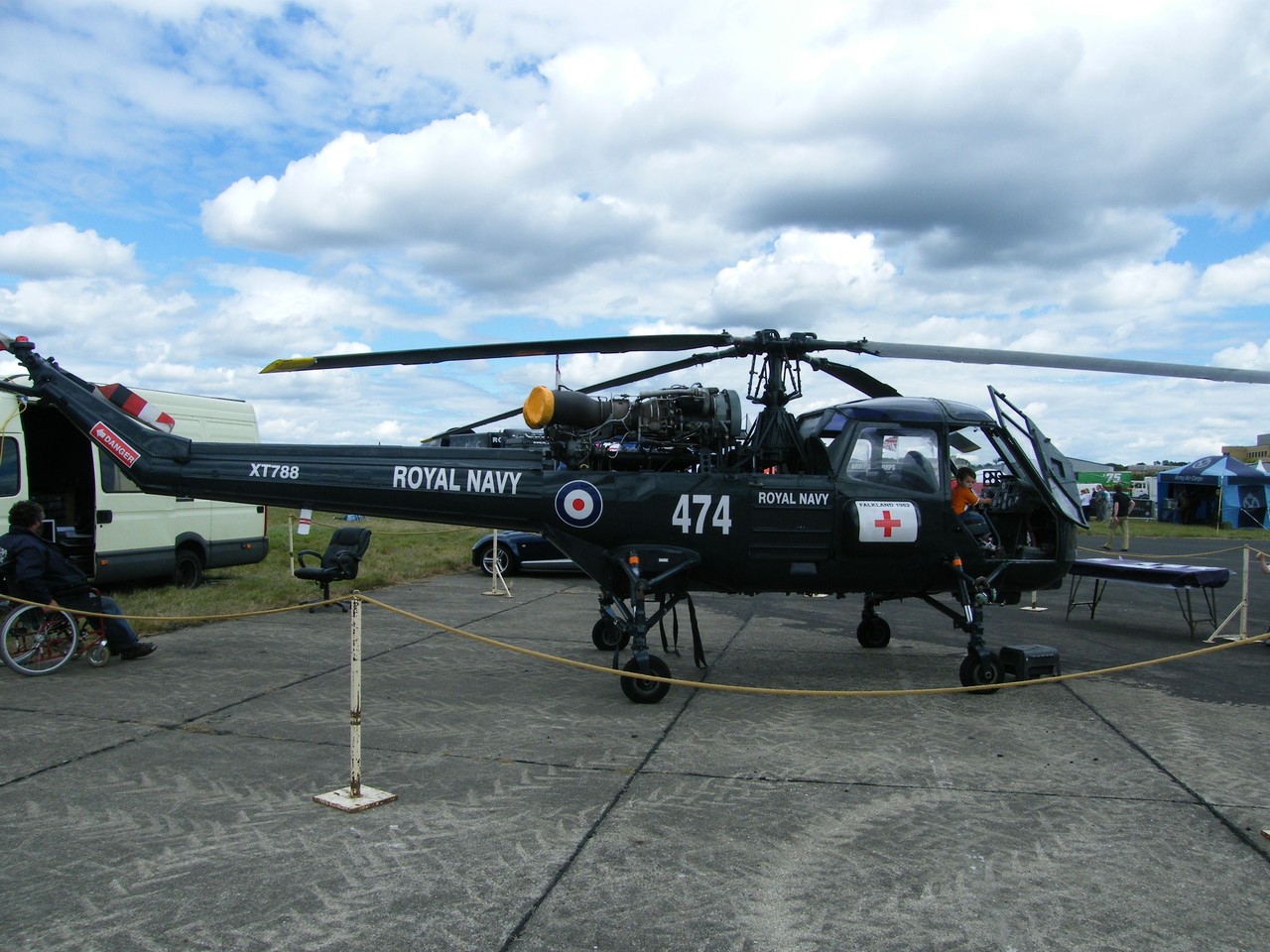
Naval Innovation
The Wasp emerged from Westland's acquisition of Fairey Aviation in 1960, adapting the land-based Scout airframe for maritime operations. Design teams focused on creating a helicopter compact enough for the landing decks of Leander, Tribal, and Rothesay-class frigates while maintaining full anti-submarine warfare capability. The folding rotor system proved crucial, allowing storage in the confined spaces aboard escort vessels that previously relied solely on sonar and shipboard weapons for submarine detection.
Royal Navy Service
No. 829 Naval Air Squadron became the primary operator when the Wasp entered Royal Navy service in 1963, with 98 aircraft delivered for fleet operations. The helicopter equipped frigates with extended ASW reach, carrying Mk.44 and Mk.46 torpedoes or Mk.11 depth charges to prosecute submarine contacts beyond the ship's immediate vicinity. Training squadrons 706 NAS (1965-1967) and 703 NAS (1972-1981) prepared aircrew for the demanding combination of helicopter flying and frigate deck operations in challenging sea conditions.
The versatile platform also carried Nord AS.12 wire-guided missiles for anti-surface warfare, with the aircrewman using joystick controls and stabilized optical sights to guide weapons against enemy vessels. This dual capability made the Wasp valuable beyond pure ASW missions, providing frigates with both offensive and reconnaissance capabilities.
Combat Proven
During the 1982 Falklands War, Wasps from eight Royal Navy ships demonstrated their operational value under combat conditions. The helicopters flew 712 combat sorties throughout the conflict, performing anti-submarine patrols, surface attacks, search and rescue missions, and logistics support including mail delivery between ships. This intensive combat usage validated the original design concept of extending frigate capabilities through embarked helicopter operations.
Westland Heritage
Westland Aircraft's roots traced to 1915, with the company becoming a helicopter specialist after World War II through production of the Dragonfly, Whirlwind, and Wessex. The 1960 acquisition of Fairey Aviation brought naval helicopter expertise that proved essential for the Wasp program. Manufacturing occurred primarily at the former Fairey Division factory in Hayes, Middlesex, with some assembly work at Yeovilton. The company became Westland Helicopters in 1971, underwent nationalization in 1976, privatization in 1985, and eventual acquisition by GKN in 1994 before becoming part of what is now Leonardo Helicopters.
Power and Performance
The Bristol Siddeley Nimbus 103/104 turboshaft engine provided 710 shaft horsepower, derived from the French Turbomeca Turmo design but manufactured under license by Blackburn Aircraft. This powerplant proved reliable for shipboard operations, delivering sufficient performance for weapon delivery missions while maintaining the compact dimensions essential for frigate operations. The Wasp achieved a service ceiling of 12,200 feet with a maximum range of 303 miles, adequate for extended patrols around the mother ship.
Two-person crews consisted of a pilot and aircrewman, with the latter serving as weapons operator for AS.12 missile guidance or observer for ASW and reconnaissance missions. The cramped cockpit demanded precise coordination between crew members, particularly during weapons delivery or deck landing approaches in rough seas.
International Success
Beyond the 98 Royal Navy aircraft, Westland exported 35 Wasps to six nations including Indonesia, Brazil, the Netherlands, South Africa, New Zealand, and Malaysia. The Royal New Zealand Navy operated aircraft like XT435 aboard frigates including HMS Achilles, while Malaysia continued Wasp operations until 2002, making it among the final operators of the type.
Replacement and Legacy
The larger and more capable Westland Lynx gradually replaced Wasps in Royal Navy service during the late 1980s, offering greater payload, range, and advanced sensors. However, the Wasp established the template for frigate-based helicopter operations that continues today aboard modern naval vessels worldwide.
Several examples remain preserved in British museums, including XT443 at The Helicopter Museum after serving with 829 NAS and surviving a crash-landing at Portchester in March 1971 during test flights. XT435 flies with Navy Wings as a privately-maintained example of the type that pioneered small-ship helicopter operations during the Cold War era. The Wasp's legacy extends beyond its own service record to prove that even small escort vessels could project ASW capability far beyond the range of shipboard sensors and weapons.