
Service History
The WB-57 emerged from the United States Air Force's urgent need for a high-speed tactical bomber during the Korean War era. When the conflict began in 1950, the USAF lacked a jet-powered bomber capable of combining fighter agility with effective bomb delivery. Rather than develop an entirely new aircraft, the Air Force chose to license-build the proven British English Electric Canberra, marking the first major foreign aircraft design adopted by the U.S. military since World War I.
While the B-57 series arrived too late for Korean War combat operations, entering service after the 1953 armistice, it proved invaluable during Vietnam War operations in the 1960s. The weather reconnaissance variants, designated WB-57, served specialized roles in atmospheric research and meteorological reconnaissance missions. Two aircraft were converted to WB-57E configuration in 1971-1972, including serial numbers 55-4237 and 55-4249, demonstrating the type's adaptability for scientific missions.
The Manufacturer
The Glenn L. Martin Company, founded in 1917 by aviation pioneer Glenn L. Martin, built all 403 B-57 variants at its Baltimore, Maryland facilities between 1953 and 1957. The B-57 represented Martin's final bomber program before the company shifted focus from aircraft manufacturing to missiles and space systems. Martin had previously produced notable World War II aircraft including the B-26 Marauder medium bomber, establishing the company's reputation for robust military aircraft.
Following the B-57 program's completion, Martin ceased aircraft production and merged with American-Marietta Corporation in 1961 to form Martin Marietta. This aerospace giant later merged with Lockheed in 1995, creating today's Lockheed Martin Corporation, which continues as a major defense contractor while maintaining the historical legacy of the original Martin company.
Engine & Technical Details
Early WB-57 variants utilized Wright J65 turbojet engines, which were license-built versions of the British Armstrong Siddeley Sapphire. Wright Aeronautical initially subcontracted J65 production to Buick, but this arrangement caused significant problems including oil contamination in the bleed air system and cockpit smoke issues that plagued early operations. Wright assumed direct control of J65 manufacturing in 1954, resolving most reliability concerns.
The aircraft featured a two-person crew consisting of a pilot and navigator-bombardier, housed in a redesigned cockpit optimized for American instrumentation and operational requirements. Martin engineers incorporated numerous modifications to adapt the British design for U.S. manufacturing standards, including different thread specifications and compatibility with American ordnance systems. The revolutionary rotary bomb rack system allowed rapid reloading and weapon changes, significantly improving operational flexibility.
Operational Challenges and Improvements
Early B-57 operations encountered serious technical difficulties that resulted in aircraft losses and operational limitations. Engine malfunctions caused by the problematic Buick-built J65 engines led to emergency situations, while faulty tailplane actuators in B-57B variants contributed to additional losses. These issues were largely resolved after Wright took direct control of engine production in 1954, dramatically improving the aircraft's reliability for high-speed, low-level operations.
The improved variants, particularly the B-57B which became the most numerous production model with enhanced systems and refined engine installations, proved highly effective in Vietnam combat operations. The aircraft's ability to operate at medium altitudes while maintaining high speed made it valuable for both tactical bombing and reconnaissance missions in contested airspace.
Legacy and Current Operations
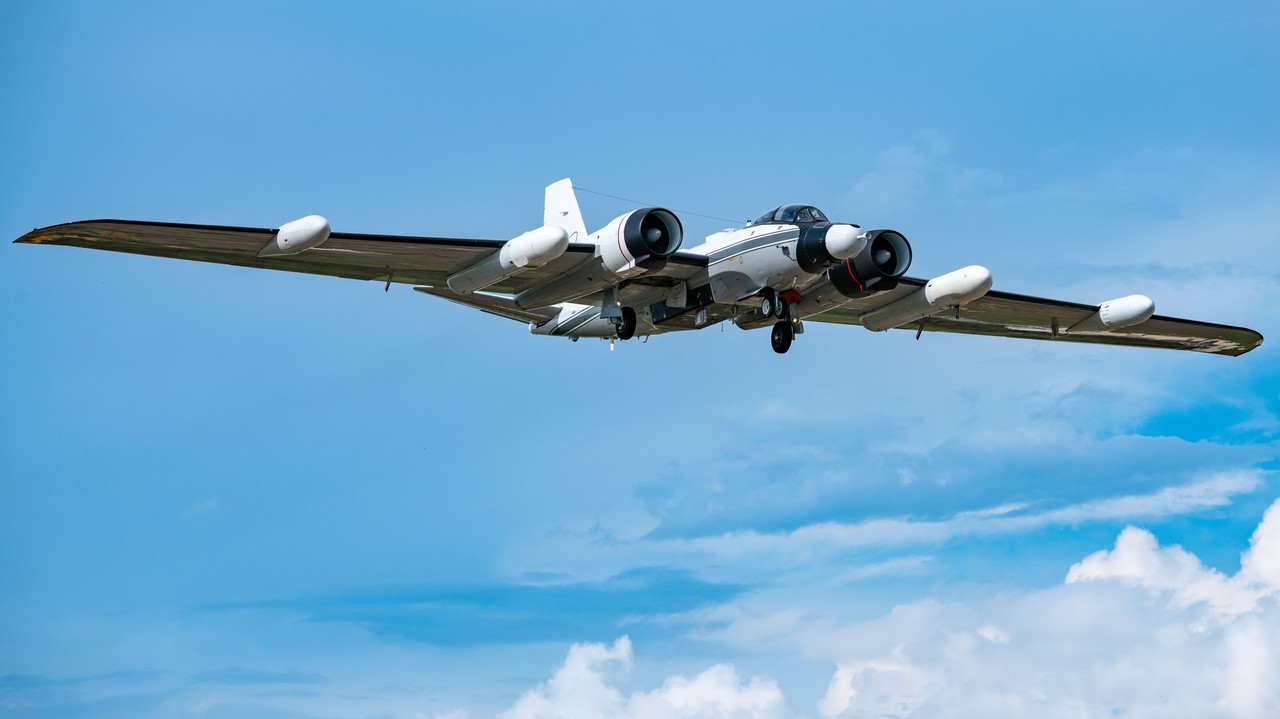
Today, only two WB-57F aircraft remain operational, both serving with NASA for high-altitude atmospheric research missions. One notable example, NASA 927 (originally military serial 63-13295), returned to flight status in 2013 after spending over 41 years in storage at Davis-Monthan Air Force Base. These surviving aircraft represent the culmination of WB-57 development, featuring extended wings and enhanced high-altitude performance capabilities.
The B-57 series, including the specialized WB-57 weather variants, holds historical significance as the last bomber produced by the Martin Company and the first successful American adoption of a foreign jet bomber design. The program's 403 total aircraft production run helped establish the twin-jet tactical bomber concept that influenced Cold War airpower doctrine. The type's transformation from tactical bomber to scientific research platform demonstrates the adaptability that has allowed these remarkable aircraft to remain useful more than seven decades after the original Canberra's first flight.