
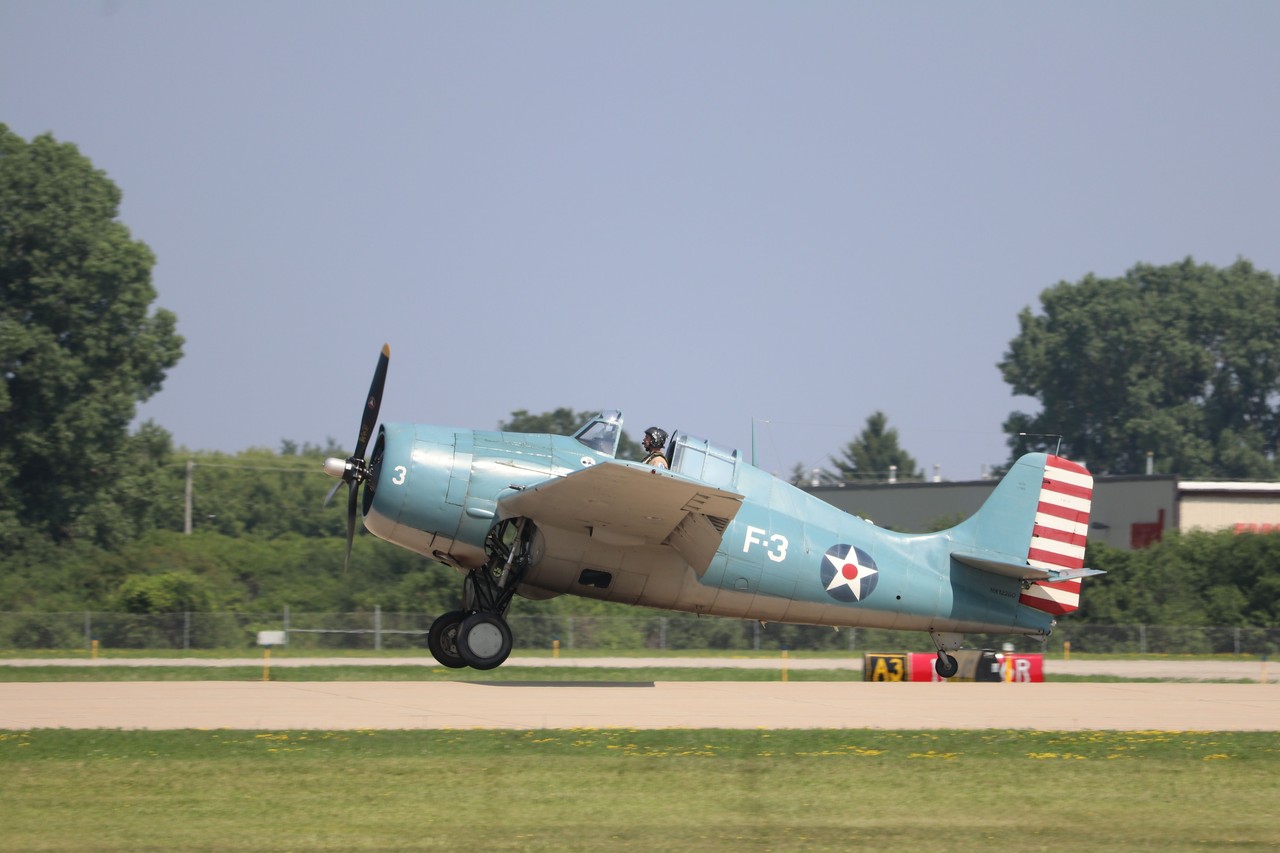
Combat Dominance and Service History
The Wildcat emerged from near-rejection to become the backbone of U.S. naval aviation during 1941-1943. When the Navy initially selected the competing Brewster F2A Buffalo in June 1938, Grumman received a consolation contract in October 1938 to rebuild their prototype into the improved XF4F-3 configuration. This persistence paid dividends when the Wildcat entered service in December 1940 and quickly proved superior to the Buffalo in combat conditions.
By 1942, Wildcats equipped every U.S. Navy carrier fighter squadron, serving as the sole American carrier fighter in Pacific operations until the F6F Hellcat's introduction in mid-1943. The aircraft demonstrated its combat effectiveness immediately at the Battle of Wake Island in December 1941, where it proved capable of engaging the vaunted Mitsubishi A6M Zero on nearly equal terms. Through battles including the Coral Sea and Midway, Wildcats bore the brunt of carrier-based fighter operations during America's most desperate phase of the Pacific War.
International Service and Royal Navy Operations
Over 1,100 Wildcats served with the Royal Navy Fleet Air Arm, initially designated "Martlet" until January 1944 when the British adopted the American "Wildcat" name. The type achieved a historic first on December 25, 1940, when two Martlet Is of No. 804 Squadron became the first U.S.-built aircraft in British service to destroy a German aircraft, shooting down a Junkers Ju-88 over Scapa Flow. Fleet Air Arm Wildcats continued scoring victories through March 1945, when they downed four Messerschmitt Bf 109s in their final air-to-air engagements.
Manufacturing Revolution and Variants
Production began with Grumman building 183 F4F-3s powered by 1,200-horsepower R-1830-76 engines, achieving 328 mph and a service ceiling of 37,500 feet. The improved F4F-4 introduced manually-folding wings in 1941, allowing twice as many aircraft to fit on carrier decks despite a slight performance penalty. Grumman produced 1,169 F4F-4s before General Motors assumed production responsibilities in 1943.
General Motors revolutionized Wildcat production, building over 60% of all variants as FM-1 and FM-2 models. The company produced 839 FM-1s with R-1820 engines before introducing the definitive FM-2 variant. With 4,437 examples built, the FM-2 represented the most numerous Wildcat version, featuring a 1,200-horsepower R-1820-56W engine with water-methanol injection that boosted top speed to 330 mph while reducing weight to 7,950 pounds gross.
Design Innovation and Engineering
Robert L. Hall, famous for designing the Gee Bee racers, created the Wildcat's fundamental design. His monoplane configuration represented a dramatic advancement over the Navy's previous biplane fighters, while the hydraulic landing gear and later manual wing-folding mechanism solved critical carrier storage limitations. The F4F-4's folding wings became standard on subsequent carrier aircraft, establishing a configuration template used throughout the jet age.
The Wildcat's rugged construction and self-sealing fuel tanks provided crucial survivability advantages in combat. Armed with four .50-caliber machine guns and capable of carrying 200 pounds of bombs, the aircraft balanced firepower with the structural strength necessary for carrier operations. Its wide-track landing gear and docile handling characteristics made it particularly suitable for shipboard operations by relatively inexperienced wartime pilots.
Grumman Aircraft Engineering Corporation
Founded in 1930, Grumman Aircraft Engineering Corporation established itself as the Navy's premier carrier aircraft supplier through designs like the Wildcat. The company continued this specialization throughout World War II with the F6F Hellcat and F7F Tigercat, then transitioned to jets with the F9F Panther and F-14 Tomcat. Following mergers and acquisitions, Grumman became part of Northrop Grumman Corporation in 1994, continuing as one of America's largest defense contractors.
Legacy and Preservation
Production ended in August 1945 after delivering between 7,885 and 7,898 aircraft across all variants. The Wildcat's service bridged the gap between prewar biplane fighters and advanced designs like the Hellcat, proving that well-executed conventional engineering could compete effectively against more advanced opponents. The Smithsonian Institution's National Air and Space Museum preserves an FM-1 variant, representing this crucial period in naval aviation development when American carrier aviation evolved from a experimental concept into the Pacific War's decisive weapon system.