
Service Dominance
The Wessex transformed British helicopter operations across multiple military branches, becoming the backbone of Royal Navy anti-submarine warfare and Royal Air Force transport missions for over four decades. When the first production Wessex HAS.1 aircraft were delivered to the Royal Navy's Fleet Air Arm in early 1960, they represented a quantum leap over the older Westland Whirlwind helicopters previously in service. The aircraft's turbine powerplant provided dramatically improved performance while reducing vibration and noise levels—critical advantages for anti-submarine operations and medical evacuation missions.
Military Operations
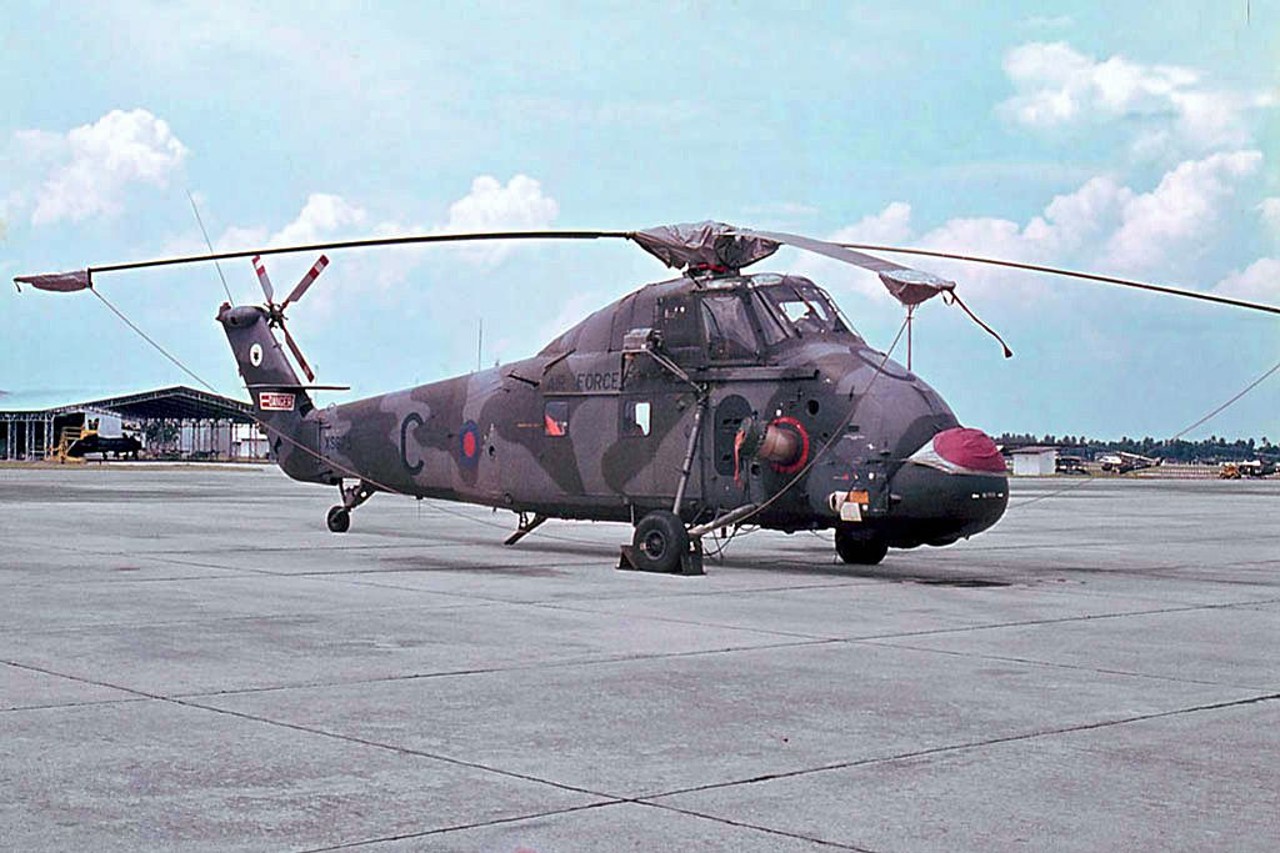
The Royal Navy introduced the Wessex HAS.1 to operational service in 1961 as their premier anti-submarine platform. The improved HAS.3 variant entered service in 1967, incorporating enhanced avionics and systems. Meanwhile, the Royal Air Force adopted the twin-engine Wessex HC2 for general-purpose operations, with No. 18 Squadron at RAF Odiham, Hampshire, receiving the first aircraft in January 1964. The RAF utilized the Wessex for troop transport, air ambulance duties, search and rescue operations, and ground attack missions.
A specialized variant, the Wessex HCC4, served VIP transport duties in a distinctive red and dark blue paint scheme. The first HCC4 flew on March 17, 1969, operating from RAF Benson before transferring to RAF Northolt on March 31, 1995, as part of No. 32 (The Royal) Squadron.
The Manufacturer
Westland Aircraft Limited traced its origins to 1915 as the Westland Aircraft Works, a division of Petters, formally incorporating as Westland Aircraft Limited in 1935. During World War II, the company produced the famous Lysander liaison aircraft and other designs. Following the war, Westland made the strategic decision to concentrate exclusively on helicopter development under a licensing agreement with Sikorsky Aircraft Corporation.
In 1961, Westland merged with several other British aerospace firms to form Westland Helicopters, which continued operating under various corporate restructurings until becoming part of larger international aerospace consolidations. The company's Yeovil facility became Britain's primary helicopter manufacturing center.
Technical Innovation
The Wessex emerged from Westland's ambitious project to re-engine the American Sikorsky S-58 with modern turbine power. A prototype conversion using a Napier Gazelle turboshaft first flew on May 17, 1957, proving the concept's viability. The production Wessex incorporated this powerplant innovation, with the 600-pound lighter Gazelle engine requiring careful weight redistribution but delivering superior performance characteristics.
Later variants employed twin de Havilland Gnome turboshaft engines, with the Wessex HU.5 battlefield transport version producing double the power output of the single-engine HAS.1. This twin-engine configuration significantly enhanced payload capacity and operational safety margins.
Design Excellence
The Wessex's turboshaft powerplant represented a fundamental advancement over piston-engine helicopters of the era. The gas-turbine engines provided greater load capacity, reduced vibration, and quieter operation—qualities particularly valuable during casualty evacuation flights where patient comfort was paramount. The aircraft's single-rotor configuration with anti-torque tail rotor became the standard layout for subsequent Westland helicopter designs.
Production Legacy
Westland manufactured the Wessex from 1958 through 1970, producing aircraft for both military and limited civilian applications. The type served with distinction across multiple variants, from the initial HAS.1 anti-submarine platform through specialized VIP transport and battlefield utility configurations. The Wessex remained in Royal Air Force service until 2003, representing one of the longest service careers of any British helicopter design.
The aircraft's success established Westland as Britain's premier helicopter manufacturer and validated the company's post-war strategy of focusing exclusively on rotorcraft development. Today, surviving Wessex aircraft can be found in museums and private collections, though specific numbers of airworthy examples remain undocumented in available records.