
Dominance in the Pacific Theater
The F4U Corsair established itself as the premier Allied fighter in the Pacific, shooting down 2,140 Japanese aircraft during World War II while maintaining an impressive 11-to-1 kill ratio. Marine squadrons like VMF-312 "Checkerboards" wielded the Corsair with devastating effectiveness, initially operating from land bases due to early carrier landing difficulties that were later resolved through design modifications. The aircraft's six .50-caliber machine guns and ability to carry bombs and rockets made it equally potent in ground attack missions.
Revolutionary Design Achievement
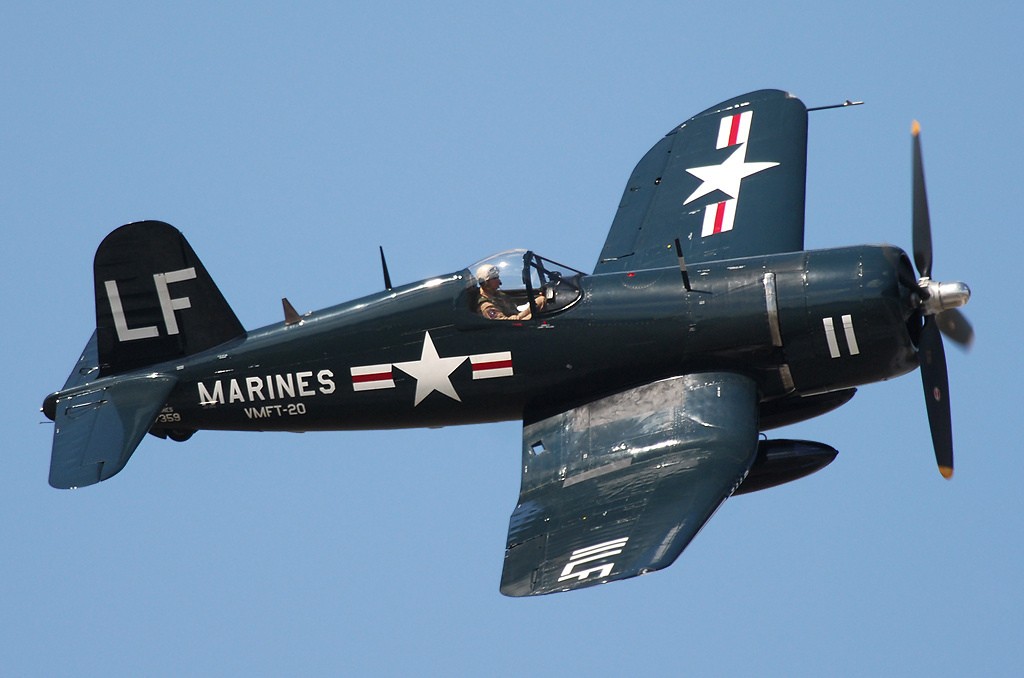
Chief Engineer Rex Beisel began developing the Corsair in early 1938 with a clear mandate: create the fastest possible fighter around the most powerful available engine. His team's solution featured the innovative inverted gull wing design, which allowed the massive 13-foot propeller adequate ground clearance while keeping the landing gear relatively short for carrier operations. The cockpit was positioned three feet farther aft than conventional designs to accommodate fuel tanks and the enormous R-2800 engine, initially creating visibility challenges that were overcome in later variants.
Manufacturing Excellence
Production reached extraordinary levels during wartime, with three manufacturers contributing to the total output of 12,571 aircraft between 1942 and 1952. Chance Vought's Stratford, Connecticut facility served as the primary producer, achieving a remarkable pace of one aircraft every 82 minutes by late 1944. Goodyear manufactured 4,006 FG-series variants between 1943 and 1945, while Brewster contributed 735 F3A-series aircraft before production difficulties ended their involvement in July 1944. Peak monthly production reached 596 aircraft in May 1944 across all three manufacturers.
The Vought Legacy
Chance Vought Corporation, founded in 1917 as Lewis and Vought, specialized in naval aviation throughout its existence. The company merged with Sikorsky in 1939 to form Vought-Sikorsky Aircraft, but split again in January 1943 when Vought remained in Stratford to focus on fighters while Sikorsky relocated to Bridgeport for helicopter development. Post-war consolidation eventually absorbed Vought into United Aircraft in the 1950s, later becoming part of LTV Aerospace in 1961, with remnants ultimately incorporated into Lockheed Martin and Triumph Group.
Powerplant Evolution
The heart of the Corsair's performance was the Pratt & Whitney R-2800 Double Wasp radial engine, initially producing 2,000 horsepower in the R-2800-8 configuration. Later variants like the F4U-4 received the upgraded R-2800-18W engine generating 2,450 horsepower, making it the fastest piston-engine Corsair variant. Experimental installations included the massive R-4360 Wasp Major producing 3,000 horsepower, tested in prototypes like the XF4U-1M and production FG-2 variants, though these saw limited service.
Combat Versatility and Variants
Sixteen major variants demonstrated the Corsair's adaptability to diverse combat roles. The F4U-1D specialized in fighter-bomber missions, while the F4U-2 and F4U-5 served as night fighters equipped with radar. The F4U-4 represented the pinnacle of Vought's development when production ended in 1946, incorporating water injection systems and improved aerodynamics. Marine Corps pilots particularly valued the aircraft's ruggedness and firepower, continuing operations well into the Korean War where a Marine pilot achieved the first propeller-driven victory over a MiG-15 jet in 1950.
Extended Service Life
The Corsair's operational longevity exceeded that of most World War II fighters, serving in frontline roles until the late 1970s. Beyond American forces, the aircraft equipped air forces and navies of France and five other nations, seeing action in French Indochina, Algeria, and the Suez Crisis. The last recorded aerial victory occurred in 1969, demonstrating the design's enduring effectiveness even in the jet age.
Preservation and Legacy
Today, an estimated 70 to 100 Corsairs remain airworthy worldwide, with notable examples preserved at the National Naval Aviation Museum, EAA Museum, and National World War II Museum. The National Naval Aviation Museum's F4U-4 BuNo 97349, wearing VMF-312 markings, has been displayed since 1985 after acceptance in 1946. These surviving aircraft serve as testament to what many consider the longest-produced World War II fighter, representing a pinnacle of piston-engine fighter development that briefly proved superior even to early jet fighters in certain combat scenarios.