
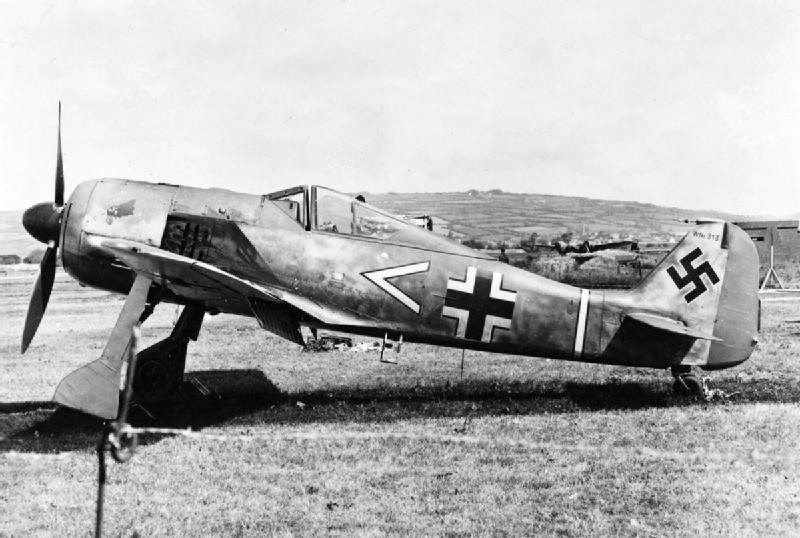
Combat Dominance and Service History
The Fw 190 entered Luftwaffe service in March 1941 with Jagdgeschwader 26, immediately establishing superiority over the Royal Air Force's Spitfire Mk V. Its combat effectiveness was so pronounced that Allied pilots initially reported encountering a new, unknown German fighter type. The aircraft's robust construction and heavy armament made it particularly deadly in the bomber interception role, with specialized units like IV(Sturm)/JG-3 "Udet" achieving devastating success against American B-17 and B-24 formations during 1944-1945.
Production peaked in 1944 when the Luftwaffe accepted 11,411 units—a staggering 375% increase over 1943 despite Soviet forces overrunning 30% of German factories by February 1945. Even as late as April 1945, JG-6 operated 150 of the high-altitude D-9 "Dora" variants, though fuel shortages limited operations to just four aircraft aloft simultaneously.
Variant Development and Specialized Roles
The Fw 190 family encompassed multiple specialized variants beyond the basic A-series fighter. The A-1 initial production model carried four 7.92mm MG 17 machine guns, while later A-4 and A-8 variants incorporated the MW-50 water-methanol injection system and increased fuel capacity. The heavily armored F-series served as dedicated ground-attack aircraft, with F-8 models rebuilt from fighter variants and equipped with reduced armament to accommodate bomb loads.
The revolutionary D-9 "Dora," introduced in 1944, marked a dramatic departure with its liquid-cooled Junkers Jumo 213A inline engine producing 1,776 horsepower, boosted to 2,240 horsepower with water-methanol injection. This powerplant transformation addressed high-altitude performance limitations of the BMW radial engines and represented one of Germany's most effective late-war interceptors.
The Manufacturer and Designer
Focke-Wulf Flugzeugbau AG originated from the 1923 merger of the Focke and Wulf aviation firms, evolving into one of Germany's premier aircraft manufacturers under the leadership of chief designer Kurt Tank. Tank submitted his fighter proposals in autumn 1937 under a Reich Air Ministry contract, with his radical radial-engine design approved by mid-1938 over competing liquid-cooled configurations.
The company's manufacturing network expanded dramatically during wartime, operating production facilities at Marienburg, Bernburg, Cottbus, Kassel-Waldau, and other dispersed locations to survive Allied bombing campaigns. At peak efficiency, the Marienburg plant alone produced eight D-model aircraft daily during December 1944. Following Germany's defeat, Focke-Wulf's assets were absorbed into successor companies, with the original firm ceasing operations.
Engineering Excellence and Innovation
Detail design work began in summer 1938 under Oberingenieur R. Blaser's direction, culminating in the first prototype (Fw 190 V1) flight on June 1, 1939, at Bremen with Flugkapitän Hans Sander at the controls. The aircraft's stressed-skin construction and cantilever low-wing design emphasized structural strength and manufacturing efficiency while delivering exceptional performance.
The BMW 801-series radial engines represented a technological triumph, providing superior reliability compared to liquid-cooled alternatives while generating impressive power outputs. The BMW 801C-1 produced 1,660 horsepower in early variants, while the refined 801D-2 delivered 1,800 horsepower in later models. This powerplant choice proved prescient, as radial engines demonstrated better combat survivability and simplified maintenance under field conditions.
Pilot Experience and Performance
Luftwaffe pilots consistently praised the Fw 190's superior handling characteristics, robust construction, and devastating firepower compared to the Bf 109. The aircraft's wide-track landing gear provided excellent ground stability, while its spacious cockpit and comprehensive instrumentation enhanced pilot effectiveness during extended missions.
Performance specifications varied by variant, with the A-4 achieving 416 mph at 21,000 feet when equipped with MW-50 boost. The D-9's inline engine configuration delivered improved high-altitude performance, making it particularly effective against Allied bomber formations operating above 25,000 feet.
Production Legacy and Museum Preservation
Total Fw 190 production encompassed approximately 13,250 fighters and 6,250 fighter-bomber variants across all models, with an estimated 650-700 D-9 "Dora" aircraft completed before war's end. Manufacturing continued until Germany's surrender in May 1945, representing one of the war's most successful fighter programs.
Today, original airworthy Fw 190s are virtually nonexistent, with flying examples represented primarily by modern reproductions. Flug Werk GmbH of Munich constructed 21 faithful replicas, including F-8/R1 variants now displayed at institutions like the Tri-State Warbird Museum. The National Air and Space Museum preserves Fw 190 D-9 Werksnummer 601088, currently on loan to the National Museum of the United States Air Force at Wright-Patterson Air Force Base, Ohio, serving as a testament to this remarkable aircraft's enduring historical significance.