
Development and Design
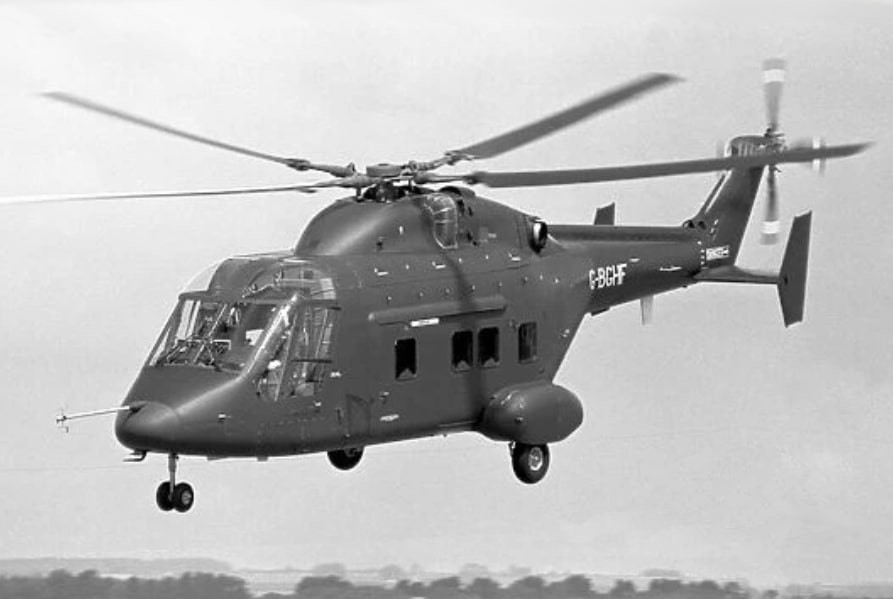
The WG-30 emerged from Westland Helicopters' strategy to capitalize on the North Sea oil exploration boom of the late 1970s. Under the leadership of Managing Director Don Berrington, Westland's engineering team adapted the proven dynamic components of their military Lynx helicopter, combining the rotor system and transmission with an entirely new passenger-oriented fuselage. The prototype, registered G-BGHF and bearing constructor's number 1, lifted off from Yeovil on April 10, 1979.
Westland incorporated several innovative features to distinguish the WG-30 from existing offshore helicopters. Engineers designed a larger, slower-rotating main rotor that promised extended service life and reduced vibrations compared to faster-turning rotors. The tail rotor operated in reverse direction to minimize noise, while a composite tail boom reduced weight. Fixed landing gear housed in streamlined aft fairings eliminated the complexity of retractable systems while maintaining aerodynamic efficiency.
Powerplant Evolution
The WG-30 program witnessed significant powerplant development across its variants. The initial 30-100 model employed twin Rolls-Royce Gem 41-1 turboshaft engines, each producing 1,135 shaft horsepower. These free-turbine engines had proven reliable in naval applications aboard Lynx helicopters. By 1984, Westland introduced the 30-160 variant with uprated Gem 60 engines delivering 1,260 shaft horsepower, representing an 11 percent power increase that enhanced payload capacity and hot-weather performance.
In a departure from Rolls-Royce powerplants, Westland developed the 30-200 variant around twin General Electric CT7-2B turboshafts producing 1,712 shaft horsepower each. Only one example of this high-powered variant flew, making its maiden flight in 1983. The substantial power increase was intended to support a proposed Series 300 military variant that never reached production.
Commercial Operations
British Airways Helicopters became the launch customer, accepting three WG-30-100 helicopters beginning January 6, 1982. These aircraft initially served North Sea gas platforms before transitioning to the Penzance-Isles of Scilly passenger route. The operation later transferred to British International Helicopters as British Airways restructured its helicopter division.
Pawan Hans of India emerged as the WG-30's largest operator, acquiring 21 aircraft between 1986 and 1988 through a substantial UK government grant totaling £65 million. This export success represented Westland's most significant commercial breakthrough with the type, as Pawan Hans deployed the helicopters for offshore oil support operations along India's coastline. The Indian Air Force evaluated the WG-30 during 1983 demonstrations in New Delhi, though no military orders materialized.
The Westland Legacy
Westland Helicopters, the WG-30's manufacturer, traced its roots to 1915 aircraft manufacturing operations, formally organizing as Westland Helicopters in 1971 through mergers of earlier entities. The company gained international recognition for military helicopters including the Lynx, which shared dynamic components with the WG-30. During the mid-1980s, Westland became embroiled in the "Westland Affair," a political controversy involving competing acquisition bids from Sikorsky-General Electric and Fiat-GEC-Marconi consortiums. Government intervention ultimately supported European partners, though the company eventually joined AgustaWestland in 2000, later becoming Leonardo Helicopters UK.
Performance and Specifications
The WG-30 achieved respectable performance figures within its transport category. Maximum takeoff weight reached 12,800 pounds (5,806 kg), while empty weight measured 6,982 pounds (3,167 kg). Fuel capacity totaled 1,043 kg distributed between two tanks, enabling the aircraft's 750-kilometer range. Two-pilot crews operated the aircraft, with passenger loads varying between 17 and 21 seats depending on configuration requirements.
Cruising at 222 km/h (138 mph), the WG-30 offered competitive speed for offshore operations where payload capacity often mattered more than velocity. The aircraft's cargo configuration could accommodate 2,435 kg of freight, making it suitable for supply missions to drilling platforms and remote installations.
Commercial Failure and Retirement
Despite technical merit and initial optimism, the WG-30 program succumbed to market forces beyond Westland's control. The 1980s oil industry depression severely curtailed offshore helicopter demand just as WG-30 production reached full stride. Westland had projected a market for approximately 400 aircraft, but actual sales totaled only 41 examples including prototypes and all variants.
Production ceased in 1988, with most aircraft retiring by 1991 as operators consolidated fleets around more common types. The prototype completed its final flight on September 26, 1985, accumulating 1,988.35 total flight hours before retirement.
Museum Preservation
The original WG-30 prototype, G-BGHF, found permanent preservation at The Helicopter Museum in the United Kingdom, arriving February 10, 1989. This aircraft represents the sole confirmed museum example of the type, serving as a testament to Westland's ambitious but ultimately unsuccessful attempt to capture the civilian helicopter transport market during the North Sea oil boom.