
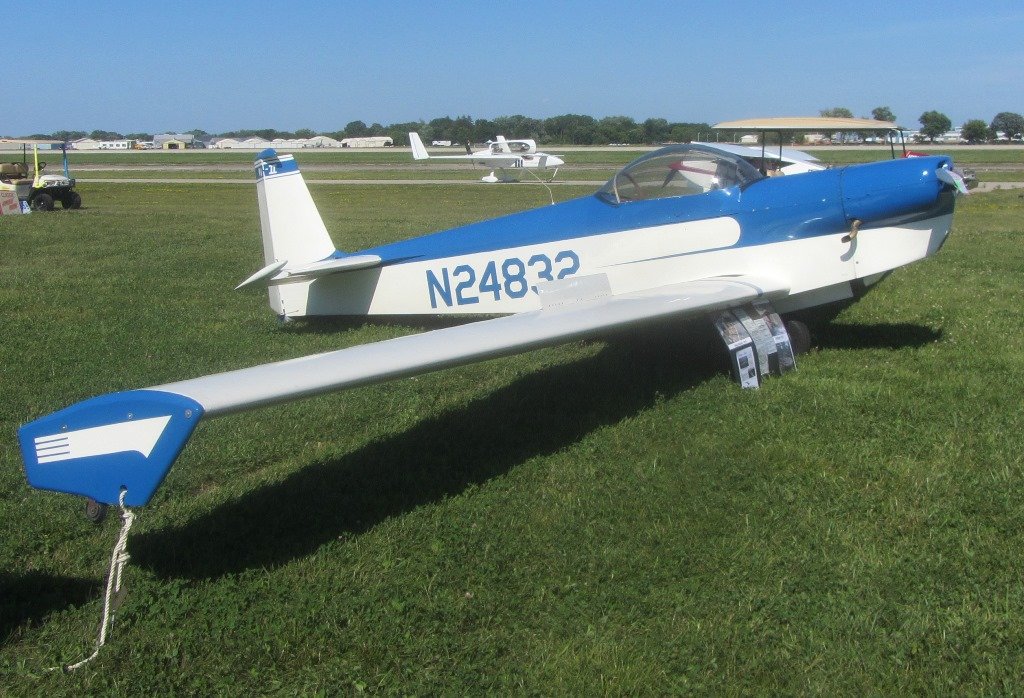
The Designer's Vision
William T. Miller, already established in sailplane design, conceived the WM-2 as a bridge between pure gliders and conventional powered aircraft. Working from his base in Allentown, Pennsylvania, Miller aimed to create a machine that could climb under power to find thermals, then soar efficiently like a sailplane. His design incorporated modified NACA laminar-flow airfoils across wings spanning 40 feet, achieving an impressive 11.1 aspect ratio that rivaled dedicated gliders of the era.
Technical Innovation
The WM-2's construction blended traditional and modern techniques. Miller built the 20-foot fuselage from plywood covered with fiberglass, while the wings and tail surfaces used fabric-covered wooden construction. This mixed-media approach kept the empty weight to just 775 pounds while providing the structural integrity needed for both powered flight and thermal soaring loads.
The aircraft featured a manually retractable monowheel landing gear with tailskid, reducing drag during soaring flight. A bubble canopy provided excellent visibility for spotting thermal activity, essential for the motor glider's intended role. The single Continental A65 engine, producing 65 horsepower, offered sufficient power for takeoff and climb while remaining light enough not to compromise gliding performance.
Performance Characteristics
Miller's design achieved its performance goals on paper, with projected maximum speeds of 142 mph and economical cruise speeds of 126 mph. More importantly for its soaring mission, the WM-2 demonstrated a gentle stall speed of just 45 mph, allowing pilots to work weak thermals effectively. The aircraft's 275-pound useful load provided adequate margin for a pilot and limited baggage for cross-country soaring expeditions.
The high aspect-ratio wings that defined the WM-2's appearance also determined its flight characteristics. While providing exceptional glide performance, these long, narrow wings required careful handling in turbulence and crosswinds, typical of motor glider designs prioritizing efficiency over ease of operation.
Limited Production Reality
Despite Miller's hopes for the homebuilt market, the WM-2 never progressed beyond its single prototype, registered as N24832. The complexity of the design, combined with the specialized nature of motor gliding, limited its appeal to amateur builders. Plans were made available to homebuilders, but the combination of advanced aerodynamics and mixed construction techniques proved daunting for most potential builders.
The prototype's first flight in August 1972 demonstrated the soundness of Miller's design concepts, but market realities quickly became apparent. Most homebuilders of the 1970s preferred simpler, more conventional designs that emphasized ease of construction over specialized performance capabilities.
The Continental A65 Powerplant
Miller's choice of the Continental A65 engine reflected practical considerations for the motor glider role. This air-cooled, four-cylinder inline engine had proven itself in thousands of light aircraft since the 1930s, offering reliable operation with relatively simple maintenance requirements. Producing 65 horsepower at modest weight, the A65 provided adequate power for the WM-2's climb requirements without the complexity of larger engines.
The Continental A65 series represented mature technology by 1972, with production spanning several decades and encompassing tens of thousands of units across various light aircraft applications. This widespread use ensured parts availability and mechanic familiarity, important considerations for homebuilders operating far from factory support.
Legacy and Current Status
The Miller WM-2 remains a footnote in homebuilt aviation history, representing the challenges of bringing specialized designs to the amateur construction market. No examples remain in flying condition today, and the fate of the original prototype is undocumented beyond the 1970s. The aircraft's registration records show no active examples, reflecting the limited production and specialized nature of the design.
Miller's contribution to motor glider development, while limited in scope, demonstrated the feasibility of combining efficient soaring characteristics with adequate powered performance in a homebuilt package. However, the market's preference for simpler designs ultimately limited the WM-2's influence on subsequent homebuilt aircraft development.
The WM-2 should not be confused with the Miller JM-2, a completely different aircraft design that shared only the designer's surname and similar ICAO designation, representing the Formula One racing category rather than motor gliding applications.