
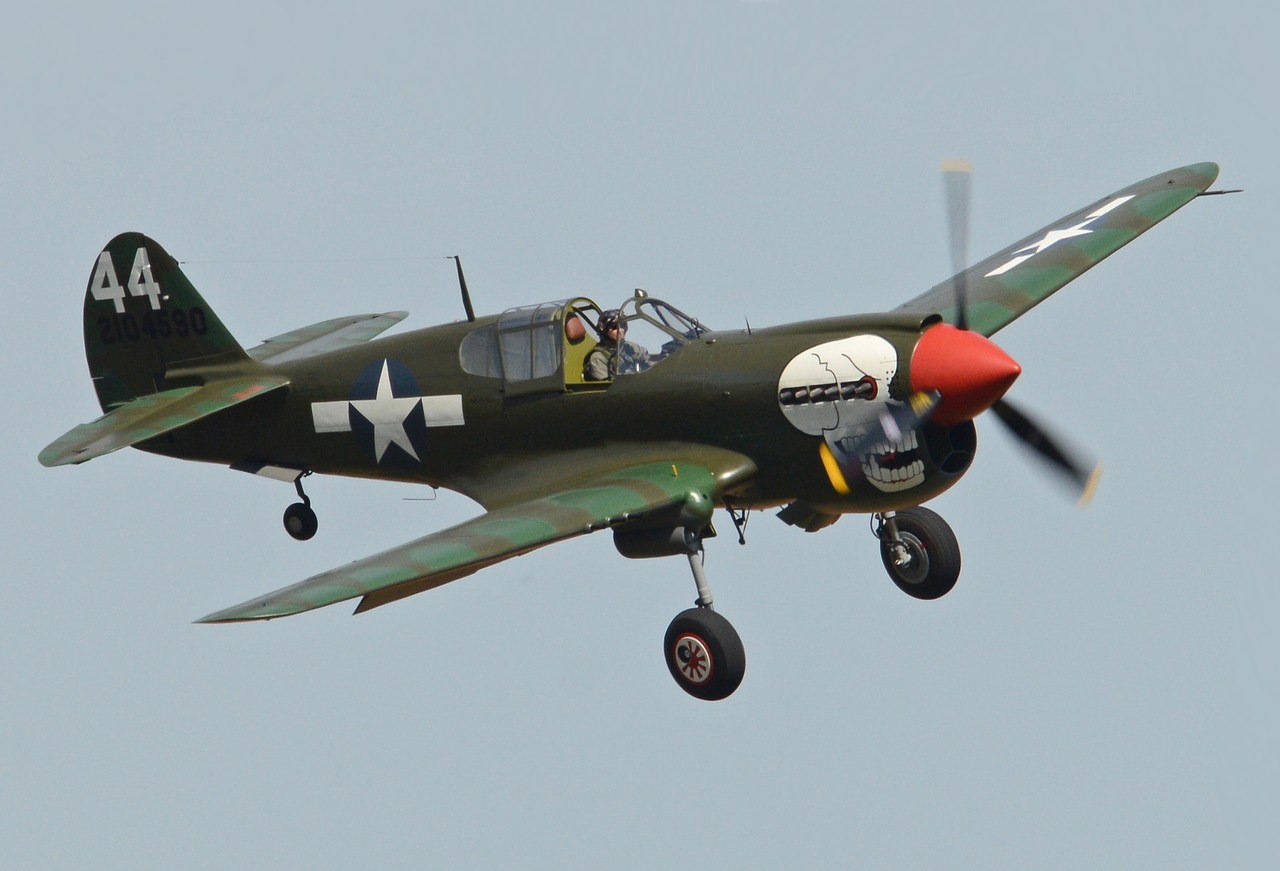
Service History
The P-40 dominated Allied fighter operations during the critical early years of World War II, when more advanced aircraft remained unavailable in sufficient quantities. By 1942, P-40s equipped the majority of USAAF fighter squadrons and served with air forces across six continents. The aircraft filled the desperate need for a modern fighter that could be mass-produced quickly, with Curtiss-Wright delivering 13,738 examples between March 1940 and November 30, 1944, making it the third most-produced American fighter of the war.
Wartime Operations
The P-40's most famous combat service came with the American Volunteer Group, the legendary Flying Tigers, who defended the Burma Road from 1941 to 1942. Under Claire Chennault's command, AVG pilots like Tex Hill, who scored 12.25 victories, demonstrated the P-40's effectiveness against Japanese aircraft, claiming 296 enemy planes destroyed. The distinctive shark-mouth nose art painted on Flying Tigers P-40s became one of aviation's most recognizable symbols.
In the Pacific Theater, the Royal Australian Air Force operated approximately 850 P-40s, with 75 Squadron achieving notable success in New Guinea during 1942. Flight Lieutenant Bruce "Buster" Brown's P-40E "Polly" (A29-133) exemplified the type's service in this demanding theater. Australian ace Clive Caldwell scored 28.5 victories flying P-40s, proving the aircraft's capability in experienced hands.
The P-40 evolved through numerous variants to meet changing combat requirements. Early P-40B Tomahawks gave way to the improved P-40D and P-40E Kittyhawks, which first flew on May 22, 1941, featuring enhanced armament and protection. The P-40F and P-40L incorporated the 1,300-horsepower Packard Merlin engine, offering superior high-altitude performance before supply shortages forced a return to Allison powerplants. The P-40N became the most numerous variant with 5,219 built, optimized as a fighter-bomber capable of carrying 1,500 pounds of ordnance.
The Manufacturer
Curtiss-Wright Corporation emerged from the 1929 merger of the Curtiss Aeroplane and Motor Company with Wright Aeronautical, combining the aviation pioneering legacy of Glenn Curtiss with established engine expertise. Based in Buffalo, New York, the company competed directly with Boeing for 1930s military fighter contracts, winning the P-40 order with a competitive bid of $24,566.60 per aircraft.
The company continued aircraft production through the 1940s but ceased major airframe manufacturing by the 1950s as the industry consolidated. Curtiss-Wright Corporation survives today as a specialized aerospace, defense, and industrial components manufacturer, though far removed from its wartime aircraft production peak.
Engine and Technical Innovation
Don R. Berlin's engineering team designed the P-40 as an evolution of the successful P-36 Hawk, adapting the airframe for the liquid-cooled Allison V-1710 inline engine. This V-12 powerplant, manufactured by the Allison Division of General Motors, produced between 1,040 and 1,700 horsepower depending on the variant. The V-1710-33 generated 1,040-1,090 horsepower in early models, while later versions like the V-1710-81 delivered 1,700 horsepower.
The P-40's innovative forward-mounted radiator scoop created the distinctive nose profile that inspired the famous shark-mouth artwork. Self-sealing fuel tanks in later variants provided crucial survivability improvements, while the all-metal construction ensured durability in harsh combat conditions.
Combat Performance
Pilots appreciated the P-40's rugged construction and reliable handling characteristics, though they recognized its limitations at high altitude where the unsupercharged Allison engine lost effectiveness. The aircraft excelled in low-to-medium altitude combat and ground-attack missions, where its heavy armament of four to six .50-caliber machine guns proved devastating.
With a top speed of 357 mph in early variants increasing to 378 mph in the P-40N, the fighter offered adequate performance for its era. Combat radius extended to 950 miles with external tanks, while the service ceiling reached 33,000 feet. The P-40's dive characteristics particularly impressed pilots, enabling effective boom-and-zoom tactics against more maneuverable opponents.
Legacy and Preservation
Fewer than 50 P-40s remain airworthy today, making survivors precious representatives of World War II aviation. The Australian War Memorial preserves P-40E "Polly" (A29-133), while the National Air and Space Museum in Washington, D.C., displays a restored P-40E in 75th Fighter Squadron markings. The Tri-State Warbird Museum maintains P-40M Kittyhawk III (NZ3119) among its collection.
The P-40's cultural impact extends far beyond aviation enthusiasts, with the Flying Tigers' shark-mouth livery appearing in films like the 1942 John Wayne movie "Flying Tigers." The aircraft symbolizes the determined Allied resistance during World War II's darkest early years, when obsolescent but available fighters held the line until superior aircraft could reach production. The P-40's service with 28 nations demonstrates its crucial role as a bridge between pre-war designs and the advanced fighters that would later dominate the skies.