
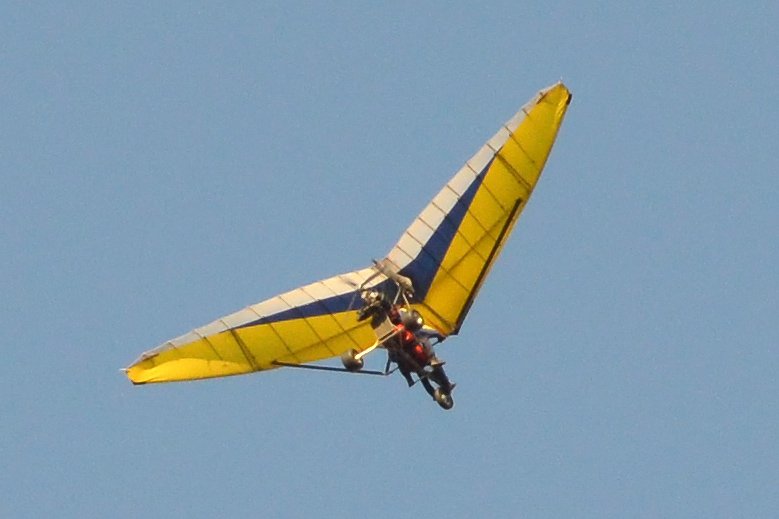
What a Weight-Shift-Control Aircraft Is
A weight-shift-control aircraft — universally known as a trike — combines two very different pieces of flying machinery: a flexible fabric wing derived directly from the hang glider, and a powered tricycle carriage ("trike") suspended beneath it. The wing is a swept-back Rogallo-style flying wing built from aluminum leading-edge and keel tubes with a tensioned sailcloth surface; the carriage carries the pilot (and often a passenger in tandem), the fuel tank, and a small engine — commonly a Rotax — driving a pusher propeller. The two halves connect at a single pivoting hang point, so the carriage swings beneath the wing like a pendulum. Because the wing folds down into a slim tube roughly 16 to 20 feet long, a trike can be de-rigged and trailered or stored in a garage.
How Weight-Shift Control Works
What makes these aircraft unique is that they have no ailerons, elevator, or rudder — no hinged control surfaces at all. The pilot grips a triangular control bar (an "A-frame" or control frame) hanging below the wing and flies by moving the whole carriage relative to the wing. Pushing the bar forward or pulling it back shifts the center of gravity fore and aft to control pitch (speed and climb); moving the bar left or right rolls the wing to control turns. This is the same intuitive body-English control that a foot-launched hang glider pilot uses, scaled up to move a powered carriage. Coordinated turns come naturally from the wing's built-in sweep and twist (washout) rather than from a rudder, making the aircraft simple and reflexive to fly once the "backwards" control logic is learned.
The Flex-Wing Design
The defining feature of the category is the flexible wing, or flex-wing. Rather than a rigid structure, the wing relies on a framework of tubes — leading edges, a central keel, and a crossbar — held in shape by a tensioned sail. Built-in wing twist gives the trike gentle, forgiving stall behavior and inherent pitch stability, while different wing models trade off top speed against handling: larger, slower wings suit training and relaxed flying, while smaller, faster "topless" wings are chosen for cross-country performance. A single carriage can often be paired with more than one wing, letting an owner tune the aircraft's character. This modular flex-wing architecture is what visually and mechanically distinguishes trikes from fixed-wing microlights.
Sport, Microlight, and Recreational Use
In the United States, the FAA formally recognizes Weight-Shift-Control as its own aircraft category, alongside airplane, glider, rotorcraft, powered parachute, and gyroplane. Two-seat trikes are certified as Light-Sport Aircraft (LSA) and can be flown on a Sport Pilot certificate, while single-seat versions fall under Part 103 ultralight rules. LSA trikes are limited to fixed landing gear, a single reciprocating engine, and a fixed or ground-adjustable propeller. Internationally, trikes are regulated within broader microlight or ultralight categories defined mainly by maximum weight and stall speed. Across both regimes the appeal is the same: an affordable, open-air, low-and-slow flying experience with an unobstructed view, short-field capability from grass or gravel strips, and easy transport and storage.
Major Manufacturers
The modern trike market is served by a number of specialist builders rather than large aircraft corporations. Air Création of France is one of the oldest and most influential flex-wing makers; Evolution Trikes (Revo, Rev) and North Wing are leading U.S. manufacturers of carriages and wings; and Airborne of Australia is a major producer known for its integrated trike-and-wing packages. Other builders and cottage manufacturers around the world produce compatible wings and carriages, and the healthy aftermarket in used airframes and mix-and-match wings keeps a large fleet flying.
Why This Is a Category, Not a Single Type
Because weight-shift-control aircraft are produced by many small manufacturers, come in countless carriage-and-wing combinations, and share a common control principle rather than a common airframe, they are not assigned an individual ICAO aircraft type designator. Air traffic and flight-planning systems treat them generically as microlights. On AviatorDB, WSFT therefore serves as a catch-all category page: every registered trike, powered hang glider, and flex-wing microlight links here so that its entry connects to a useful, shared reference rather than to a nonexistent type record.