
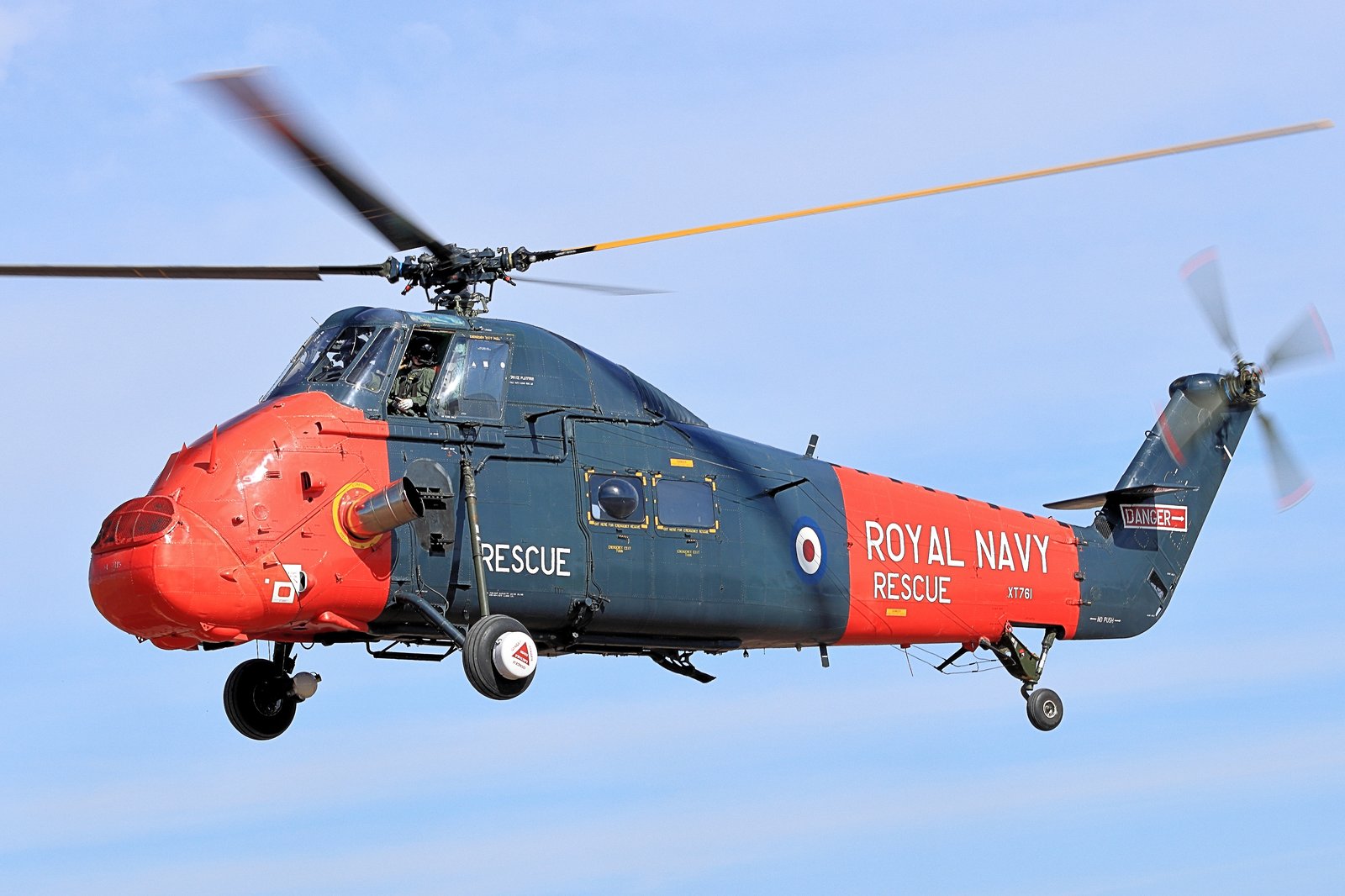
The Westland Wessex (ICAO code WSSX) was a British-developed medium helicopter based on a licence-built and extensively redesigned version of the Sikorsky S-58/H-34. Developed to incorporate British systems and turbine power, the Wessex prototype first flew on May 17, 1958, at Yeovil. Production took place at Westland's Yeovil facility in Somerset, England, a site associated with aircraft manufacturing since 1915. Approximately 380 to 382 airframes were produced from the late 1950s into the early 1970s, with the initial Royal Navy HAS.1 variant entering service in 1961.
Technologically, the Wessex represented a major shift from piston-engined designs. While the early HAS.1 utilized a single Napier Gazelle turboshaft engine, later production variants—including the HAS.3, HU.5, and the RAF's HC.2 series—standardized on the Rolls-Royce Gnome. These later versions often employed a twin-turboshaft installation, delivering roughly 2,800 to 3,000 total shaft horsepower, which significantly improved reliability and performance in maritime environments. The aircraft was designed for versatility, featuring configurations for shipborne anti-submarine warfare (ASW) equipped with dipping sonar and radar, as well as assault and utility roles capable of transporting 16 to 18 troops or multiple medical stretchers.
Militarily, the Wessex was a mainstay for the Royal Navy's Fleet Air Arm and the Royal Air Force. It operated from aircraft carriers like HMS Ark Royal and served in various global conflicts, including the Indonesia–Malaysia Confrontation (1963–1966), operations in Aden and Radfan, and internal security duties during the Troubles in Northern Ireland. During the 1982 Falklands War, the Wessex provided essential logistics, troop transport, and SAR support, though several aircraft were lost during the conflict. The Royal Australian Navy also operated the HAS.31 and HAS.31B variants for ASW duties.
Beyond military service, a limited number of ex-military Wessex helicopters were used in the UK for civil offshore oil support, firefighting, and utility lifting. The type was eventually phased out of UK service by the early 2000s, replaced by the Westland Sea King and Puma HC.1. Today, the Wessex is preserved in several museums, including the Fleet Air Arm Museum at Yeovilton and the RAF Museum at Cosford and Hendon, with only a handful of airframes remaining airworthy worldwide.