
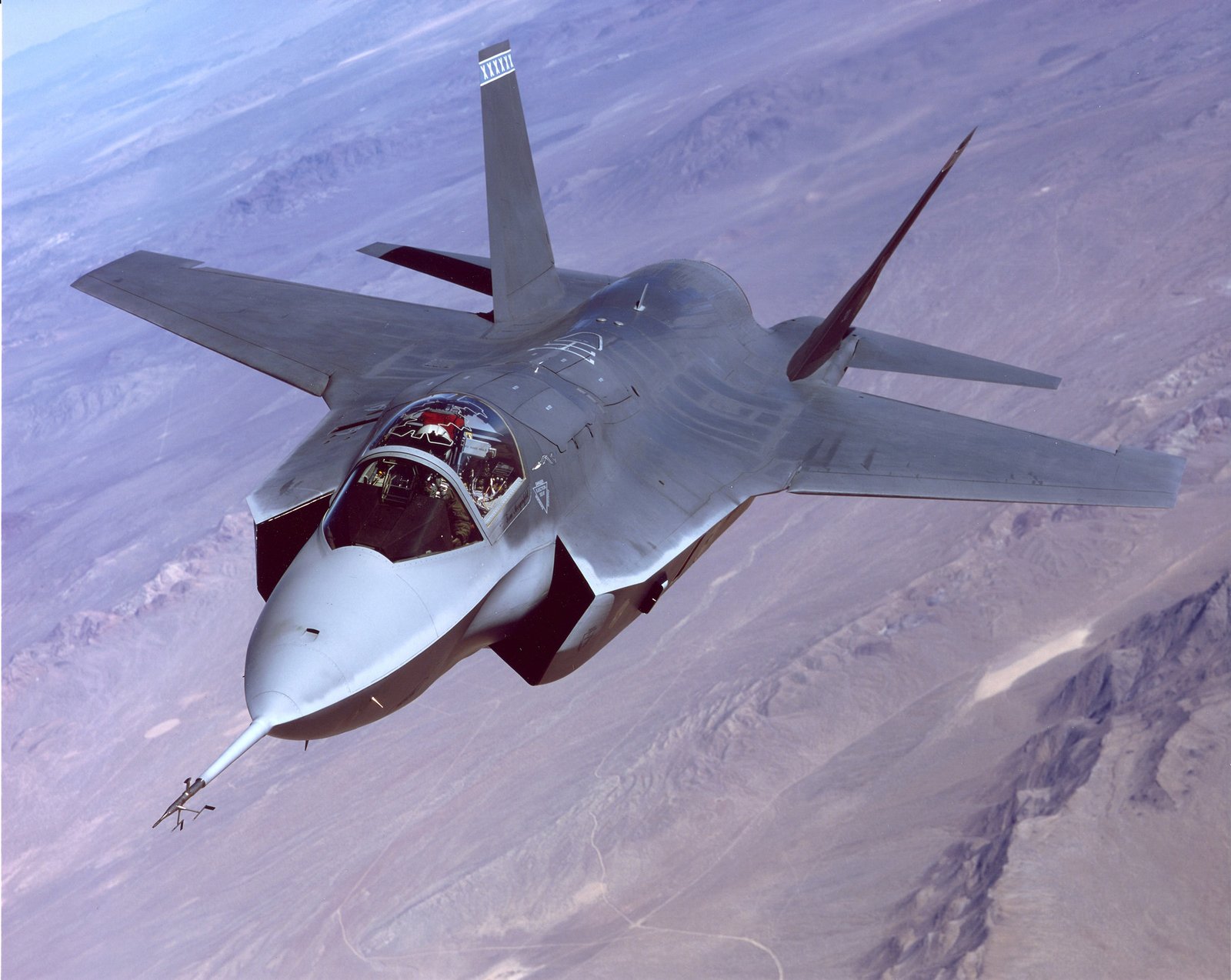
The Lockheed Martin X-35 was developed as a Concept Demonstration Aircraft (CDA) under the U.S. Joint Strike Fighter (JSF) program. Rather than a production fighter, the X-35 served as a technology validator to compete for a multi-service stealthy multirole fighter contract. On November 16, 1996, contracts were awarded for the concept demonstration phase, leading to the construction of two airframes at Lockheed Martin’s Skunk Works facility at Air Force Plant 42 in Palmdale, California.
Design leadership for the program included Chief Engineer Richard A. Rezabek and Chief Engineer George Law. A critical innovation was the shaft-driven lift fan STOVL propulsion concept invented in 1990 by Paul Bevilaqua and Paul Shumpert. This system allowed the X-35 to achieve supersonic performance while maintaining short takeoff and vertical landing capabilities, a combination that distinguished it from the subsonic Harrier. The X-35 utilized a common outer mold line adaptable to three variants: the X-35A (CTOL), the X-35B (STOVL), and the X-35C (carrier variant with a larger wing).
Flight testing occurred between 2000 and 2001. The X-35A first flew on October 24, 2000, piloted by Tom Morgenfeld. The X-35C followed on December 16, 2000, piloted by Joe Sweeney. After approximately 28 CTOL flights, the X-35A was converted into the X-35B, which first flew on June 23, 2001. A landmark achievement occurred on July 20, 2001, when the X-35B performed a short takeoff (under 500 feet), a level supersonic dash, and a vertical landing in a single flight. This success led to Lockheed Martin being selected for the System Development and Demonstration (SDD) phase in October 2001.
Power was provided by a single Pratt & Whitney JSF119-PW-611 augmented turbofan, producing approximately 25,000 lbf of dry thrust and up to 40,000 lbf with afterburner. For the X-35B, a Rolls-Royce shaft-driven LiftSystem was integrated, featuring a 50-inch counter-rotating lift fan generating 20,000 lbf of cold thrust, supplemented by a three-bearing swivel module and wing roll posts. The X-35A/B configuration featured a wingspan of 33 feet and a length of 50.5 feet, with a maximum takeoff weight of approximately 50,000 lb. While the X-35 never entered operational military service, its legacy persists through the F-35 Lightning II. Today, the X-35B is displayed at the National Air and Space Museum's Steven F. Udvar-Hazy Center, and the X-35C is located at the Patuxent River Naval Air Museum.