
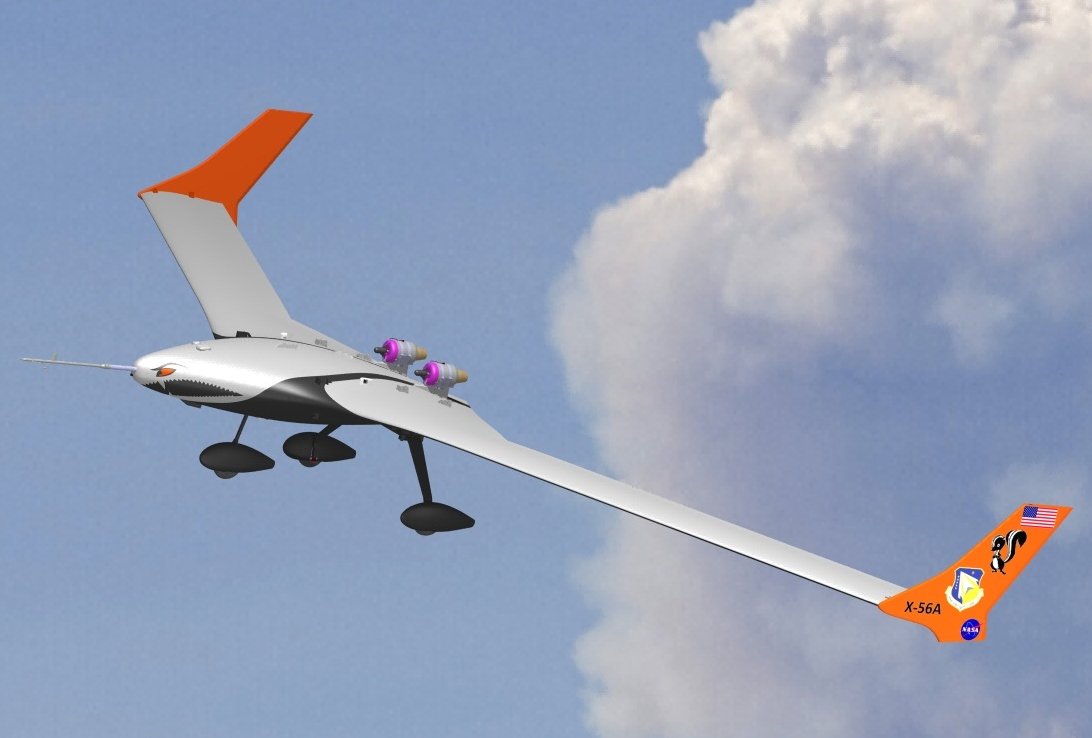
The Lockheed Martin X-56 is a family of small, remotely piloted experimental aircraft developed by Lockheed Martin Skunk Works for the U.S. Air Force Research Laboratory (AFRL). Designed as a low-cost technology demonstrator, the aircraft serves as a testbed for active aeroelastic control technologies, specifically focusing on gust load alleviation and active flutter suppression. These capabilities are critical for the development of future high-efficiency aircraft that utilize very flexible, high-aspect-ratio wings.
The X-56A, designated as the Multi-Utility Technology Testbed (MUTT), was developed under AFRL's Multi-Utility Aeroelastic Demonstrator (MAD) program. It first flew on July 26, 2013, at the NASA Dryden Flight Research Center (now the Armstrong Flight Research Center) at Edwards Air Force Base, California. This initial 14-minute flight was conducted at low altitude, with handling qualities evaluated at a speed of 70 knots. The aircraft's design is notably modular, featuring a slender central fuselage (centerbody) capable of accepting various wing sets—ranging from stiff to highly flexible—to allow for comparative research into structural dynamics.
Technically, the X-56A is a twin-engine UAV with a wingspan of 8.4 meters and a length of 2.3 meters, weighing approximately 220 kg. It is powered by two JetCat P400 turbojet engines, each producing 395 N (89 lbf) of thrust. The aircraft is capable of reaching a maximum speed of 222 km/h. Because it is remotely piloted, the X-56 can be flown in aeroelastically challenging regimes that would be too hazardous for manned flight.
Following the initial AFRL phase, NASA Armstrong operated the X-56A to further research aeroservoelasticity, concluding its test series in 2019. In 2021, NASA reactivated the aircraft as the X-56B, utilizing the same centerbody but equipped with a new set of wings. The X-56B made its first flight on April 19, 2021; however, the program ended prematurely when the aircraft crashed on July 9, 2021, due to an unspecified in-flight anomaly. Despite the loss of the airframe, the program provided vital real-world data on flutter prediction and suppression, which now informs digital certification efforts in collaboration with Istari Digital's "Flyer Øne."