
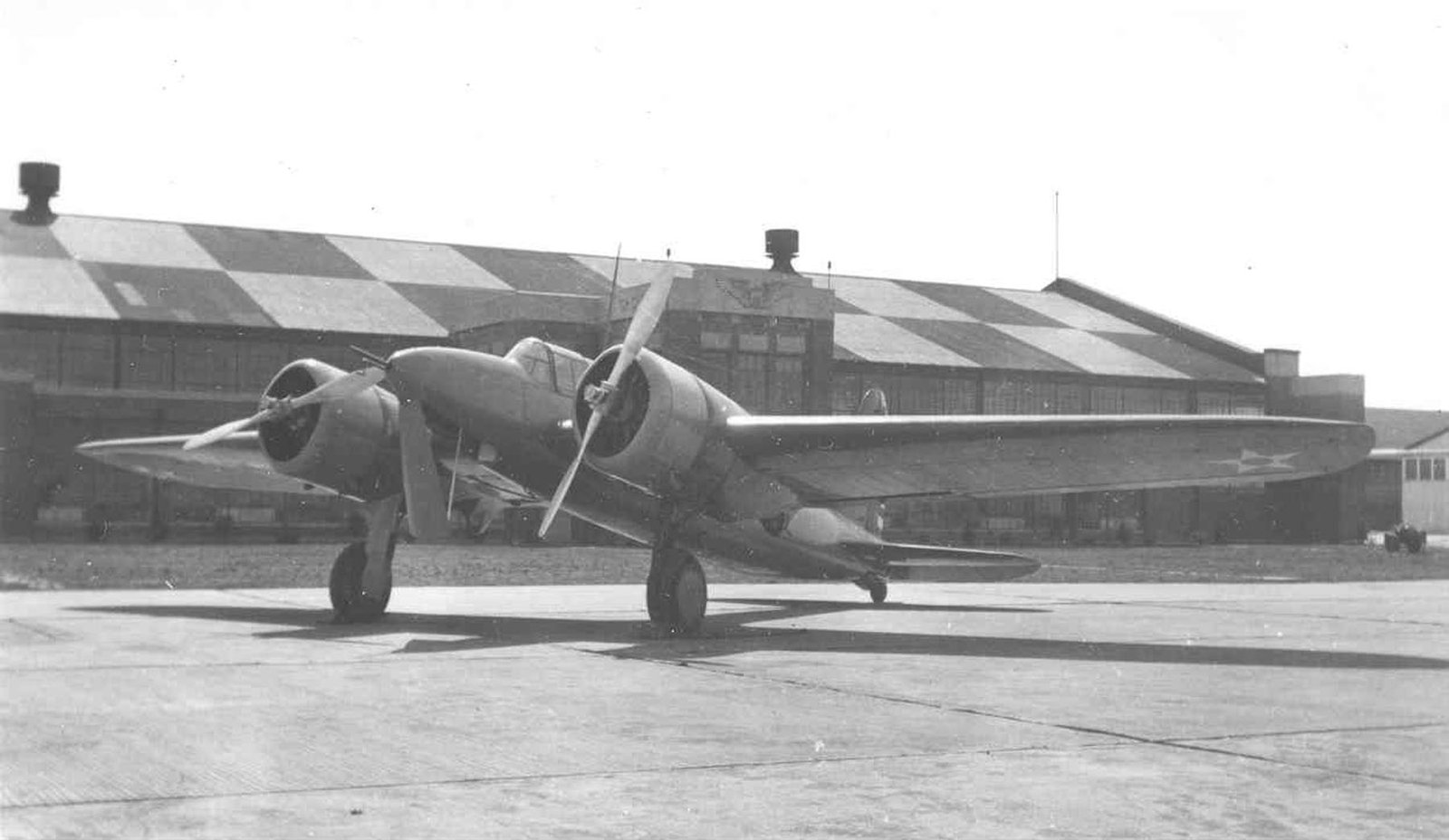
The Curtiss XA-14 was a specialized experimental attack aircraft developed during the mid-1930s. Designed as a private venture by the Curtiss Aeroplane & Motor Company (which had merged with Wright Aeronautical in 1929 to form the Curtiss-Wright Corporation), the aircraft was designated as Model 76. The project began in 1934 with the goal of providing the U.S. Army Air Corps (USAAC) with a more survivable and faster attack platform than existing single-engine designs. This was achieved through a streamlined airframe that enclosed weapons and bombs internally.
The XA-14 first took flight in September 1935, carrying the civil registration X-15314. It was a two-seat aircraft, accommodating a pilot and a gunner/observer. The design was characterized by clean aerodynamic lines, featuring a narrow fuselage and low-drag engine nacelles. These features allowed the XA-14 to reach a maximum speed of 243 mph at sea level, a performance metric that made it as fast as the standard single-engine pursuit aircraft in service at the time. The aircraft's dimensions included a wingspan of 47 ft 6 in, a length of 40 ft 6 in, and a wing area of 340 sq ft.
Power was provided by two Wright R-1670-5 engines, which were 14-cylinder, two-row, air-cooled radial piston engines. Each engine produced 775 hp (578 kW) and drove a two-bladed, two-position variable-pitch propeller. This configuration enabled a cruise speed of 222 mph and a rate of climb of 1,690 ft/min, with a service ceiling of 28,000 ft. For offensive operations, the XA-14 was equipped with four 0.30 in M1919 Browning machine guns in the nose and an internal bomb bay capable of carrying up to 650 lb of bombs. Defensive protection was provided by a single 0.30 in machine gun on a flexible mount in the rear cockpit.
As a one-off prototype, the XA-14 never entered series production or saw combat service. However, its evaluation by the USAAC was historically significant as it proved the viability of the twin-engine attack concept. This developmental work led directly to the Curtiss A-18 Shrike II, the first operational twin-engine attack bomber used by the USAAC. While no XA-14 airframes survive today, the aircraft's legacy is preserved through historical photographs, including those held by the National Museum of the United States Air Force.