
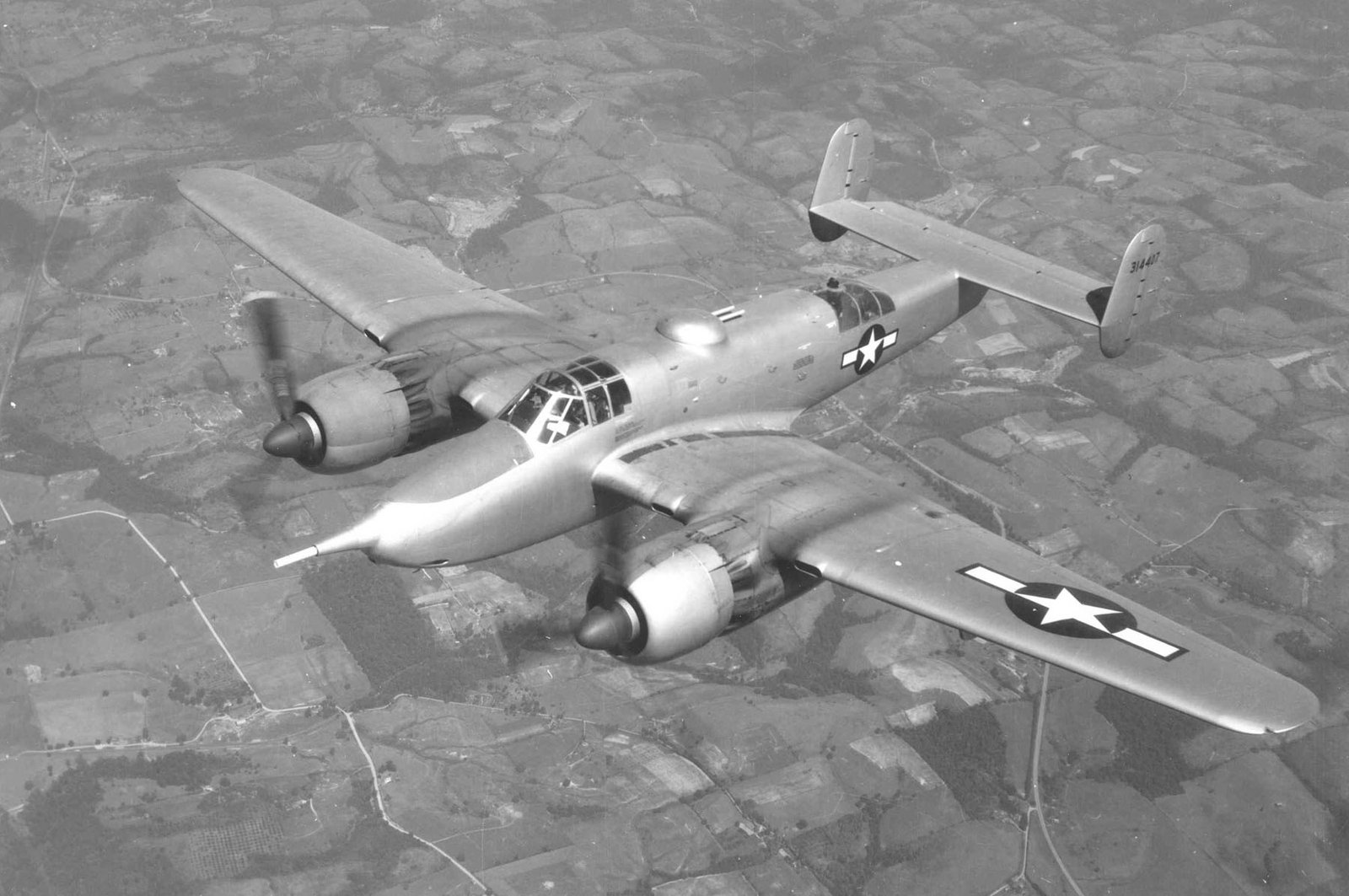
The Beechcraft XA-38 Grizzly was developed as a heavily armed ground-attack aircraft for the U.S. Army Air Forces during World War II. Originally conceived by the Beech Aircraft Corporation as the Model 28 "Destroyer," the aircraft was intended to serve as a bomber hunter before the Army redirected its purpose toward the destruction of tanks, bunkers, fortifications, and other support vehicles. The program resulted in the construction of only two prototypes at Beech's facility and airfield in Wichita, Kansas, following contracts issued in late 1942.
Technically, the XA-38 was an exceptionally powerful aircraft for its role. It was powered by two Wright R-3350-43 air-cooled radial engines, each producing 2,300 horsepower. This propulsion system allowed the aircraft to reach top speeds cited between 370 and 375 mph. The airframe featured a wingspan of 67.4 ft, a length of 51.9 ft, and a height of 15.6 ft, with a total wing area of 626 sq ft. Designed for a crew of two—consisting of a pilot and an observer/gunner—the aircraft had an empty weight of 22,480 lb and a maximum takeoff weight of 35,265 lb. Its performance specifications included a service ceiling of 29,000 ft, a rate of climb of 2,600 ft/min, and a range of 1,625 miles.
The aircraft's primary significance lay in its massive armament. The nose was equipped with a 75 mm T15E1 cannon capable of carrying 20 rounds, supplemented by six .50-caliber machine guns. The first prototype took flight on May 7, 1944, piloted by Vern Carstens in Wichita. A second prototype flew later on September 22, 1945. On August 14, 1945, one of the aircraft was transferred to the USAAF Research Center at Eglin, Florida.
Despite successful testing, the XA-38 never entered production. The program was crippled by engine shortages, as the Wright R-3350 engines were prioritized for the B-29 bomber program. With the end of the war and a loss of interest from the Army Air Corps, the project was cancelled. Both prototypes were eventually scrapped, although the 75 mm cannon remains as the sole surviving piece of the program and is currently on display at the National Museum of the United States Air Force.