
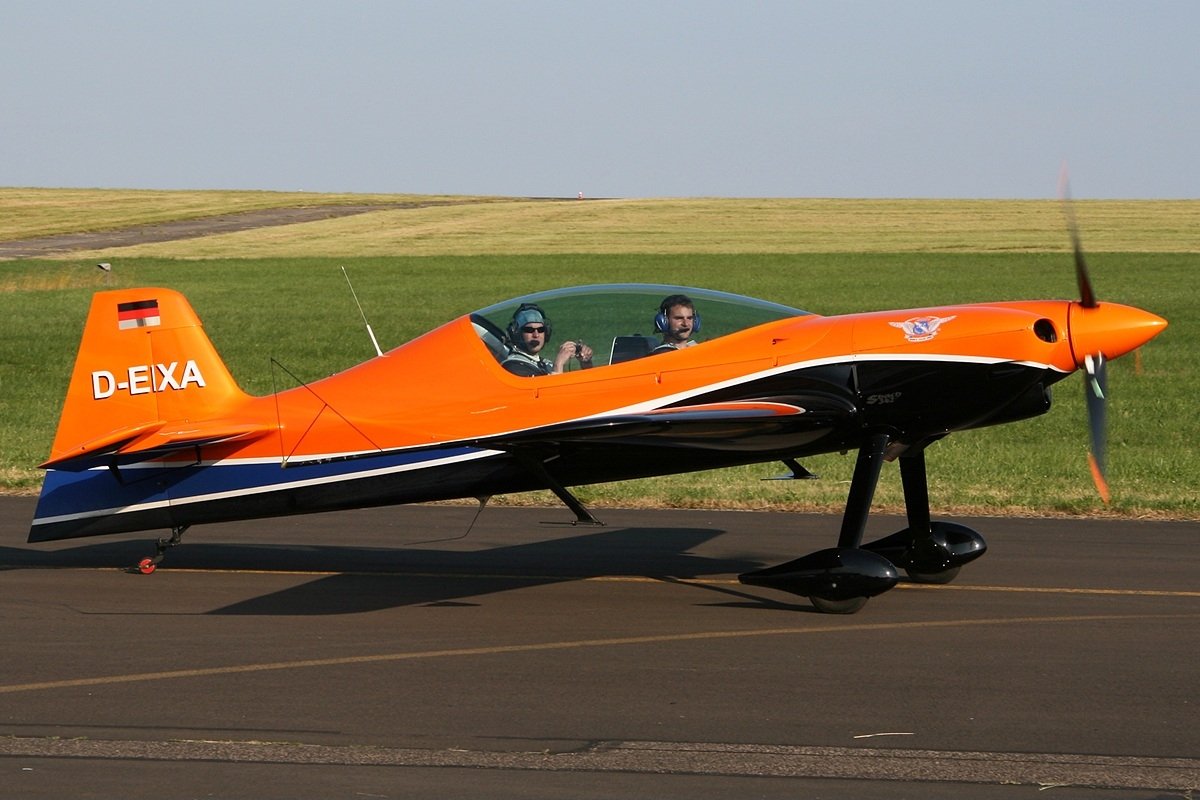
Championship Dominance
The XA-41 quickly established itself as a formidable competitor in unlimited aerobatics, achieving remarkable success in international competition. British pilot Gerald Cooper, flying an XA-41, won the first-ever gold medal for Great Britain in unlimited aerobatics in 2012, breaking decades of international competition barriers. The aircraft also dominated German national unlimited championships, demonstrating its superior performance capabilities in the most demanding aerobatic categories.
Operational examples include the Marksmen Aerobatic Team's ZU-XAX and pilot Marek Hyka's D-ESXA, both actively competing in aerobatic circuits. The aircraft's single-seat configuration limits its use strictly to competition and advanced aerobatic training, with no commercial passenger or cargo applications.
The Manufacturer's Journey
XtremeAir GmbH was founded in December 2005 by Harro Moewes in Cochstedt, Germany, specifically to produce type-certified aerobatic aircraft. The company relocated to a 2,400-square-meter manufacturing facility at Magdeburg-Cochstedt Airport in December 2006, employing approximately 50 people at its peak. In 2018, Chinese firm Zair Aerospace acquired XtremeAir, with Qing Liu serving as the final CEO and Waldemar Sawenko as Quality Manager.
The company faced financial difficulties and entered liquidation in March 2021, marking the end of 16 years of German aerobatic aircraft production. Despite the original manufacturer's closure, XA-41 production continues under successor entities, as evidenced by FAA certifications issued as recently as January 18, 2025.
Design Excellence
Philipp Steinbach designed the XA-41 with a singular focus on unlimited aerobatic performance. The aircraft's carbon-fiber construction provides exceptional strength-to-weight ratio, essential for withstanding the extreme G-forces encountered in unlimited competition maneuvers. This lightweight construction enables the aircraft to achieve its maximum takeoff weight of 850 kilograms while maintaining structural integrity during violent aerobatic sequences.
The Lycoming AEIO-580-B1A engine, manufactured by Textron's Lycoming division, produces 235 kilowatts (315 horsepower) from its horizontally-opposed six-cylinder configuration. This powerplant features fuel injection and inverted oil systems, critical for sustained inverted flight operations common in aerobatic competition. The engine's reliability and consistent power delivery have proven essential for pilots performing at championship levels.
Production and Legacy
XA-41 production began in 2011 and continues through 2025, with documented serial numbers reaching at least c/n 006, indicating a minimum of six aircraft constructed. The related XA-42 model exceeded 44 units built, suggesting the XA-41 likely achieved similar or greater production numbers given its competition success.
The aircraft's operational record includes both triumphs and tragedies. While achieving championship victories across multiple countries, at least two hull losses have occurred: a non-fatal accident on June 11, 2013, and a fatal crash involving the Marksmen Team's ZU-XAX on May 31, 2022, claiming one life.
Current Status
Several XA-41 aircraft remain airworthy as of 2025, with recent FAA registrations showing certificates valid through 2032. The aircraft continues to compete in unlimited aerobatic championships worldwide, maintaining its reputation as a benchmark for modern aerobatic design. Gerald Cooper operates from Wickenby Aerodrome in the United Kingdom as a sales agent, continuing to promote the aircraft's capabilities to the international aerobatic community.
The XA-41's cultural significance extends beyond pure competition results, representing the pinnacle of modern unlimited aerobatic aircraft design. Its success validated the concept of purpose-built carbon-fiber aerobatic machines, influencing subsequent designs in the specialized field of unlimited competition aircraft. The aircraft's legacy lives on through continued production and active competition participation, ensuring its place in aerobatic aviation history.