
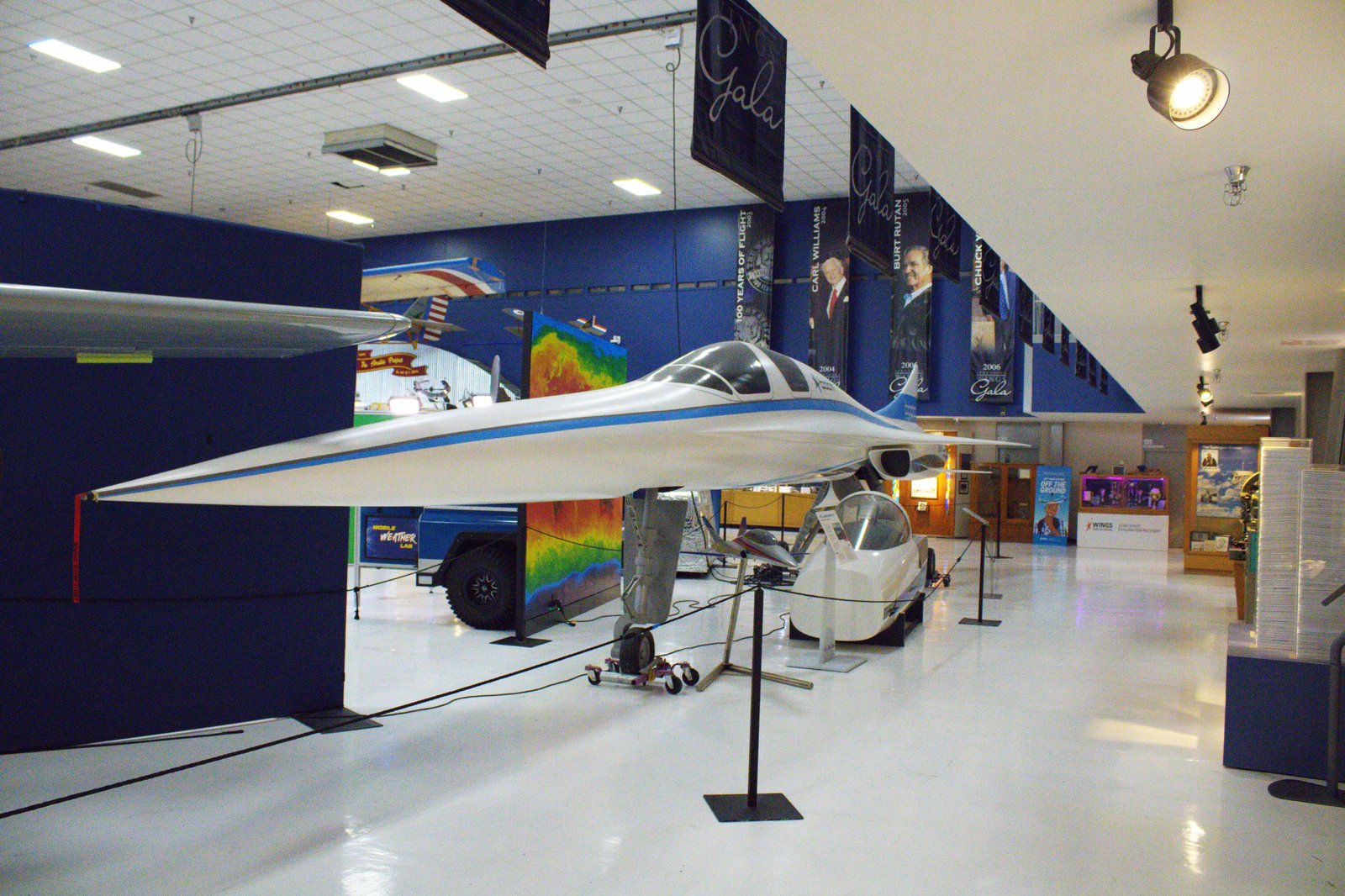
Technology Demonstrator Mission
The XB-1 served a singular purpose: validating aerodynamic concepts and design principles for Boom Technology's ambitious Overture supersonic transport program. Unlike commercial aircraft designed for revenue service, this demonstrator conducted 13 test flights between March 22, 2024, and February 10, 2025, systematically pushing performance boundaries to gather critical engineering data. The aircraft's test program methodically progressed from basic handling qualities to transonic flight, culminating in two successful supersonic flights that broke the sound barrier multiple times.
During Flight 12 on January 28, 2025, Chief Test Pilot Tristan "Geppetto" Brandenburg guided the XB-1 to Mach 1.122 at 35,290 feet, breaking the sound barrier three separate times in a single mission. This achievement represented the first supersonic flight by a privately funded jet aircraft, distinguishing it from government-sponsored programs that had dominated supersonic aviation since the 1940s.
The Manufacturer
Boom Technology emerged in 2016 under founder Blake Scholl's leadership with the explicit goal of reviving commercial supersonic transport. The Denver-based company announced the Overture supersonic airliner concept in August 2016, followed by the XB-1 demonstrator program just three months later in November 2016. Unlike established aerospace giants, Boom represented a startup approach to supersonic aviation, leveraging modern materials and computational design methods unavailable during Concorde's development era.
The company partnered with The Spaceship Company, Virgin Galactic's manufacturing arm, for flight testing operations at Mojave Air and Spaceport. This collaboration provided access to specialized supersonic flight test expertise and facilities proven during Virgin Galactic's suborbital vehicle development.
Engine Evolution and Technical Innovation
The XB-1's propulsion system underwent significant evolution during development. Initial designs called for General Electric CJ610 turbojet engines, but by July 2018, the configuration shifted to three GE J85-21 engines producing 3,500 pounds of thrust each. The final specification adopted GE J85-15 engines generating 4,300 pounds of thrust per engine, providing the additional power necessary for supersonic performance.
This trijet configuration incorporated variable geometry inlets and exhaust systems optimized for both subsonic and supersonic flight regimes. The engine placement and inlet design represented critical technology validation for the larger Overture program, which faces similar challenges in managing airflow at varying Mach numbers.
A stability augmentation system provided enhanced safety margins during high-speed flight and takeoff-landing phases. This computer-assisted flight control system, added after the initial 2016 design announcement, reflected lessons learned from previous supersonic aircraft programs and modern safety standards.
Flight Test Progression
The XB-1's methodical test program demonstrated systematic risk management typical of modern experimental aircraft development. Early flights focused on basic airworthiness, with Flight 2 on August 26, 2024, validating landing gear retraction and stability augmentation systems. Subsequent flights progressively increased speed and altitude, with Flight 7 reaching Mach 0.82 at 23,015 feet and Flight 10 achieving Mach 0.95 in the transonic regime.
Chief Test Pilot Bill "Doc" Shoemaker conducted the inaugural flight on March 22, 2024, validating basic handling characteristics. The test program accumulated critical data on transonic behavior, structural loads, and flight control effectiveness across the aircraft's performance envelope.
Production and Legacy
As the sole XB-1 completed its mission, Boom Technology leveraged the gathered data for Overture development. The company reports 130 orders and pre-orders from American Airlines, United Airlines, and Japan Airlines for the production airliner, with first Overture rollout scheduled for 2026 and certification targeted for 2029. Each Overture aircraft carries a projected production cost of $200 million.
The XB-1's retirement in February 2025 marked the conclusion of the first privately funded supersonic aircraft program since the jet age began. Its achievement validated the viability of startup aerospace companies tackling complex supersonic challenges traditionally reserved for government programs or established manufacturers. The demonstrator's success provided crucial proof-of-concept data while generating significant industry attention for commercial supersonic transport revival.
The aircraft's development timeline, spanning from 2016 announcement to 2025 retirement, reflected the inherent challenges of supersonic flight testing, experiencing multiple delays from original 2017 first flight projections. Despite schedule extensions, the program ultimately delivered its primary objective: demonstrating that modern engineering approaches could successfully address supersonic flight challenges for commercial applications.