
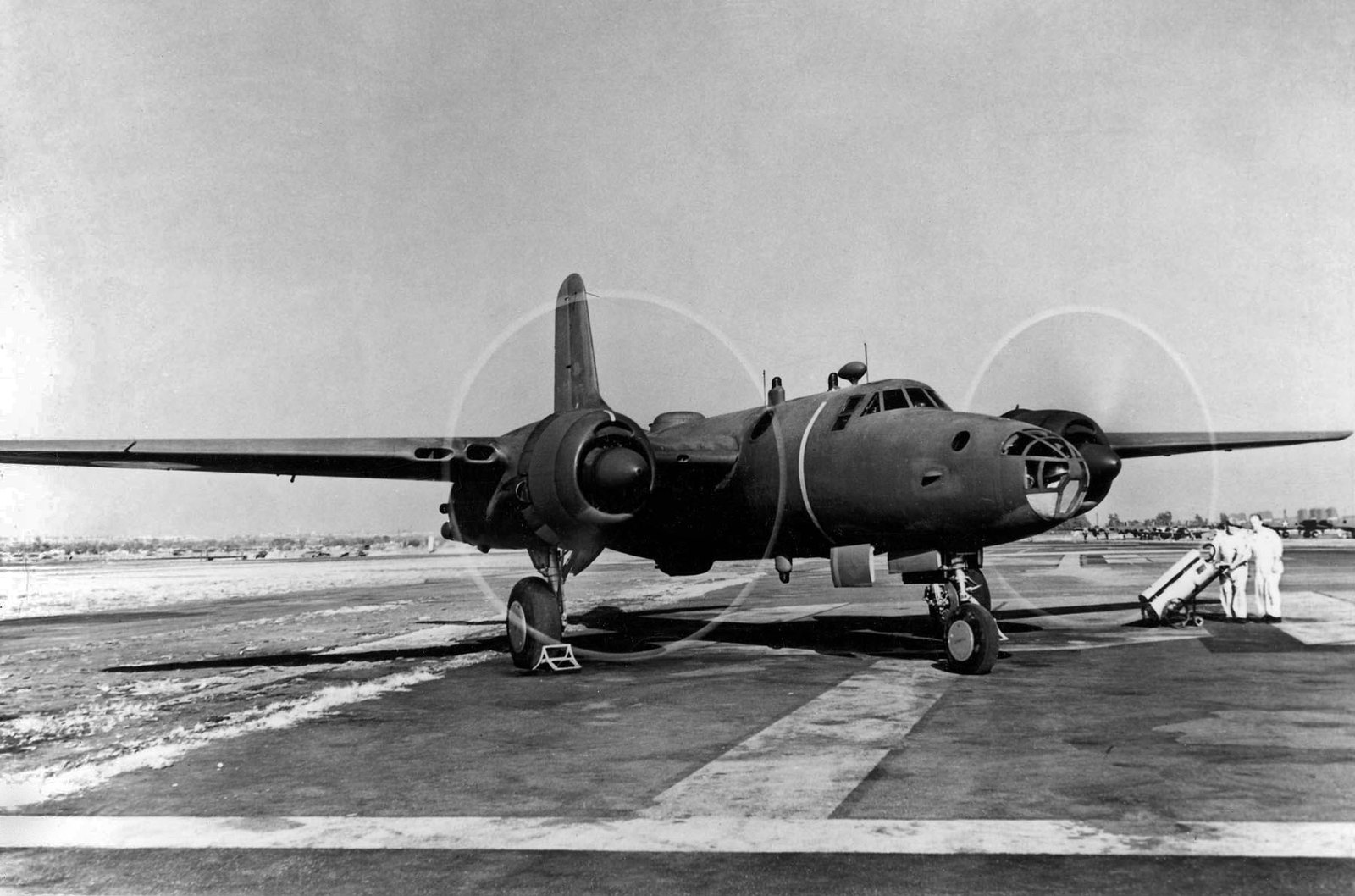
The North American XB-28 "Dragon" was developed as a response to a U.S. Army Air Corps requirement issued on February 13, 1940, for a high-altitude medium bomber. Designed by North American Aviation (NAA) at their Inglewood facilities in California, the aircraft was conceptually envisioned as a pressurized evolution of the B-25 Mitchell. However, the final design evolved into a completely new aircraft with a circular fuselage section, sharing very little structural commonality with its predecessor. The first prototype, the XB-28, made its maiden flight from Mines Field on April 26, 1942.
Technically, the XB-28 was ahead of its time, featuring a fully pressurized cabin that allowed the crew of five to operate at altitudes near 35,000 feet. For defense, it utilized three remote-controlled turrets—located in the dorsal, ventral, and tail positions—each armed with twin .50 in (12.7 mm) M2 Browning machine guns. These were operated by gunners within the pressurized cabin using periscope sights. The aircraft was powered by two Pratt & Whitney R-2800-27 "Double Wasp" 18-cylinder radial engines, each producing 2,000 hp and utilizing turbosupercharging for high-altitude performance. This configuration enabled a maximum speed of 372 mph at 25,000 feet and a service ceiling of 34,800 feet.
Only two prototypes were ever constructed. The first was the bomber variant, and the second, designated the XB-28A, was a reconnaissance version that first flew on April 24, 1943, with a crew including Joe Barton and Ed Virgin. Despite its superior speed and altitude performance compared to the B-25, the USAAF rejected the XB-28 for production. Wartime experience indicated that medium bombers were most effective at lower altitudes, and the Douglas A-26 Invader provided a simpler, non-pressurized alternative with a smaller crew.
Neither prototype survived. The XB-28A crashed into the Pacific Ocean off Southern California on August 4, 1943. The original XB-28 was retained at Wright Field as a ground test article for pressurization studies before being scrapped after the war. While it never saw combat, the XB-28 remains a significant example of early pressurized military aviation.