
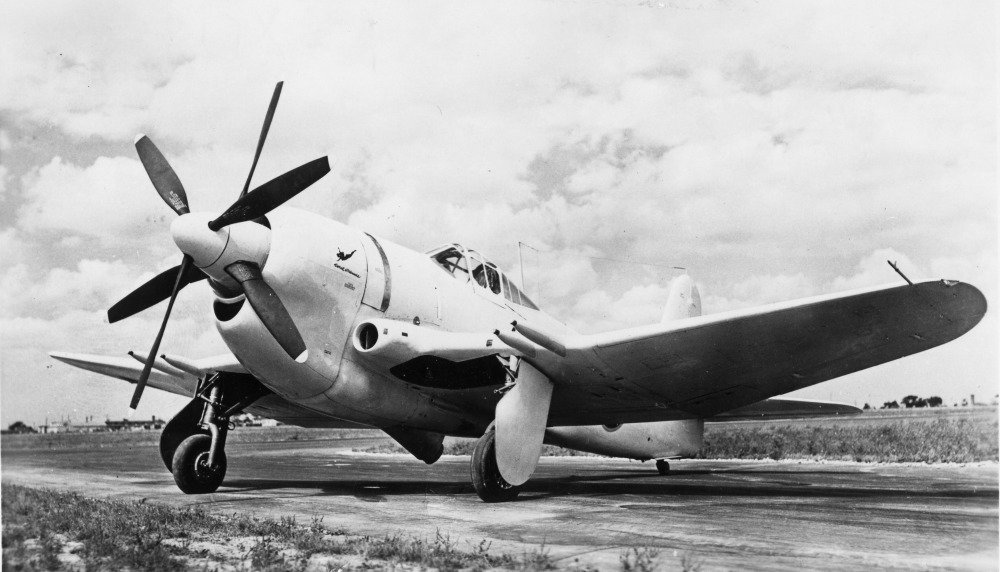
The Curtiss-Wright Curtiss XF14C was developed as a response to a 1941 U.S. Navy requirement for a high-performance carrier-based fighter capable of surpassing existing naval aircraft. The project was intended to push the boundaries of single-engine piston power, though it ultimately remained a prototype program that never reached production or operational service.
The aircraft's development underwent significant changes in configuration. The initial concept, designated the XF14C-1, was designed around the Lycoming XH-2470, a liquid-cooled 24-cylinder "Hyper" engine. However, due to the Navy's shifting preferences and difficulties in developing the Lycoming engine, the first airframe was re-engined and redesignated as the XF14C-2. This version utilized a Wright XR-3350-16, an 18-cylinder, two-row air-cooled radial engine. To manage the immense power of the XR-3350-16 and mitigate torque effects, the XF14C-2 was equipped with an advanced six-bladed contra-rotating constant-speed propeller.
The XF14C-2 prototype first flew in July 1944 and was officially delivered to the U.S. Navy for evaluation on September 2, 1944. Designed as a high-altitude interceptor, it featured a planned armament of four wing-mounted 20 mm cannons, a heavier battery than the .50-caliber machine guns common in many contemporary Navy fighters. Technical specifications for the XF14C-2 included a wingspan of 46 feet, a length of 37 feet 9 inches, and a gross weight of 14,950 lb. It achieved a maximum speed of 418 mph at 32,000 feet and a service ceiling of 39,800 feet.
Despite these specifications, the program was a failure. Flight testing revealed that the aircraft did not meet the Navy's performance requirements, and it was found to be heavy and disappointing compared to established fighters like the Vought F4U Corsair and Grumman F6F Hellcat. A further high-altitude variant, the XF14C-3, was planned but cancelled before completion. The program was terminated due to engine availability delays and a declining strategic need for specialized high-altitude interceptors late in the war. The XF14C represents one of the final attempts by Curtiss-Wright to compete in the top-tier naval fighter market before the company transitioned away from airframe manufacturing after World War II.