
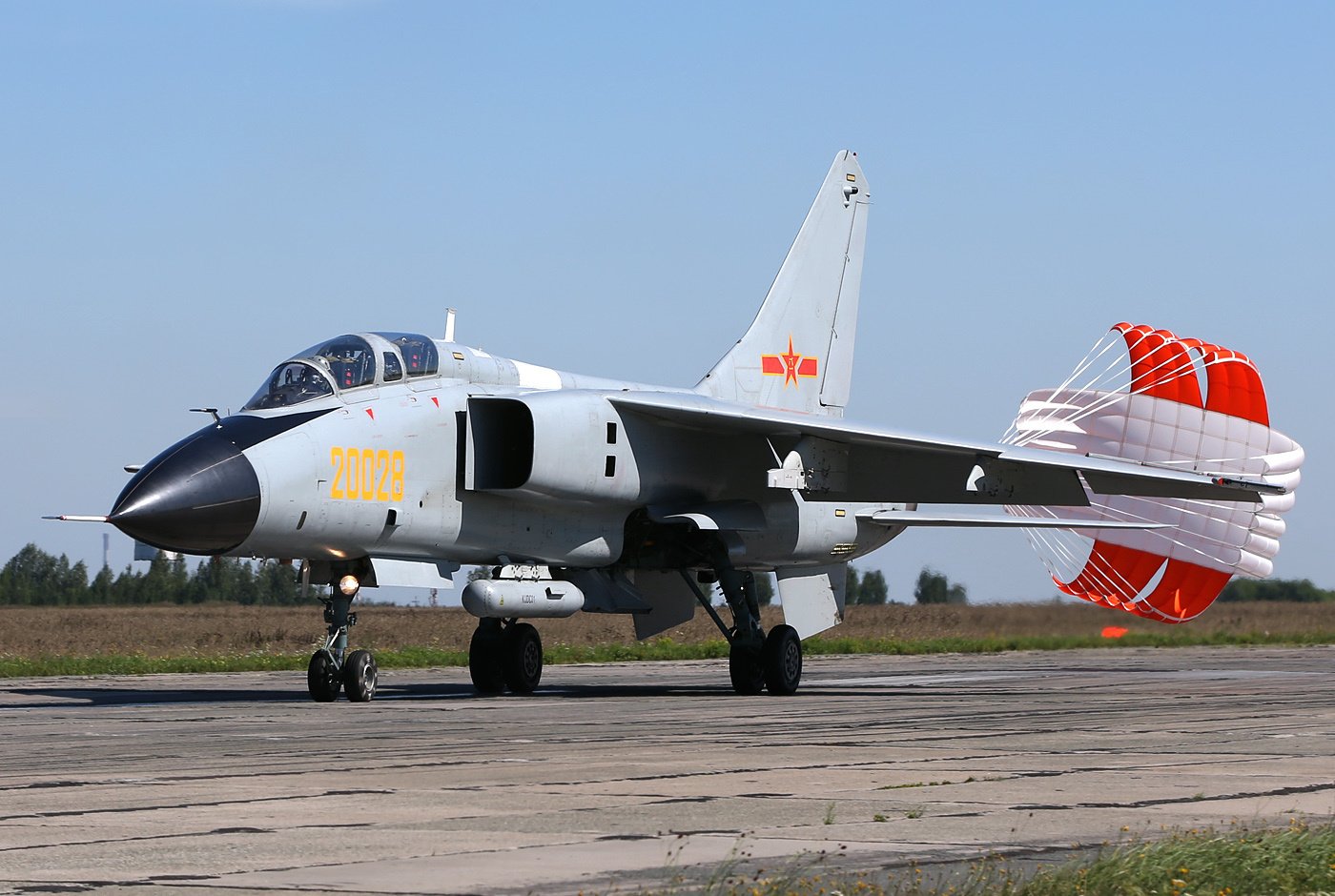
The Xi’an JH-7, known as the "Flying Leopard," was developed to fulfill a 1973 People’s Liberation Army Air Force (PLAAF) requirement for a modern strike aircraft to replace the aging Harbin H-5 and Nanchang Q-5. The program received formal approval from Deng Xiaoping on April 19, 1983, and the original prototype performed its maiden flight in December 1988. The aircraft was designed jointly by the Xi’an Aircraft Industry Corporation (XAC) and the 603 Institute (now the AVIC First Aircraft Institute). Notably, the JH-7 was the first Chinese aircraft design to utilize computer software during its development process.
Production of the original JH-7 began in 1984 at XAC's facility in the Yanliang District of Xi’an, Shaanxi. The aircraft entered operational service with the People’s Liberation Army Naval Air Force (PLANAF) in the early 1990s, with some sources citing deliveries as early as 1990 and full service entry by 1994. To enhance capabilities, the JH-7A variant was developed, with two prototypes completed in May 2002. The first JH-7A prototype flew on July 1, 2002, and the variant entered service with both the PLANAF and PLAAF in late 2004. While official production totals are not published, estimates range from 96 to over 200 airframes.
Technically, the JH-7 transitioned from Western to indigenous powerplants. The original model used two British Rolls-Royce Spey Mk.202 low-bypass afterburning turbofans, each producing 91.26 kN of thrust with afterburner. The JH-7A utilizes the Xian WS-9 "Qinling," a Chinese-built derivative of the Spey. The JH-7A features a maximum take-off weight of 28,475 kg and can carry approximately 9,000 kg of external stores across nine hardpoints. Its armament includes a 23 mm twin-barrel GSh-23L autocannon and a variety of missiles, such as the YJ-8 series for anti-ship strikes and PL-12 for air-to-air combat. The JH-7A is equipped with the JL-10A fire-control radar and can reach a top speed of Mach 1.52.
In service, the JH-7 has become a cornerstone of China's maritime strike capability. The PLANAF utilizes the aircraft for sea-lane denial and anti-shipping missions, while the PLAAF employs it for deep interdiction and tactical strikes. Although it has not been used in high-intensity combat, it is frequently deployed in military exercises involving the South China Sea and the Taiwan Strait. The JH-7 remains active in front-line service, with estimates suggesting roughly 110–120 JH-7A aircraft are operational in both the PLANAF and PLAAF as of the mid-2020s.