
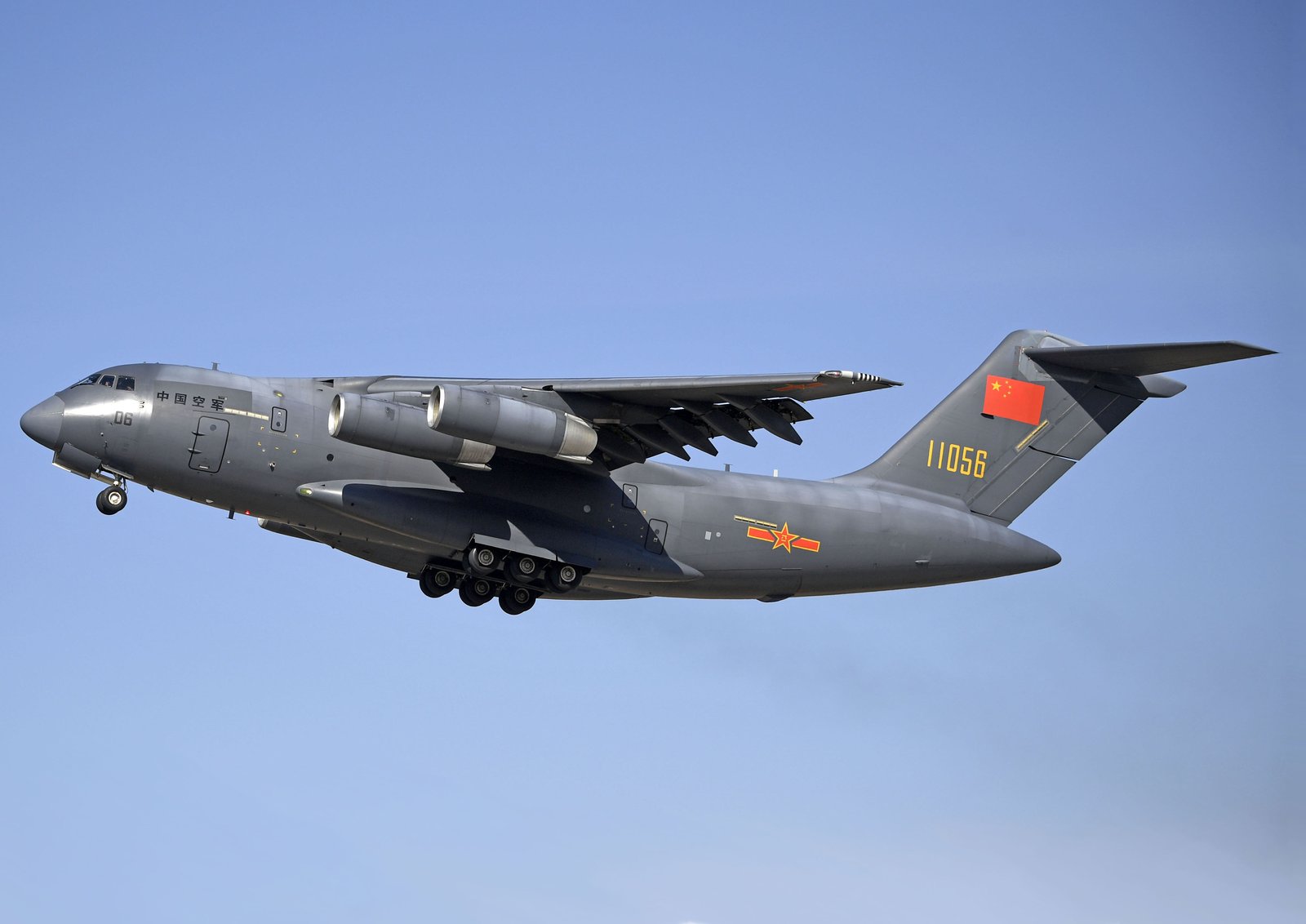
The Xi’an Y-20, also known as the "Kunpeng," represents a pivotal shift in Chinese aerospace capability as the nation's first indigenously designed and produced strategic airlifter. Developed by the Xi’an Aircraft Industrial Corporation (XAC)—a subsidiary of the state-owned Aviation Industry Corporation of China (AVIC)—the aircraft was created to eliminate China's reliance on imported Russian Il-76 transports. The Y-20 is the largest military aircraft ever built domestically in China, featuring a high-wing, T-tail configuration with a rear loading ramp, a design broadly analogous to the Boeing C-17A Globemaster III.
The aircraft's development progressed through the early 2010s, culminating in the first prototype's maiden flight in January 2013 at the Shaanxi Yanliang Aviation Base. Serial production followed, and the first production Y-20 officially entered service with the People’s Liberation Army Air Force (PLAAF) on July 6, 2016. While the exact number of airframes produced remains undisclosed, the PLAAF has indicated a requirement for approximately 400 aircraft.
Technical specifications highlight the Y-20's heavy-lift capacity, with a maximum takeoff weight of 220 tons and a maximum payload capacity of 66 tons. This allows the aircraft to transport significant military hardware, such as one ZTZ-99 main battle tank, two ZTQ-15 light tanks, or two ZTL-11 wheeled armored assault vehicles. In terms of performance, the aircraft reaches a top speed of 800 km/h and a cruise speed of 630 km/h, with a service ceiling of approximately 13,000 meters. Range estimates vary by payload: a ferry range of 8,000–10,000 km is cited, while a 66-ton payload reduces the estimated range to 3,700 km.
Powerplant evolution is a key aspect of the Y-20's history. Prototype aircraft were equipped with four Russian-designed Soloviev (Aviadvigatel) D-30KP-2 low-bypass turbofan engines, each producing 117.68 kN of thrust. Production aircraft are transitioning to the WS-20, a Chinese high-bypass turbofan. This evolution is seen in the Y-20B variant. Additionally, the airframe has been adapted for specialized roles, most notably the YY-20 aerial refueling tanker, which first flew in 2018 and entered service in 2022. The platform is also intended for future configurations as anti-submarine warfare (ASW) and airborne early warning and control (AEW&C) aircraft.