
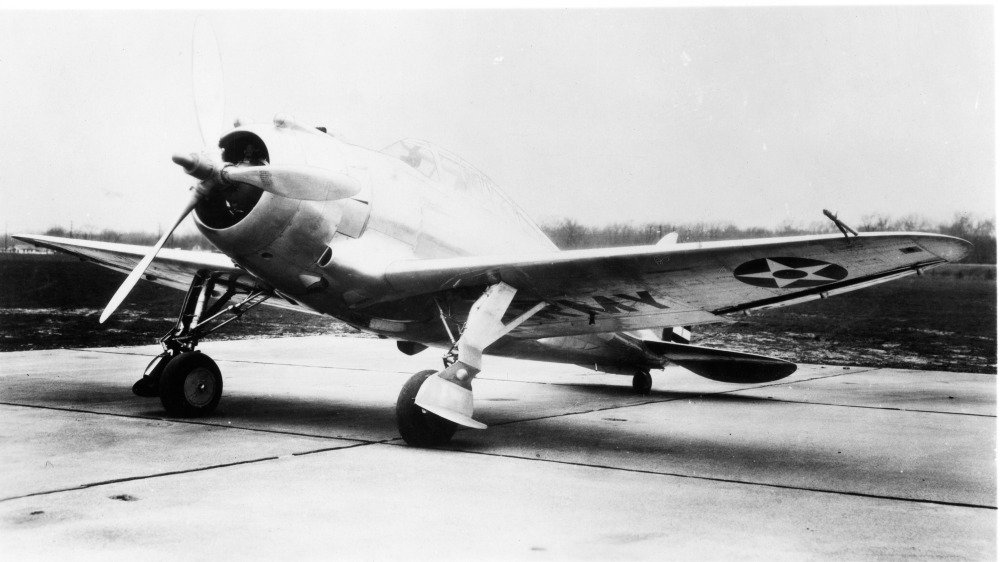
Production and Manufacturer History
The XP-41 was developed by the Seversky Aircraft Company, founded by Alexander P. de Seversky in the early 1930s. Based in Farmingdale, Long Island, New York, the company produced the P-35 and various derivatives for the United States Army Air Corps. The XP-41 was not a mass-produced aircraft; instead, it was a single prototype completed in 1938. This aircraft was created by converting the final P-35 production airframe, identified by serial number 36-430, into an improved fighter configuration. The XP-41 holds particular corporate significance as the final fighter design to bear the Seversky name before the company was reorganized in late 1939 to become the Republic Aviation Corporation. Republic Aviation later became renowned for producing the P-47 Thunderbolt, F-84 Thunderjet, and F-105 Thunderchief, though the company is now defunct as a standalone manufacturer.
Design and Technical Specifications
Designated as the Model AP-2, the XP-41 was engineered by Seversky's staff to test performance enhancements over the baseline P-35. The aircraft featured several critical aerodynamic refinements, most notably a streamlined "greenhouse" canopy to improve pilot visibility and fully enclosed main landing gear to reduce drag. To increase power, the XP-41 was equipped with a Pratt & Whitney R-1830 Twin Wasp radial piston engine. This 14-cylinder, air-cooled engine utilized a two-speed supercharger and produced approximately 1,200 horsepower, a substantial increase over previous iterations.
Performance and Service History
The XP-41 first flew in 1939, with some reports specifying the testing occurred in March of that year. In flight tests, the prototype reached a maximum speed of approximately 325 mph at an altitude of 15,000 feet. Despite these performance gains, the aircraft remained a prototype and never entered series production or operational service. It was evaluated exclusively by the United States Army Air Corps and did not participate in any combat missions or conflicts.
Legacy
While the XP-41 never saw squadron service, it is historically significant as a developmental stepping stone. The technical experiments conducted with the Model AP-2—specifically the integration of more powerful supercharged engines and streamlined airframes—directly informed the design of the P-43 Lancer and the legendary P-47 Thunderbolt. No examples of the XP-41 are known to survive today in museums or flying condition.