
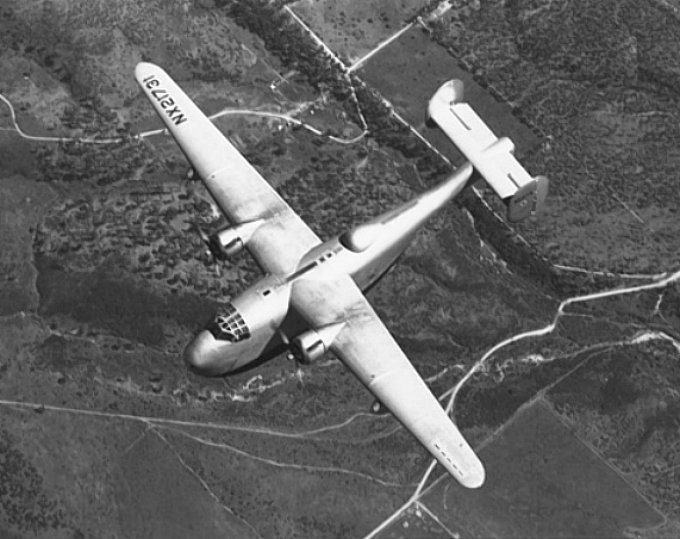
The Consolidated XP4Y-1, known as the "Corregidor," was a specialized long-range maritime patrol flying boat developed by the Consolidated Aircraft Corporation. Originally designated as Company Model 31, the aircraft was conceived as a versatile platform capable of serving both military patrol roles and commercial transoceanic transport. The project was heavily supported by Consolidated's leadership, with Reuben H. Fleet investing approximately $1 million of company funds into the design. The prototype first took to the skies on May 5, 1939.
Technically, the Model 31 was a pioneer for its era, featuring an all-metal construction and the high-aspect-ratio, low-drag Davis wing, a design element that would later prove critical to the success of the Consolidated B-24 Liberator. To reduce aerodynamic drag during flight, the aircraft utilized retractable wingtip floats. Unlike many large flying boats of the period that relied on four smaller engines, the XP4Y-1 employed two exceptionally powerful Wright R-3350 Duplex Cyclone 18-cylinder radial piston engines, each producing 2,300 hp. This configuration allowed for a maximum speed of 398 km/h and an impressive range of 5,279 km.
Following the United States' entry into World War II on December 7, 1941, the U.S. Navy acquired the prototype and redesignated it as the XP4Y-1. To adapt the aircraft for a patrol and torpedo-bomber role, the Navy implemented several modifications, including the addition of a dorsal turret and redesigned nose and tail structures. The military version was armed with one 37 mm cannon and two 12.7 mm machine guns, with the capacity to carry up to 4,000 lb of bombs under the wings. While a production order for 200 P4Y-1 aircraft was placed in October 1942—with plans to build them at a new facility in New Orleans, Louisiana—the program was cancelled in 1943. This cancellation was primarily driven by a critical shortage of Wright R-3350 engines, which were prioritized for the Boeing B-29 Superfortress program.
Ultimately, only one aircraft was ever completed. While the civil version was designed to accommodate 52 passengers or 28 sleeping berths, it never entered commercial service. No operational combat record exists for the XP4Y-1, as it remained a test and evaluation airframe. Today, no complete aircraft are known to survive; however, the San Diego Air & Space Museum preserves photographic records and a company model of the aircraft.