
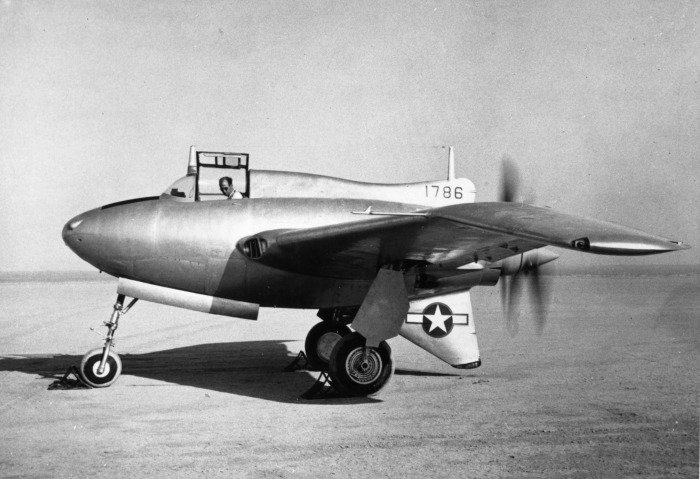
The Northrop XP-56 "Black Bullet" was an experimental fighter-interceptor developed for the United States Army Air Forces (USAAF) during World War II. The project originated from the Northrop N2B concept study, created in response to the USAAC R-40C radical fighter specification issued between 1939 and 1940. This specification sought designs that could provide superior speed, climb rates, and firepower compared to conventional aircraft of the time. Construction of the first prototype, serial number 41-786, was authorized on June 22, 1940.
Designed under the guidance of John K. Northrop, the aircraft featured a highly unconventional configuration. It was essentially a hybrid flying wing with a short central fuselage that housed the pilot and the engine. To eliminate torque effects and reduce drag, the aircraft utilized a pusher installation with dual contra-rotating propellers. Furthermore, the airframe and skin were constructed primarily from magnesium alloy, a choice made to conserve strategic aluminum and to test new welding techniques. The design was intended to reach speeds of approximately 465 mph at 25,000 feet, though these targets proved elusive during testing.
Two prototypes were built by the Northrop Corporation in California. The first aircraft (Ship No. 1) made its maiden flight on September 6, 1943, at Army Air Base Muroc, piloted by Northrop Chief Test Pilot John W. Myers. However, this airframe was destroyed during a takeoff accident on October 8, 1943. The second prototype (Ship No. 2, serial 42-38353) flew for the first time in March 1944 with test pilot Harry Crosby. Between March and August 1944, Ship No. 2 completed ten flights, reaching a maximum speed of roughly 250 mph.
Power was provided by a Pratt & Whitney R-2800-29, a 14-cylinder, two-row air-cooled radial piston engine producing 2,000 hp. While the design planned for a heavy armament of two 20 mm cannons and four 0.50 inch machine guns in the nose, these were never installed in the prototypes. Due to dangerous handling characteristics and the rapid advancement of jet propulsion, the project was abandoned by 1945 and formally cancelled in 1946. Ship No. 2 survived and is currently held in storage by the Smithsonian Institution’s National Air and Space Museum in Suitland, Maryland.