
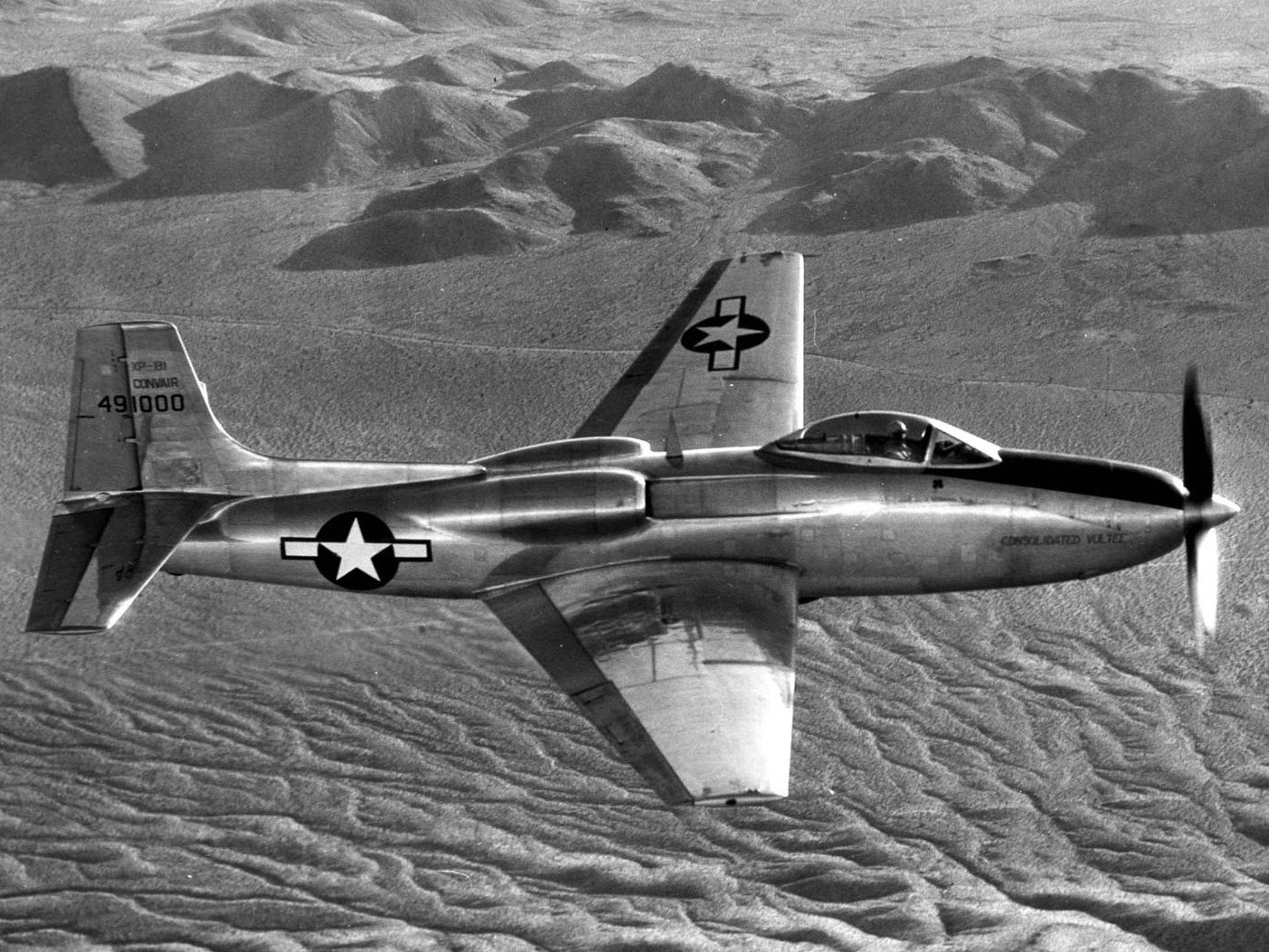
Production and Manufacturer History
The XP-81 was developed by the Consolidated Vultee Aircraft Corporation, commonly known as Convair, following a 1943 United States Army Air Forces (USAAF) requirement for a long-range escort fighter. Convair was formed in 1943 through the merger of Consolidated Aircraft Corporation and Vultee Aircraft. While the company later became a division of General Dynamics, the Convair brand is now defunct. Only two prototypes, serial numbers 44-91000 and 44-91001, were completed in 1945. Although 13 pre-series YP-81 service-test aircraft were ordered, this contract was cancelled on January 27, 1947, before any were finished.
Design and Technical Specifications
Designed as a single-seat fighter with a pressurized cockpit, the XP-81 featured a unique mixed-propulsion system. It was equipped with a General Electric/Allison XT31 (TG-100) turboprop in the nose, producing approximately 2,300 hp for efficient cruising, and a General Electric J33 turbojet in the rear fuselage providing 3,750 lbf of thrust for combat and climbing. Due to delays with the XT31, the first prototype initially flew using a Packard V-1650-7 Merlin liquid-cooled V-12 piston engine in the nose.
The aircraft's dimensions included a wingspan of 50.5 ft and a length of approximately 45 ft. It had an empty weight of 14,135 lb and a maximum takeoff weight of 22,000 lb. Planned armament included a choice between six 20 mm Hispano T-31 cannons or six .50-cal M2 Browning machine guns, with external hardpoints capable of carrying up to 3,200 lb of bombs or 14 HVAR rockets.
Flight Testing and Service
First flights occurred at Muroc Dry Lake, California, in early February 1945 (sources cite either February 7 or 11), piloted by Frank Davis. The USAAF sought a top speed exceeding 500 mph and a combat radius of 1,250 miles to support B-29 operations. However, the program was plagued by developmental issues, including vibration and unreliability of the XT31 turboprop. Consequently, the aircraft only accumulated about 10 hours of total flight time before the program was cancelled on May 9, 1947.
Legacy
The XP-81 never entered operational service, as the establishment of B-29 bases on Guam and Saipan reduced the need for ultra-long-range escorts. After their testing phase, both prototypes were used as bombing and photography targets at Edwards AFB. Both aircraft were eventually rescued and are currently held in storage at the National Museum of the United States Air Force in Dayton, Ohio.