
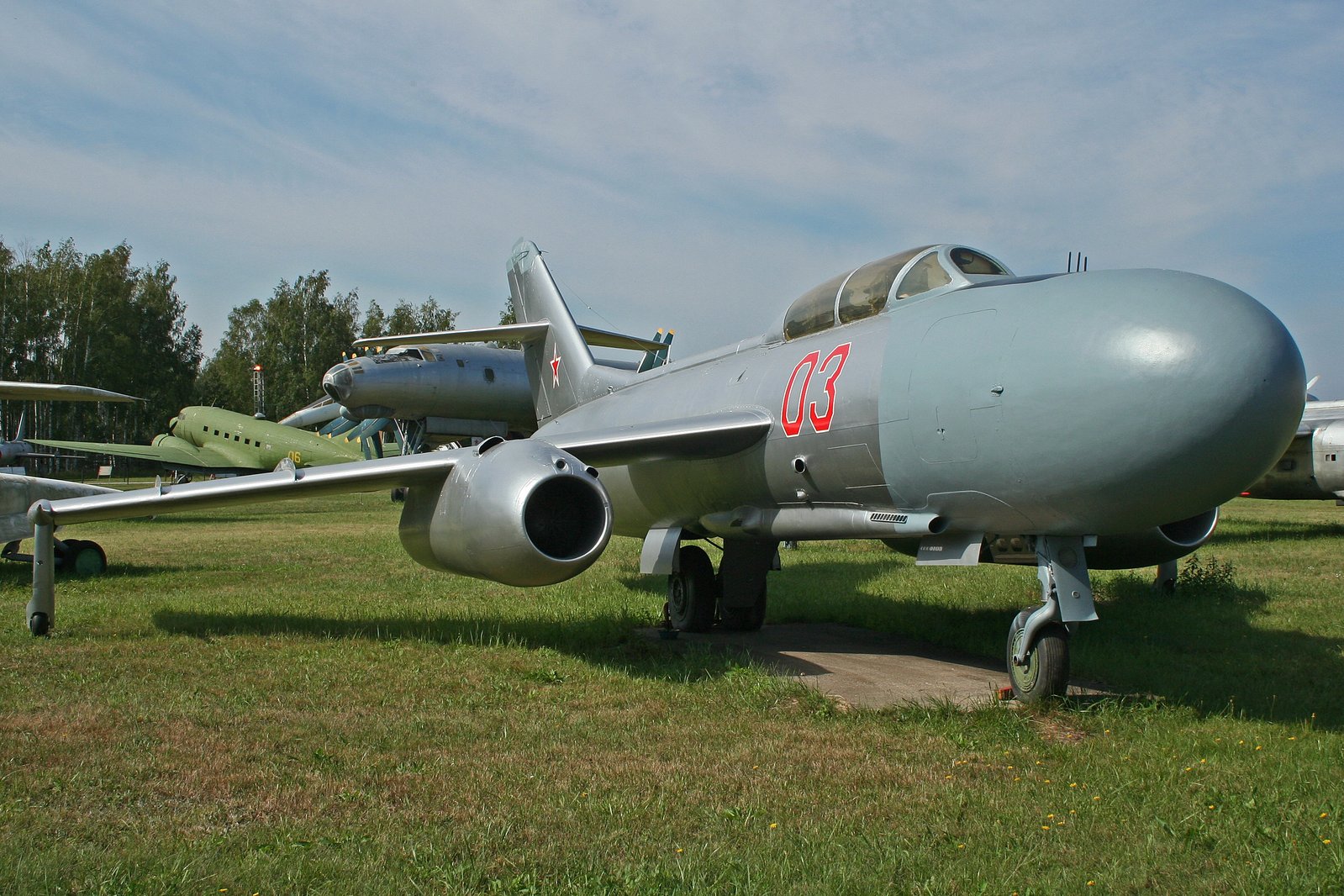
The Yakovlev Yak-25 was developed in response to a directive issued by Joseph Stalin on August 6, 1951, which called for a long-range, all-weather interceptor capable of defending the USSR's expansive borders. The resulting design, initially designated as the Yak-120, made its first flight on June 19, 1952, piloted by Valentin Volkov. The aircraft was designed by the Yakovlev Experimental Design Bureau (OKB-115) under the leadership of Alexander S. Yakovlev.
Production of the Yak-25 took place between 1954 and 1957. The Saratov Aviation Plant (Factory No. 292) served as the primary manufacturing site, having previously produced Yak-1 and Yak-3 fighters during World War II. The Saratov plant, which began as an agricultural machinery facility in 1929, worked alongside the Yakovlev bureau to produce ten pre-production aircraft. While the interceptor variants were largely built in Saratov, the high-altitude reconnaissance variant, the Yak-25RV, was serially produced at the Ulan-Ude Aviation Plant. Total production figures vary; Yakovlev corporate history cites 483 interceptors, while other sources suggest a total family count of approximately 638 when including 155 Yak-25RV units.
Technically, the Yak-25 was powered by two Mikulin AM-5 axial-flow turbojet engines, each providing approximately 4,410 lbf of thrust. The aircraft featured a crew of two—a pilot and a radar intercept officer—and was equipped with the RP-6 "Sokol" radar, which could detect bombers at 25 km. For armament, the interceptor utilized two 37 mm Nudelman NL-37 cannons with 50 rounds each. The Yak-25M variant could reach maximum speeds of approximately 677 mph and had a service ceiling of nearly 40,000 ft, with an endurance of 4 hours and 15 minutes when using auxiliary tanks.
Operated exclusively by the Soviet Air Defence Forces (PVO Strany), the Yak-25 served as a critical transitional aircraft in Soviet air defense. The interceptor variants were phased out between 1963 and 1967, while the Yak-25RV reconnaissance aircraft remained in limited service until 1974. Today, no examples are airworthy, though a preserved aircraft is on display at the Central Air Force Museum at Monino.