
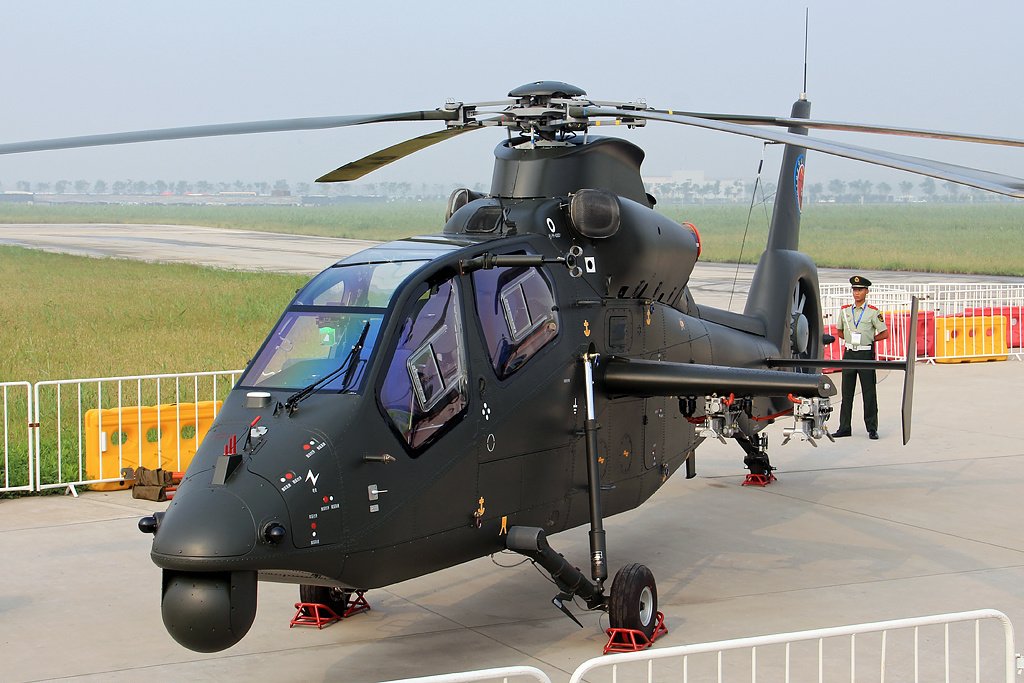
The Harbin Z-19, known as the "Black Whirlwind," is a modern light reconnaissance and attack helicopter developed by the Harbin Aircraft Manufacturing Corporation (HAMC) in Harbin, China. The aircraft is a specialized combat derivative of the Harbin Z-9, which was itself a license-built version of the Eurocopter/Aérospatiale Dauphin (SA365). By utilizing an existing airframe, China was able to accelerate the deployment of a dedicated attack platform for the People's Liberation Army Ground Force (PLAGF) and other aviation branches of the PLA.
Development of the Z-19 took place between 2005 and 2010. While some sources report a prototype flight in May 2010, others cite 2011 as the year of the maiden flight. The aircraft officially entered service in 2012. Production is ongoing, with estimates suggesting that between 150 and 200 units were produced by 2019. HAMC operates as a subsidiary of the Aviation Industry Corporation of China (AVIC), following a corporate consolidation in 2008.
Technically, the Z-19 is distinguished by its tandem two-seat cockpit and a fenestron (shrouded) tail rotor, which reduces the aircraft's acoustic signature. To lower its radar and infrared visibility, the helicopter incorporates infrared-suppressed exhausts and stealth-inspired shaping, leading to conceptual comparisons with the American RAH-66 Comanche. Unlike many attack helicopters, the Z-19 lacks a fixed chin cannon, instead utilizing four wing-pylon hardpoints to carry 23 mm cannon pods, 57 mm or 90 mm unguided rockets, and missiles such as the HJ-8, Blue Arrow-9, and TY-90 air-to-air missiles. Its sensor suite includes a nose-mounted electro-optical/FLIR turret and a millimeter-wave electronically scanned array (ESA) radar on certain variants.
Power is provided by two WZ-8C turboshaft engines, each producing approximately 700 kW (940 hp). This configuration allows for a maximum speed of 280 km/h and a cruise speed of 245 km/h. The aircraft has a range of 700 km and an endurance of up to four hours, with a service ceiling of 6,000 meters. While the Z-19E variant has been cleared for export, the primary operator remains the People's Republic of China. There are no documented records of the Z-19 participating in specific named wars or foreign combat operations, as it is primarily used for domestic security, training, and exercises.