
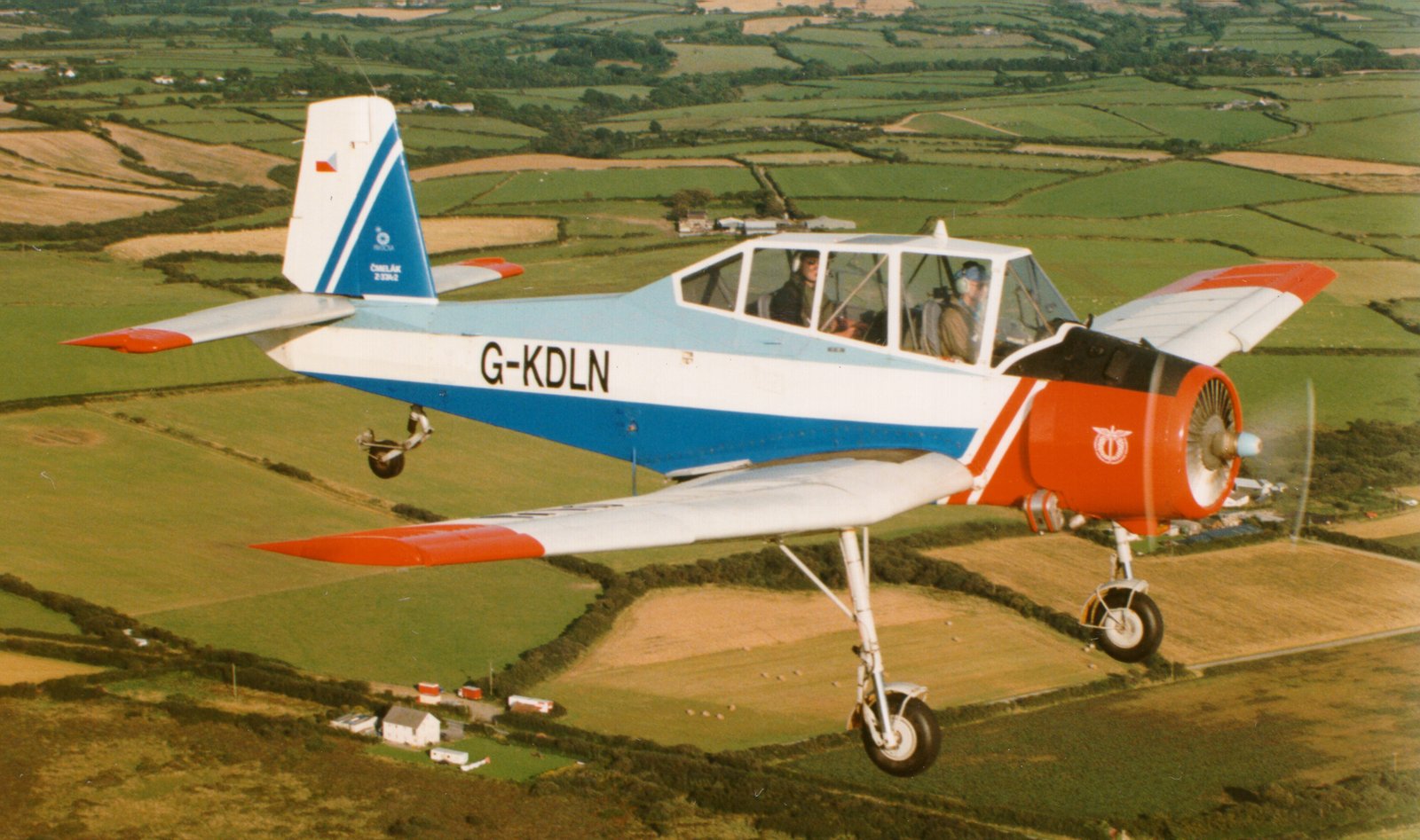
Agricultural Aviation Pioneer
The Z-37 emerged from a 1961 competition to create a dedicated agricultural aircraft for Czechoslovakia's farming regions. Unlike converted military trainers commonly used for crop dusting, the Čmelák was engineered from the outset for low-level agricultural operations. The design incorporated direct input from farmers and aerial applicators, resulting in an aircraft optimized for the harsh realities of pesticide spraying.
Development and Testing
Joint engineering teams from LET Kunovice and Moravan Otrokovice began development in 1961, with the prototype XZ-37 taking flight on March 29, 1963. Early testing revealed that the initial 260-horsepower Soviet Ivchenko AI-14 engine was underpowered for the aircraft's intended role. Engineers responded by adopting the uprated Avia M-462RF, a Czechoslovak-built version producing 315 horsepower, which became standard for production aircraft.
The design featured several innovations for agricultural work. The chemical hopper, positioned behind the cockpit, could be reconfigured as a fuel tank for ferry flights, enabling non-stop delivery to distant customers in Sudan and India. The fixed tailwheel undercarriage provided rugged simplicity essential for operations from unprepared agricultural strips.
Production Success
Production began in 1965 with the initial Z-37 variant continuing until 1971. The strengthened Z-37A followed from 1971 to 1975, incorporating structural improvements based on operational experience. Total production exceeded 700 aircraft across all variants, with the Z-37A alone accounting for 650 units. Manufacturing occurred at two Czechoslovak facilities under the state-controlled aviation industry.
Political factors influenced production schedules. Comecon decisions halted Z-37 production in 1977 to favor Poland's competing PZL M-18 Dromader. However, Slov-Air, Czechoslovakia's primary agricultural operator, rejected the Polish aircraft and successfully lobbied for Z-37A production to resume from 1983 to 1984, yielding approximately 60 additional units.
Turboprop Evolution
The turboprop Z-37T prototype first flew on September 6, 1981, powered by the Czech Walter M-601Z engine producing 691 shaft horsepower. Production prototypes followed on July 12 and December 29, 1983. The turboprop variant, later redesignated Z-137T, featured winglets for improved efficiency and remained in production from 1985 to 1994. This powerplant change significantly enhanced performance while maintaining the type's reputation for reliability in harsh agricultural environments.
The Manufacturers
LET Kunovice specialized in agricultural and utility aircraft within Czechoslovakia's nationalized aviation sector, while Moravan Otrokovice operated under the Zlin brand, known for training aircraft. Following the 1993 Czech-Slovak split, LET Kunovice evolved into Evektor-Aerotechnik, which continues producing light aircraft today. Moravan Otrokovice became part of Zlin Aircraft a.s., maintaining focus on trainer aircraft production.
International Operations
The Čmelák found markets well beyond the Eastern Bloc, with exports reaching Sudan, India, Finland, Iraq, Austria, England, and the United States. The aircraft's ability to use its hopper as a ferry tank proved crucial for long-distance deliveries. Slov-Air remained the type's most significant operator, utilizing large fleets for agricultural spraying across Czechoslovakia.
Variant production included the Z-37A-2 and Z-37T-2 two-seaters for training purposes, with 27 dual-control aircraft built. The Z-37A-3 variant accommodated a pilot plus three passengers in rear-facing seats. Some aircraft were configured for glider towing operations, capable of handling up to four gliders simultaneously.
Limited Military Service
While primarily civilian, the Z-37 saw limited military applications. Eastern Bloc air forces operated the type mainly for agricultural support rather than combat roles. A notable exception emerged in 2025 when a Ukrainian Army Aviation Z-137AT was observed armed with two R-73 air-to-air missiles for intercepting Russian drones, demonstrating the type's adaptability to unconventional roles.
Current Status and Legacy
As of 2025, operational numbers remain limited, with active aircraft primarily in Slovakia for crop dusting and glider towing operations. Rising fuel costs have reduced commercial viability for many operators. Several aircraft are preserved in museums, including a Z-37A at Čáslav Air Base in the Czech Republic and the Z-37TM military prototype at Kunovice.
The Čmelák's nickname, meaning "Bumblebee" in Czech, reflects both its appearance and low-altitude buzzing operations over agricultural fields. The aircraft represents Eastern Bloc aviation self-reliance, successfully competing with Western designs while establishing Czechoslovakia's presence in the specialized agricultural aviation market. Despite eventual displacement by more efficient designs like the Polish Dromader, the Z-37 demonstrated that purpose-built agricultural aircraft could achieve significant commercial success through thoughtful engineering and robust construction.