
Children of the Magenta Line: What 150,000 Safety Records Reveal About the Next Generation of Pilots
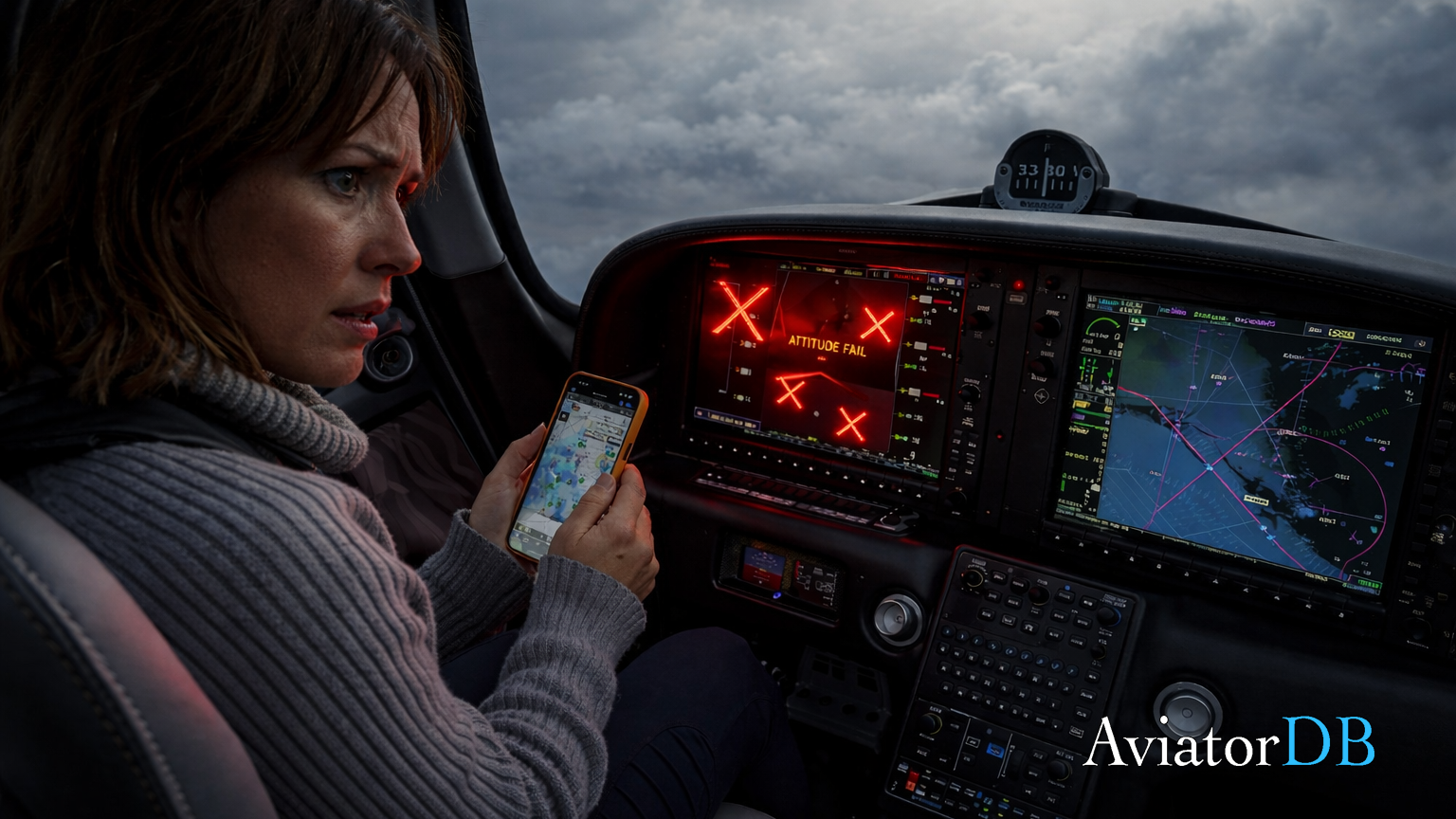
By Jim Kerr, AviatorDB
AviatorDB analyzed 150,000 NTSB accident records, NASA safety reports, and FAA registration data to investigate a question the aviation industry has debated for two decades: Is technology making pilots safer — or making them unable to fly without it?
On the morning of December 7, 2023, a Beech 35-C33 Debonair (N5891J) departed Knoxville Downtown Island Airport in Tennessee, bound for Benton, Arkansas. The pilot was Jenny Blalock — a private pilot with a single-engine land rating and no instrument certification, an aviation content creator known to her 54,000 followers as TNFlyGirl. She was working toward her instrument rating but had not completed it — two weeks before the flight, a phase check instructor noted deficiencies in "almost all aspects of aircraft control, situational awareness, and risk management."
Weather was not a factor. Conditions were clear.
About 140 nautical miles into the flight, cruising at 6,400 feet, an air traffic controller advised Blalock that she was left of course. She acknowledged and said she was correcting. Then the airplane entered a series of altitude oscillations — climbing and descending between 6,400 and 5,300 feet with corresponding fluctuations in groundspeed. The oscillations continued for nearly 40 minutes. ATC twice instructed her to contact Memphis Center. Neither instruction was acknowledged.
In the final moments, the airplane descended to 4,300 feet, climbed back to 6,050 feet at just 85 knots, then entered a rapid descent. ADS-B data showed a maximum groundspeed of 228 knots and an estimated descent rate of 11,900 feet per minute. A faint transmission from the pilot declared an emergency. About 60 seconds later, a largely unintelligible transmission came from the passenger. N5891J struck hilly, wooded terrain near Pulaski, Tennessee. The engine was producing power at impact. Both occupants were killed.
The NTSB investigation (ERA24FA058) found no mechanical failure. The autopilot could not be examined due to impact damage, but the aircraft's flight behavior — the oscillations, the speed fluctuations, the loss of course tracking — was consistent with a pilot struggling to manage automation she did not fully understand, on a clear day, in an airplane that was mechanically sound.
Jenny Blalock's death was not an isolated case. It was an illustration of a pattern that appears over and over in federal safety data — and one that is accelerating as a new generation of pilots learns to fly in cockpits more advanced than anything their instructors trained in.
The Magenta Line
In 1997, American Airlines Captain Warren Vanderburgh gave a presentation to fellow pilots that would become one of the most widely referenced talks in aviation safety history. He called it "Children of the Magenta Line" — a reference to the magenta course line displayed on flight management systems that automates navigation from takeoff to landing.
Vanderburgh's thesis was simple: pilots had become so reliant on automation that when it failed or behaved unexpectedly, they didn't know what to do. They would stare at the magenta line on their screens, pushing buttons to make the computer fix the problem, instead of doing what every pilot is trained to do first — fly the airplane.
He was talking about airline pilots in 1997. Twenty-nine years later, the same pattern has migrated to general aviation — where pilots have fewer hours, less training, and are now flying behind glass cockpits that would have been unrecognizable a generation ago.
Two Paradoxes in the Data
AviatorDB's analysis of NTSB accident records and NASA's Aviation Safety Reporting System reveals two contradictions that define the modern relationship between pilots and technology.
Paradox One: Technology is saving lives and creating dependency simultaneously.
VFR-into-IMC accidents — pilots flying under visual rules into weather they couldn't see through — have declined dramatically over two decades. GPS moving maps, weather datalink, terrain awareness, and traffic advisory systems have given pilots an unprecedented picture of the world around their aircraft. The general aviation fatal accident rate hit a historic low of 0.65 per 100,000 flight hours in 2023 — less than half the rate of the 1990s.
But the accidents that technology prevents are being replaced by accidents that technology creates. NASA's Aviation Safety Reporting System (ASRS) — a confidential database where pilots voluntarily report safety incidents without fear of enforcement action — shows GPS-related incident reports have increased significantly over the past decade. Reports citing automation confusion and situational awareness problems have grown alongside the adoption of glass cockpits and electronic flight bags.
In 2010, a pilot who got lost probably didn't have a GPS. In 2025, a pilot who gets lost has a GPS, an iPad with ForeFlight, ADS-B weather, and a moving map — and still doesn't know where they are. That is not a navigation problem. That is a dependency problem.
Paradox Two: The safest airplane has the highest fatality rate.
The Cirrus SR22, equipped standard with the Cirrus Airframe Parachute System (CAPS), has one of the lowest overall accident rates in single-engine general aviation. It is arguably the safest single-engine piston airplane ever built — glass cockpit, whole-airframe parachute, and avionics that can fly a coupled approach to minimums.
Yet an NTSB Safety Study SS-10/01 found that glass-cockpit aircraft had a fatal accident rate approximately twice that of conventional-cockpit aircraft of similar size and performance. The explanation is not the aircraft. It is the pilot. Buyers tend to transition directly into high-performance glass cockpits with fewer total flight hours, the best equipment in aviation and the least experience with what happens when it stops working.
The CAPS deployment data sharpens the point. According to the Cirrus Owners and Pilots Association (COPA), there have been 145 saves with 291 survivors as of March 2026. Roughly 40% were for engine failures, the scenario the parachute was designed for. But 30% were for loss of control: pilots who became spatially disoriented, entered unusual attitudes, or lost situational awareness in weather. These were not mechanical emergencies. They were piloting failures. Every CAPS deployment destroys the aircraft. The passengers walk away, which is what matters. But a third of those destroyed aircraft went down because the pilot put themselves in a situation they could not get out of.
There is a darker number. COPA estimates that an additional 125 people have died in Cirrus accidents where the parachute was available but never pulled — pilots in survivable situations who were too distracted, too disoriented, or too fixated on troubleshooting to reach for it. They had the ultimate safety net and never used it.
Cirrus and COPA deserve credit — standardized training programs and proficiency initiatives have driven measurable safety gains in recent years, particularly in newer models. But the data still shows persistent risks when pilots transition quickly into advanced glass cockpits without building the raw flying skills that no parachute can replace.
When the iPad Goes Dark
The electronic flight bag (EFB) — ForeFlight, Garmin Pilot, FlyQ — has become the single most important tool in the modern GA cockpit. The EFB has consolidated paper charts, instrument approach procedures, weight-and-balance worksheets, and flight planning tools into one device. It is indispensable. And it has created a new category of accident that did not exist fifteen years ago.
In 2018, a Cessna 150 pilot flying over Puget Sound looked down at his iPad for navigation, pushed the yoke forward, and flew into the water (WPR18LA151). The NTSB's probable cause cited "distraction by using the tablet for navigation." But that was seven years ago, when tablet flying was still relatively new.
The problem has not gone away. It has gotten worse.
NASA ASRS filings from 2024 and 2025 describe a steady stream of EFB-related incidents that paint a picture of systemic dependency. A 2024 report from a Bonanza pilot: "iPad overheated and shut down during approach. I had no backup charts loaded on any other device. Had to request vectors from ATC to navigate to the airport I could see out the window." A Cirrus pilot in 2025: "ForeFlight froze during a complex arrival. I spent approximately 90 seconds trying to restart the app instead of flying the airplane. Lost 300 feet and deviated from the STAR." A Skyhawk pilot the same year: "GPS signal was intermittent for the entire flight due to military jamming exercises. I realized I could not identify my position without GPS. I have not used a VOR in three years."
GPS jamming and spoofing — once a theoretical concern — has become a routine operational hazard. Pilots in the eastern Mediterranean, the Baltic region, and increasingly in U.S. military operating areas report GPS dropouts lasting minutes to hours. For pilots who have never navigated without it, a GPS dropout is not an inconvenience. It is an emergency.
"Just Fly the Airplane"
The phrase appears in nearly every accident analysis involving automation confusion. It is the first thing taught in flight school and the first thing forgotten in a crisis. And the federal safety data shows it is being forgotten more often.
AviatorDB's analysis of 94,000 NTSB accident records found dozens of fatal crashes where the probable cause explicitly cites a pilot's inability to fly without automation. The pattern is consistent: a Citation pilot who could not maintain airspeed without the autopilot engaged, stalled, and died (ERA17FA135). A CitationJet pilot who became spatially disoriented because of "mode confusion related to the status of the autopilot" — six people killed (CEN17FA072). A Malibu pilot distracted by an autopilot malfunction who lost spatial orientation in dark IMC (ERA14FA058). A Cirrus pilot who fixated on an electrical anomaly instead of flying, and flew into the ground in instrument conditions (CEN12FA251). Another Cirrus pilot who lost control while programming his autopilot (CEN09FA267).
In every case, the airplane was mechanically sound. The technology was available. The pilot's attention was on the system instead of the sky.
The ASRS data tells the same story from the other side — the incidents where the pilot survived but recognized something had gone badly wrong. In 2015, automation-related reports accounted for roughly 8.6% of all ASRS filings. By 2024, that share had grown to 11.2%. Pilots are filing more reports about autopilot confusion, unexpected flight mode changes, and loss of situational awareness during automation transitions than at any point in the program's history.
The trend is not subtle. A 2024 ASRS filing from a Cirrus SR22 pilot: "I was heads-down programming the Garmin, looked up and was 400 feet below assigned altitude in IMC." A King Air pilot the same year: "Autopilot disconnected without annunciation during approach. I did not notice the disconnect for approximately 30 seconds. Aircraft had deviated 200 feet below glidepath." A 2025 report from a G1000-equipped Cessna: "GPS lost signal during approach. I reverted to raw data but had difficulty maintaining course — I have very little practice flying without GPS guidance."
These are not low-time students. These are instrument-rated pilots, many with thousands of hours, who have become so accustomed to automation that the absence of it creates a crisis.
The Data Is Clear. The Solution Is Not.
The numbers do not argue against technology. Fatal accident rates are at historic lows. GPS, ADS-B, and glass cockpits have saved thousands of lives. CAPS has saved 291 people who would otherwise be dead.
But the numbers also show that technology without proficiency is a different kind of risk. The pilot who cannot hold altitude and heading when the autopilot disconnects. The pilot who cannot navigate without an iPad. The Cirrus pilot who destroys a $900,000 airplane because he never learned to recover from the unusual attitude the autopilot was preventing — or worse, flies into terrain with a parachute he never pulled.
Warren Vanderburgh died in 2016 at 74 — a retired American Airlines captain and 14-time Top Gun fighter pilot. He never saw his thesis validated this completely, or this tragically. In 1997, he warned airline pilots that automation dependency would erode the fundamental skills that kept aircraft in the air. He was right — Air France Flight 447, Asiana Flight 214, and Ethiopian Airlines Flight 302 all involved automation confusion as a contributing cause, killing a combined 388 people. But Vanderburgh could not have predicted how far down the automation would filter. A student pilot in 2025 trains behind a Garmin G1000 that is more capable than what he flew in the cockpit of an American Airlines 757.
The magenta line is a tool. It is the best tool general aviation has ever had. But every accident in this article shares the same root cause: a pilot who could fly with the technology but not without it. Jenny Blalock fought her autopilot for 40 minutes on a clear day. Cirrus pilots pulled the parachute because they could no longer fly the airplane — and an estimated 125 more never pulled it at all. The technology didn't fail these pilots. Their training failed to prepare them for the moment it wasn't there.
SOURCES (all verified against AviatorDB NTSB database unless noted)
- ERA24FA058 — N5891J, Beech 35-C33, December 7, 2023, Pulaski TN. Private pilot + 1 passenger, 2 fatal. Altitude oscillations, rapid descent at 228 kts/11,900 fpm. No probable cause published yet; autopilot could not be examined due to impact damage. (TNFlyGirl / Jenny Blalock)
- ERA17FA135 — N8DX, Cessna 500, March 24, 2017, Marietta GA. 1 fatal. Cause: inability to control airplane without autopilot.
- CEN17FA072 — N614SB, Cessna 525, December 30, 2016, Cleveland OH. 6 fatal. Cause: spatial disorientation, autopilot mode confusion.
- ERA14FA058 — N87NF, Piper PA-46, December 3, 2013, Dawsonville GA. 1 fatal. Cause: autopilot malfunction distraction led to spatial disorientation.
- CEN12FA251 — N110EB, Cirrus SR22, April 21, 2012, Newcomerstown OH. 1 fatal. Cause: distraction by electrical anomalies, loss of control in IMC.
- CEN09FA267 — N504MD, Cirrus SR22, April 28, 2009, Mayfield Village OH. 2 fatal. Cause: inattention to aircraft control while programming autopilot.
- WPR18LA151 — N6AF, Cessna 150M, May 27, 2018, Bainbridge Island WA. 1 fatal. Cause: distraction by tablet navigation.
- NTSB Safety Study SS-10/01 — "Introduction of Glass Cockpit Avionics into Light Aircraft" (2010)
- NASA ASRS Database — automation confusion and situational awareness trends, 2015-2025
- Warren Vanderburgh, "Children of the Magenta Line" presentation, American Airlines (1997)
- Air France Flight 447, BEA Final Report (2012) — 228 killed; Asiana Flight 214, NTSB Final Report (2014) — 3 killed; Ethiopian Airlines Flight 302, Ethiopian AAIA Report (2022) — 157 killed
- AOPA — Automation overreliance awareness campaign (November 2024)
- FAA MOSAIC NPRM — Modernization of Special Airworthiness Certificates (2024)
- Cirrus Owners and Pilots Association (COPA) — CAPS Event History (cirruspilots.org/Safety/CAPS-Event-History): 145 saves, 291 survivors as of March 2026; CAPS deployment cause analysis; estimated 125 fatalities where CAPS was available but not deployed
- BRS Aerospace — Whole Aircraft Recovery Parachute Systems, 478+ lives saved across all BRS-equipped aircraft
- AviatorDB analysis — NTSB accident database (94K records), NASA ASRS (149K records), FAA registration database (767K aircraft)
Follow @AviatorDB on X
Breaking aviation news, NTSB investigations, and industry updates delivered daily.