
Federal Data Shows 61% Surge in Near-Misses and 23-Fold Jump in Controller Workload
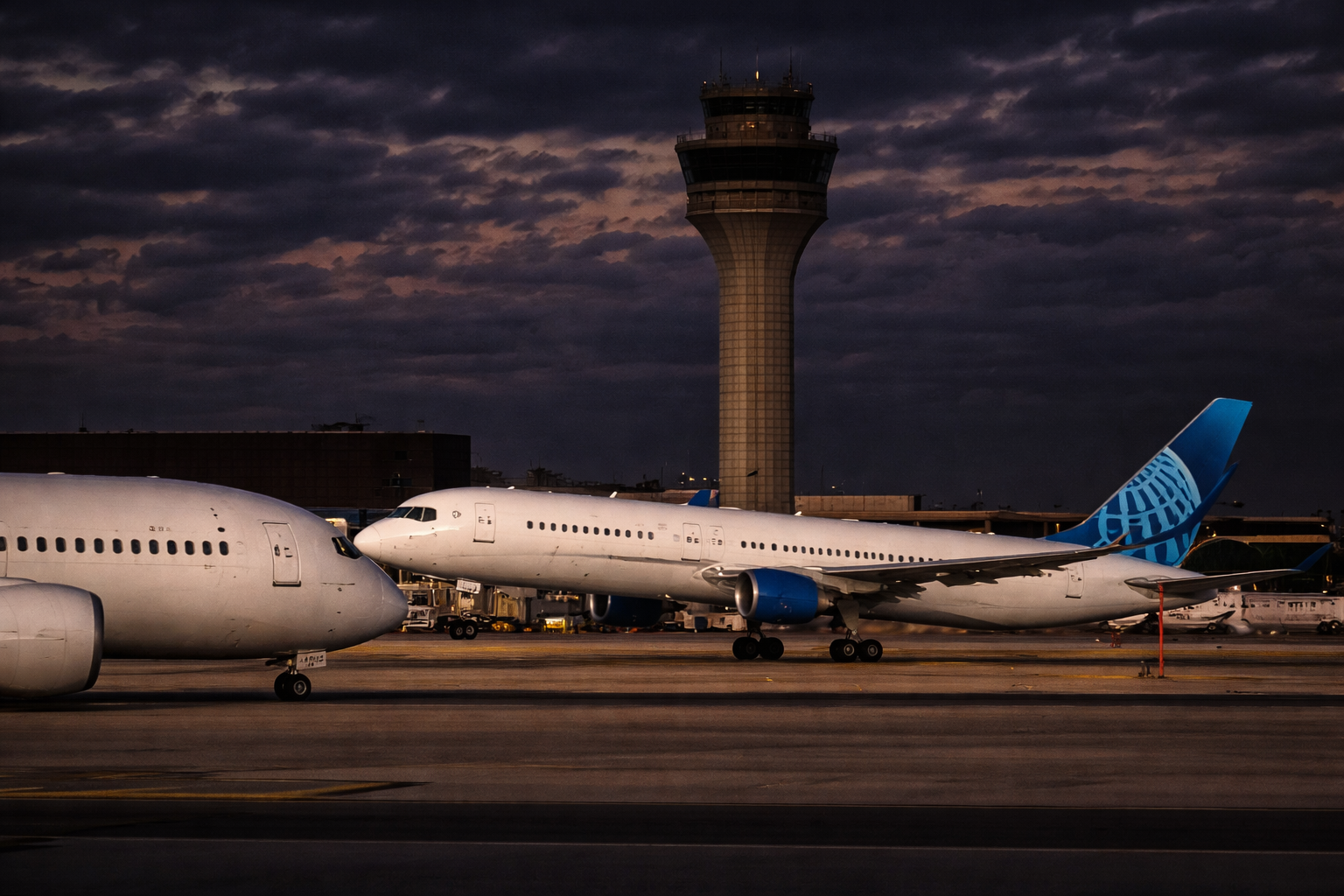
On the evening of March 23, 2026, an Air Canada Express jet touched down on Runway 4 at New York's LaGuardia Airport and struck a fire truck that a controller had cleared to cross the same runway just 12 seconds before landing. Both pilots were killed. Forty-one passengers were taken to hospitals across New York City. The air traffic controller who had cleared the fire truck keyed his radio and said what every controller dreads: "I messed up."
The runway safety system that should have warned the tower never sounded. The fire truck was not equipped with a tracking device that would have shown its exact location on the controller's screen — a system common at major airports but not legally required. The ASDE-X system — a ground radar that tracks aircraft and vehicles on runways and is designed to prevent exactly this kind of collision — was blind to it.
Fourteen months earlier, on January 29, 2025, an American Eagle regional jet, operated by PSA Airlines, and a U.S. Army Black Hawk helicopter collided over the Potomac River on approach to Reagan National Airport in Washington, D.C. Sixty-seven people were killed. The controller on duty had been working a combined position — simultaneously managing helicopter routes and fixed-wing traffic.
Two fatal accidents at two of America's busiest airports. Both involving air traffic control. Both in airspace where safety systems either failed or didn't exist.
What the Data Reveals
AviatorDB aggregates and utilizes AI systems to cross-reference multiple federal aviation safety databases — 149,000 confidential safety reports filed by pilots and controllers, 94,000 accident investigation records and FAA workforce data — to surface patterns and trends that only become visible when these datasets are analyzed together.
NASA's Aviation Safety Reporting System (ASRS) is a federal program where pilots and air traffic controllers voluntarily report dangerous incidents without fear of punishment. The reports are confidential because honesty matters more than blame: a controller who admits to a near-miss in this system will not be fired for it, which means the reports describe what actually happened, not what looks best on paper. Every report is read by a trained NASA safety analyst within days of filing. Each is coded for what went wrong: the type of incident, who was involved, and the human factors that contributed.
We cross-referenced the ASRS reports with 94,000 National Transportation Safety Board accident records covering the period from pre-COVID 2019 through December 2025. Both datasets originate from federal agencies and are publicly available.
The findings are clear.
Near mid-air collisions — events where aircraft come within 500 feet of each other and a collision hazard exists, as defined by the FAA — have increased 61 percent since 2019, from 410 to 660 in 2025. Critical runway incursions — aircraft or vehicles on active runways when they should not be — have increased 131 percent, from 54 to 125.
Not all of these incidents involve air traffic control. Pilot error, equipment malfunctions, and other factors contribute. But when the data is filtered to incidents where ATC was identified as a contributing factor, the trend is the same.
Near mid-air collisions involving air traffic control factors increased 30 percent, from 129 in 2019 to 168 in 2025. ATC-attributed critical runway incursions nearly doubled, from 18 to 35. And in 2024 — the worst year in the dataset — ATC-attributed runway incursions hit 45, a 150 percent increase from pre-pandemic levels.
| 2019 | 2021 | 2022 | 2023 | 2024 | 2025 | Change (2019→2025) | |
|---|---|---|---|---|---|---|---|
| Near Mid-Air Collisions (all causes) | 410 | 430 | 506 | 516 | 637 | 660 | +61% |
| Near Mid-Air Collisions (ATC involved) | 129 | 125 | 103 | 167 | 167 | 168 | +30% |
| Critical Runway Incursions (all causes) | 54 | 48 | 49 | 68 | 127 | 125 | +131% |
| Critical Runway Incursions (ATC involved) | 18 | 13 | 21 | 36 | 45 | 35 | +94% |
- Source: NASA Aviation Safety Reporting System (ASRS)
Incidents Are Growing Faster Than Traffic
In 2019, pilots and controllers filed 6,440 reports with NASA — the highest total in recent years. By 2025, total reports had fallen to 5,494, a decline of 15 percent. Fewer people are filing reports. But the incidents they are reporting are far more dangerous.
Measuring the rate of critical incidents per 1,000 reports filed — controlling for the volume of reporting — the picture becomes stark.
| Incidents per 1,000 ASRS reports | 2019 | 2025 | Change |
|---|---|---|---|
| Near Mid-Air Collisions | 63.7 | 120.1 | +89% |
| Critical Runway Incursions | 8.4 | 22.8 | +171% |
- Source: NASA Aviation Safety Reporting System (ASRS)
For every 1,000 safety reports filed in 2019, there were 64 near mid-air collisions. In 2025, there were 120 — nearly double. The rate of critical runway incursions per report has nearly tripled.
This is not a reporting artifact. This is not a function of more flights — according to FAA traffic data, U.S. air carrier activity in 2024 was 5.5 percent above 2019 levels, while near mid-air collisions are 61 percent above 2019 levels. The increase in reported near mid-air collisions has far outpaced modest traffic growth.
The Federal Aviation Administration tracks runway incursions through its own system. In 2024, the FAA documented more than 1,100 runway incursions nationwide. Of those, 183 were "operational incidents" — meaning the cause was an air traffic controller's action or inaction. Overall, pilot deviations account for roughly 60 percent of all runway incursions. But for the most dangerous incursions — Category A and B events, where collision was narrowly avoided or required time-critical evasive action — 57 percent were caused by air traffic control.
The number of these most serious incursions dropped in 2024 compared to the elevated levels of 2023 — a result the FAA attributes to focused training programs and runway safety initiatives launched after the surge of close calls in early 2023. That targeted effort appears to be working for the highest-severity events. But the broader trend in total incursions and near mid-air collisions continued at levels well above pre-pandemic baselines, suggesting that while the FAA can address specific failure points, the underlying staffing pressure remains.
What Is Driving the Increase in Near Mid-Air Collisions
In addition to coding each report by incident type, NASA's analysts assess the human factors that contributed — workload, communication breakdown, confusion, distraction, fatigue, and training deficiencies. These assessments reveal what is driving the increase.
"Workload" in the NASA system means the person was given more simultaneous tasks than they could safely manage. For a controller, that means working multiple positions at once, managing more aircraft than a sector is designed to handle, or handling emergencies while simultaneously directing normal traffic. When NASA codes a report for workload, the analyst concluded the person was overloaded — not careless or incompetent, but faced with more tasks than any human could safely manage.
The growth of workload as a factor in dangerous incidents is striking.
| Human factor in critical conflicts (per 1,000 ASRS reports) | 2019 | 2024 | Change |
|---|---|---|---|
| Workload | 1.1 | 25.8 | +2,245% |
| Communication Breakdown | 18.2 | 63.3 | +248% |
| Distraction | 4.5 | 20.2 | +349% |
| Training / Qualification | 3.3 | 13.4 | +306% |
| Confusion | 6.2 | 23.6 | +281% |
- Source: NASA Aviation Safety Reporting System (ASRS), human factors coded by NASA safety analysts
In 2019, workload was cited as a contributing factor in roughly 1 out of every 1,000 safety reports. By 2024, it appeared in 26 out of every 1,000. That is a 23-fold increase in the rate at which overloaded controllers and pilots are involved in the most dangerous incidents in the national airspace system.
Communication breakdowns — which in air traffic control can mean a misheard clearance, a missed handoff, or a controller too overwhelmed to issue a warning — increased 248 percent. Training and qualification issues — new controllers placed in positions they are not prepared for — increased 306 percent. Distraction — controllers pulled away from their primary task by phone calls, equipment problems, or supervisory duties — increased 349 percent.
Aviation safety experts and the controllers' union, NATCA, argue these are symptoms of a single root cause: understaffing. When there are not enough controllers, the controllers who remain work multiple positions, handle more aircraft, train less experienced replacements while simultaneously managing live traffic, and absorb duties — answering phones, supervising trainees, coordinating with maintenance — that would normally be handled by someone else. Every one of those conditions appears in the NASA reports as workload, distraction, communication breakdown, or training deficiency.
Other factors contribute to the trend. Post-pandemic recovery introduced complexity as traffic volumes returned faster than the workforce. Airspace design at congested airports like JFK, LaGuardia, and Reagan National creates inherent conflict points. Mixed military and civilian operations add coordination challenges. But the human factors data — coded independently by NASA analysts — consistently points to workload, communication, and training as the dominant contributors, and all three are direct consequences of a workforce operating below safe capacity.
The Year Everything Almost Broke
The workload surge shows up in the record of specific incidents where the system nearly failed — and in the two cases where it did. The crisis announced itself in January 2023, when seven runway incursions involving commercial aircraft occurred in the first two months of the year — the highest rate in five years.
On January 13 at JFK, an American Airlines 777 crossed an active runway while a Delta 737 was accelerating for takeoff. The ASDE-X system alerted the tower. The controller cancelled the takeoff with seconds to spare. The safety board's investigation found the ground controller had been looking down, performing a lower-priority task, when the American jet turned onto the wrong taxiway.
Three weeks later, on February 4 at Austin-Bergstrom, the margin disappeared almost entirely. A FedEx 767 on final approach and a Southwest 737 cleared for takeoff ended up on the same runway in freezing fog. The controller believed the Southwest jet was ready to roll. It wasn't — the crew had stopped for a 19-second engine run-up without informing the tower. When the FedEx crew saw the Southwest jet sitting on the runway directly in their path, the first officer shouted "Southwest, abort!" The FedEx captain pulled up. The two aircraft passed within 150 to 170 feet of each other — less than the 180-foot length of the FedEx jet itself. Austin-Bergstrom had no ground radar to track aircraft positions on the surface.
In August 2023, the New York Times published an investigation documenting at least 46 close calls involving commercial airliners in July of that year alone — attributing the surge to the air traffic controller shortage. The FAA convened a safety summit on March 15, 2023, the first in 14 years. The agency acknowledged the problem. Then traffic continued to grow.
In April 2024 at JFK, a SWISS Airbus A330 was cleared for takeoff on Runway 4L. Within the next 20 seconds, a different controller cleared four other aircraft to cross the same runway. The SWISS crew rejected the takeoff when they saw jets crossing in front of them. The ground radar safety system did not alarm — because the SWISS jet never accelerated fast enough to trigger the system's speed threshold. The technology designed to prevent the collision required the collision to already be in progress before it would sound.
Controllers Describe a System Under Strain
In February 2025, a controller at the Los Angeles Air Route Traffic Control Center (ZLA) was working a closing shift with all five sectors combined to two people and 25 aircraft inbound to Las Vegas. The controller wrote: "I turned to my coworker and told him I was at a loss, I have no idea what to do with all these aircraft, there is literally nowhere to put them. What I experienced last night was incredibly dangerous, and I do not say that lightly."
In April 2025, a controller at Savannah Tower (SAV) cleared an aircraft for takeoff before another had cleared the runway. The report was direct about the cause: "I believe mental mistake is attributable to fatigue caused by months of overtime assignments, and lack of staffing. No oversight in the Tower at the time."
In May 2025, a controller at Rocky Mountain Metropolitan Airport (BJC) in Colorado watched a colleague taxi an aircraft across a runway while another was departing. All positions had been combined to one person so the facility could have a standalone supervisor. The controller wrote: "Eventually a controller that is over saturated from working too many positions is going to make another mistake the CIC won't catch and someone will die just so we could have a standalone CIC."
In July 2025, at Denver Center (ZDV), a TRACON — a Terminal Radar Approach Control facility, responsible for managing aircraft in the airspace immediately surrounding an airport — could not open due to staffing. The Center was forced to absorb the TRACON's airspace — with controllers who had never been trained on the procedures. The controller wrote: "An adequate briefing on these contingency procedures has never occurred, and no one in Area 3 is proficient on the operation, which is a major safety concern."
In September 2025, a controller was working three jobs at once — managing aircraft on the ground, managing aircraft in the air, and supervising the entire operation — three roles that at a properly staffed facility would be handled by three separate people. While taking a sick leave call and dialing through the overtime list to find a replacement, the controller taxied an aircraft onto a runway with another on short final. The report stated: "I likely should not have been working the entire tower alone."
In November 2025, at Miami Center (ZMA) during a government shutdown, a controller climbed an aircraft into the path of another and nearly caused a midair collision. The controller wrote: "I am honestly shook up about the possibility of having a mid air collision. We were already short staffed before the shutdown and now we have less people showing up."
Seven Months of Warnings
In May 2025, a pilot on final approach to LaGuardia Runway 22 executed a go-around at 500 feet because an aircraft was still on the runway trying to taxi across. The pilot filed a report: "There was an aircraft on the runway trying to taxi across and was not across the runway in time to make a safe landing so we did a go around."
In August 2025, a captain who had narrowly avoided a collision at LaGuardia filed a confidential safety report. The tower had cleared an aircraft for takeoff on Runway 13 while the captain's plane was 300 feet from landing on Runway 22. Visibility was poor from Canadian wildfire smoke, with a helicopter nearby, making a go-around dangerous. The captain landed 10 seconds after the departing aircraft crossed the flight path. The report also noted that the runway status light system — a set of lights embedded in the pavement that glow red to warn pilots when a runway is unsafe to enter — appeared to have been disabled on Runway 13. It remained disabled. The report ended with a plea:
"The pace of operations is building in LGA. The controllers are pushing the line. On thunderstorm days, LGA is starting to feel like DCA did before the accident there. Please do something."
Seven months later, a controller at LaGuardia cleared a fire truck to cross Runway 4 while an Air Canada jet was seconds from landing on the same runway. The ground radar safety system was working, but unable to detect the fire truck because it was not equipped with a transponder tracking system. The controller attempted to stop the truck nine seconds before impact. Both pilots were killed and 41 passengers were hospitalized.
More Flights, Fewer Controllers, Broken Technology
These individual incidents reflect structural pressures in staffing, equipment, and oversight. While total controller headcount has grown modestly with record hiring, the critical number — fully certified controllers available for independent operations — has not kept pace with the FAA's own targets.
According to FAA Controller Workforce Plans, the agency's total controller headcount — including trainees at the FAA Academy — stood at approximately 14,264 at the end of fiscal year 2024. But the number of fully certified controllers — the experienced professionals who can work positions independently, without a trainer watching over their shoulder — stood at 10,730 against the FAA's own staffing target of 14,633. The deficit: 3,544 certified controllers below what the agency's own workforce model says is needed to safely run the system.
U.S. flight volumes have exceeded pre-pandemic levels and continue to grow, with 2024 marking the fourth consecutive year of increases. According to FAA data, an estimated 35.2 million flights moved through the national airspace in 2025. The FAA manages 44,000 flights and 3 million passengers every day.
The FAA has taken steps to address the shortage. The agency exceeded its hiring targets in fiscal years 2023, 2024, and 2025, bringing 1,512, 1,811, and 2,026 new trainees into the certification pipeline respectively. Academy starting salaries were increased 30 percent. The hiring process was streamlined from eight steps to five. A new retention program offers retirement-eligible controllers a 20 percent bonus for each year they continue working. But the pipeline rejects 98 percent of applicants and takes five years to certify the rest. Despite record hiring, the FAA achieved a net gain of just 15 certified controllers in fiscal year 2023 and 108 in 2024. Former FAA Administrator Mike Whitaker said publicly that air traffic control towers will "never" reach full staffing under the current system.
The technology has not kept pace either. The FAA's communication network dates to 2002 and relies on 1960s-era time-division multiplexing technology across 4,600 sites. Voice switches at some facilities are nearly 30 years old. Control towers and radar facilities across the country have failing HVAC, leaking roofs, and asbestos. The ASDE-X runway safety system — the last line of defense against ground collisions — failed to alert at JFK in April 2024 because the departing aircraft hadn't accelerated fast enough, and failed to alert at LaGuardia in March 2026 because the fire truck had no transponder.
United Airlines CEO Scott Kirby told CNBC that 68 percent of the airline's delays on clear-weather days in 2024 were caused by air traffic control staffing limitations. The FAA has capped flights at New York airports, with the restrictions in place through October 2026.
After the Reagan National crash, the National Transportation Safety Board issued 50 safety recommendations, 33 of them directed at the FAA. Congress responded with the ALERT Act of 2026. The safety board reviewed the legislation and concluded it addressed only a few of the recommendations, writing that the bill "would not implement many NTSB recommendations." Among the gaps: the legislation did not require a cockpit technology called ADS-B In, which displays the position of nearby aircraft directly on a pilot's screen — giving flight crews a way to see threats themselves rather than relying solely on a controller's voice on the radio.
Where This Leaves Us
The United States still operates the safest aviation system in the world. Tens of millions of flights land safely every year. But safety in aviation has never been about the flights that go right. It is about the margin of safety between a routine day and a disaster — and the federal data shows that margin is shrinking.
Near mid-air collisions are up 61 percent from pre-pandemic levels. Workload — the measure of how overwhelmed the people running the system are — has surged 23-fold. Two fatal accidents at major airports in 14 months involved air traffic control factors. And the confidential reports filed by the people inside the system describe a workforce running out of room to recover from the mistakes that a fully staffed system would catch.
The problems are known. The NTSB has issued its recommendations. Congress has begun to respond, though the safety board says the response falls short. The FAA is hiring, but the pipeline produces roughly 1,000 certified controllers per year while losing approximately 1,300 to retirement, training failures, and resignations. Net gains in certified controllers remain modest despite record hiring levels.
Experts across the FAA, Congress, and aviation safety organizations agree on the required steps: hire more controllers, modernize equipment, and deploy better safety technology in cockpits and on the ground. The question is whether those steps will be taken before the safety margin closes completely — or after.
Read AviatorDB's previous investigation: Nearly 58,000 Applied. Only 2% Made It: Inside the Controller Shortage the FAA Can't Fix
DATA APPENDIX — AviatorDB Analysis of NASA ASRS Reports (2019-2025)
Source: AviatorDB database, 149,431 NASA Aviation Safety Reporting System records. Queried March 26, 2026. Human factors in ASRS reports are coded by trained NASA safety analysts who independently assess each narrative — they are not self-reported by the filer.
Table 1: Near Mid-Air Collisions and Runway Incursions by Year — Raw Counts
| Category | 2019 | 2021 | 2022 | 2023 | 2024 | 2025 |
|---|---|---|---|---|---|---|
| Total ASRS Reports Filed | 6,440 | 4,510 | 5,459 | 4,526 | 5,391 | 5,494 |
| Near Mid-Air Collisions (all causes) | 410 | 430 | 506 | 516 | 637 | 660 |
| Near Mid-Air Collisions (ATC involved) | 129 | 125 | 103 | 167 | 167 | 168 |
| Critical Runway Incursions (all causes) | 54 | 48 | 49 | 68 | 127 | 125 |
| Critical Runway Incursions (ATC involved) | 18 | 13 | 21 | 36 | 45 | 35 |
| ATC-Cited Reports (all types) | 1,901 | 1,368 | 1,429 | 1,421 | 1,786 | 1,881 |
Note: 2020 omitted (COVID-19 reduced air traffic to anomalous levels). "ATC involved" means the report was tagged with ATC as a contributing factor, primary problem, or anomaly type by NASA analysts.
Table 2: Incident Rates Per 1,000 ASRS Reports (controls for reporting volume)
| Category | 2019 | 2021 | 2022 | 2023 | 2024 | 2025 |
|---|---|---|---|---|---|---|
| Near Mid-Air Collisions (all causes) | 63.7 | 95.3 | 92.7 | 114.0 | 118.2 | 120.1 |
| Critical Runway Incursions (all causes) | 8.4 | 10.6 | 9.0 | 15.0 | 23.6 | 22.8 |
Table 3: Human Factors in Critical Conflicts — Rate Per 1,000 ASRS Reports
Coded by NASA safety analysts based on independent assessment of each narrative.
| Human Factor | 2019 | 2021 | 2022 | 2023 | 2024 | 2025 |
|---|---|---|---|---|---|---|
| Workload | 1.1 | 11.5 | 14.7 | 23.4 | 25.8 | 12.6 |
| Communication Breakdown | 18.2 | 35.7 | 35.0 | 50.8 | 63.3 | 59.7 |
| Distraction | 4.5 | 15.7 | 13.6 | 15.9 | 20.2 | 7.1 |
| Training / Qualification | 3.3 | 5.5 | 6.8 | 11.3 | 13.4 | 8.0 |
| Confusion | 6.2 | 16.6 | 14.8 | 21.7 | 23.6 | 7.8 |
| Situational Awareness | — | 42.4 | 40.5 | 64.7 | 67.3 | 55.7 |
| Fatigue | — | 1.3 | 1.1 | 1.1 | 1.5 | 0.7 |
Note: 2025 rates for some factors appear lower than 2024. This may reflect incomplete coding of recent reports (NASA analysts code reports within days, but the full dataset may not reflect the most recent quarter) or natural year-to-year variation. The 2019-to-2024 trend is the most reliable comparison.
Table 4: Controller Staffing vs. Traffic
| Pre-Pandemic (2019) | Current (2024) | Change | |
|---|---|---|---|
| Total Controller Headcount (incl. trainees) | ~14,191 | ~14,264 | +73 (+0.5%) |
| Fully Certified Controllers (at facilities) | ~11,831 | 10,730 | -1,101 (-9.3%) |
| FAA Staffing Target | — | 14,633 | Deficit: 3,544 |
| Air Carrier Operations | Baseline | +5.5% above 2019 | Growing |
| Total System Flights | ~33.4M | ~34M | +1.8% |
| Near Mid-Air Collisions (per 1,000 safety reports) | 63.7 | 118.2 | +85.6% |
"Fully Certified Controllers" = Certified Professional Controllers (CPCs) plus those in their final stage of certification (CPC-ITs) — controllers qualified to work positions independently. "FAA Staffing Target" = the Collaborative Resource Workgroup (CRWG) target, the number the FAA and the controllers' union jointly determined is needed to safely staff all facilities. Sources: FAA Controller Workforce Plan 2025-2028 (staffing), FAA 2025 Review of 2024 (traffic), AviatorDB analysis of NASA ASRS (incident rates).
ASRS Report Numbers Cited in This Article
| ACN | Date | Location | Description |
|---|---|---|---|
| 2275673 | Aug 2025 | LGA Airport, NY | "Please do something" — pilot warned LGA feels like DCA before the crash |
| 2240849 | May 2025 | LGA Airport, NY | Go-around at 500ft — aircraft on Runway 22 while landing |
| 2212063 | Feb 2025 | ZLA Center, CA | "I have no idea what to do with all these aircraft" — 5 sectors combined to 2 people |
| 2289082 | Sep 2025 | Tower (ZZZ) | Controller working Ground, Local, and CIC alone — taxied aircraft onto active runway |
| 2237912 | May 2025 | BJC Tower, CO | "Someone will die just so we could have a standalone CIC" |
| 2237910 | May 2025 | TRACON (ZZZ) | "Very tired after a long and exhausting shift with low staffing" |
| 2235818 | Apr 2025 | SAV Tower, GA | "Fatigue caused by months of overtime assignments, and lack of staffing" |
| 2302105 | Nov 2025 | ZMA Center, FL | Near-midair during shutdown — manager called it a "non-event" |
| 2268226 | Jul 2025 | ZDV Center, CO | TRACON closed due to staffing — Center absorbed airspace with zero training |
| 2268216 | Jul 2025 | Tower (ZZZ) | Trainees opened tower without certified watch supervisor |
| 2270419 | Jul 2025 | ZBW Center, NH | "The NAS is slowly starting to crack" |
Follow @AviatorDB on X
Breaking aviation news, NTSB investigations, and industry updates delivered daily.