
Service History
The Aeronca 50 Tandem carved out a specialized niche in American aviation training during the critical pre-war period. Built specifically for the Civilian Pilot Training Program launched in 1939, these aircraft played a vital role in preparing pilots before America's entry into World War II. The tandem seating arrangement offered superior training visibility compared to side-by-side configurations, with the rear seat positioned nine inches higher than the front in later variants. This design philosophy directly competed with the established Piper Cub, representing Aeronca's ambitious attempt to capture the growing training market.
Wartime Contributions
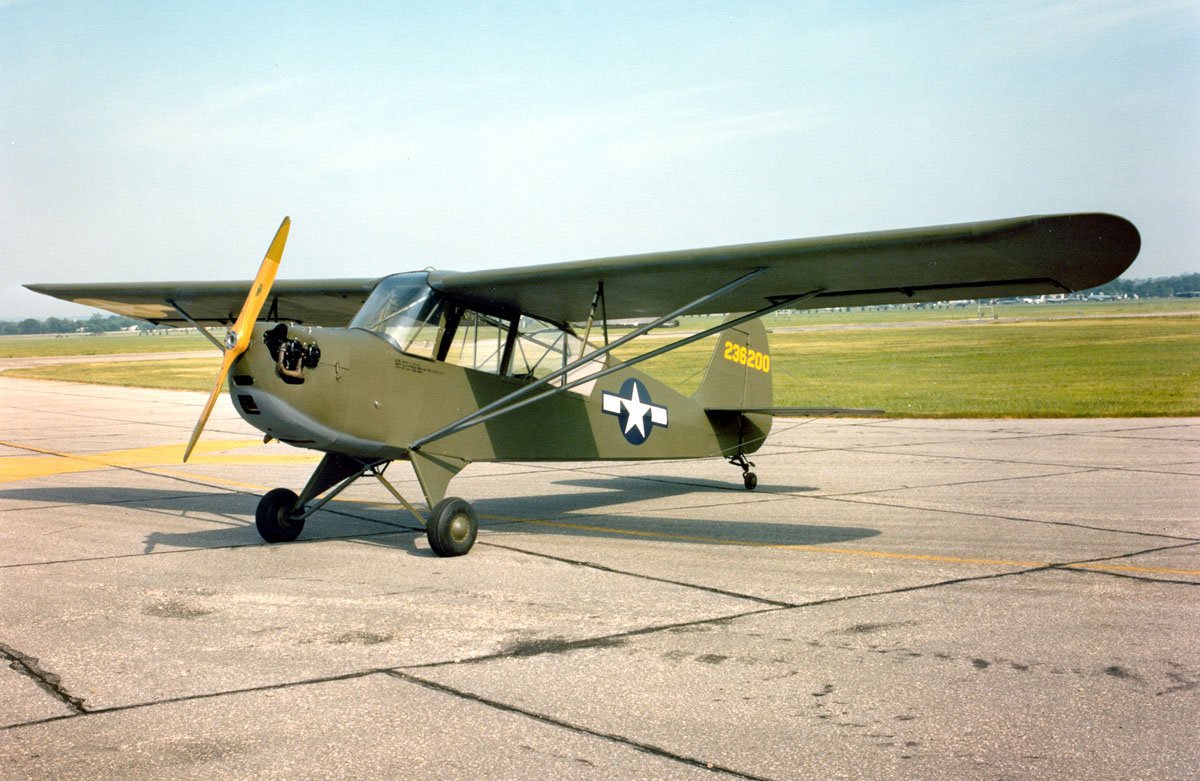
While the 50 Tandem itself never saw direct military service, its design DNA proved invaluable to the war effort. The aircraft served as the foundation for Aeronca's 65TL Tandem, which evolved into the legendary USAAF O-58 and L-3 Grasshopper series. More than 1,400 of these military derivatives served across all theaters of World War II, performing reconnaissance, artillery spotting, and liaison duties. The 299 civilian 65TL aircraft were joined by 4 YO-58 prototypes, 20 O-58 production models, 701 L-3B variants, and 499 L-3C models between 1940 and 1945.
The Manufacturer
The Aeronautical Corporation of America, founded in 1928 at Lunken Airport in Cincinnati, Ohio, represented one of America's most prolific light aircraft manufacturers. Originally established as a pioneer in affordable aviation, the company produced an impressive 17,500 general aviation and military aircraft between 1930 and 1951. At peak wartime production from 1945 to 1950, Aeronca's facilities churned out 50 aircraft per day, demonstrating remarkable manufacturing efficiency for the era.
The company's international reach extended to England, where it licensed production of the Aeronca 100 to the Aeronautical Corporation of Great Britain Ltd., resulting in 24 British-built examples. After changing its name to Aeronca Manufacturing Corporation in 1950, the company ceased light aircraft production in March 1951, selling the Champion aircraft rights to Champion Aircraft Company in Osceola, Wisconsin. The company subsequently transitioned to subcontracting work for Boeing in 1952, marking the end of an era in American light aircraft manufacturing.
Engine and Technical Innovation
The 50 Tandem showcased two distinct powerplant options, both delivering 50 horsepower but with different characteristics. The Continental A-50 featured a reliable flat-four air-cooled design that had proven itself in earlier Chief variants, while the Lycoming O-145-A1 offered exposed cylinder heads for enhanced cooling. Both engines represented the cutting edge of light aircraft powerplant technology, providing sufficient power for training operations while maintaining operational economy.
The aircraft's high-wing configuration with steel tube fuselage and fabric covering followed proven Aeronca design principles established with earlier models. The tandem arrangement marked a significant departure from the company's traditional side-by-side seating philosophy, reflecting the specific demands of flight training where instructor visibility and student independence were paramount.
Performance and Legacy
Demonstrating impressive capability for its modest power output, related Chief family aircraft achieved notable performance milestones. A Continental A-50 powered 50C Chief established a remarkable lightplane endurance record, completing a nonstop flight from Los Angeles to New York on November 29-30, 1938. This epic journey covered 2,785 miles in 30 hours and 47 minutes, maintaining an average speed of 90 miles per hour and proving the reliability of both the airframe and powerplant combination.
The 50 Tandem's limited production run of 49 aircraft reflected both the specialized nature of its training mission and the approaching demands of wartime production. While exact numbers of surviving examples remain unknown, the aircraft's design influence extended far beyond its modest production figures. The tandem configuration pioneered in the 50 series evolved into the postwar Aeronca 7AC Champion, which achieved production of 7,200 units from 1944 onward and later influenced the Citabria aerobatic trainer series.
Today, the Aeronca 50 Tandem represents a crucial link in American aviation training history, bridging the gap between Depression-era barnstorming aircraft and the sophisticated military trainers that would emerge during World War II. Its contribution to pilot training during the critical Civilian Pilot Training Program helped establish the foundation of American aviation dominance that would prove decisive in the coming global conflict.