
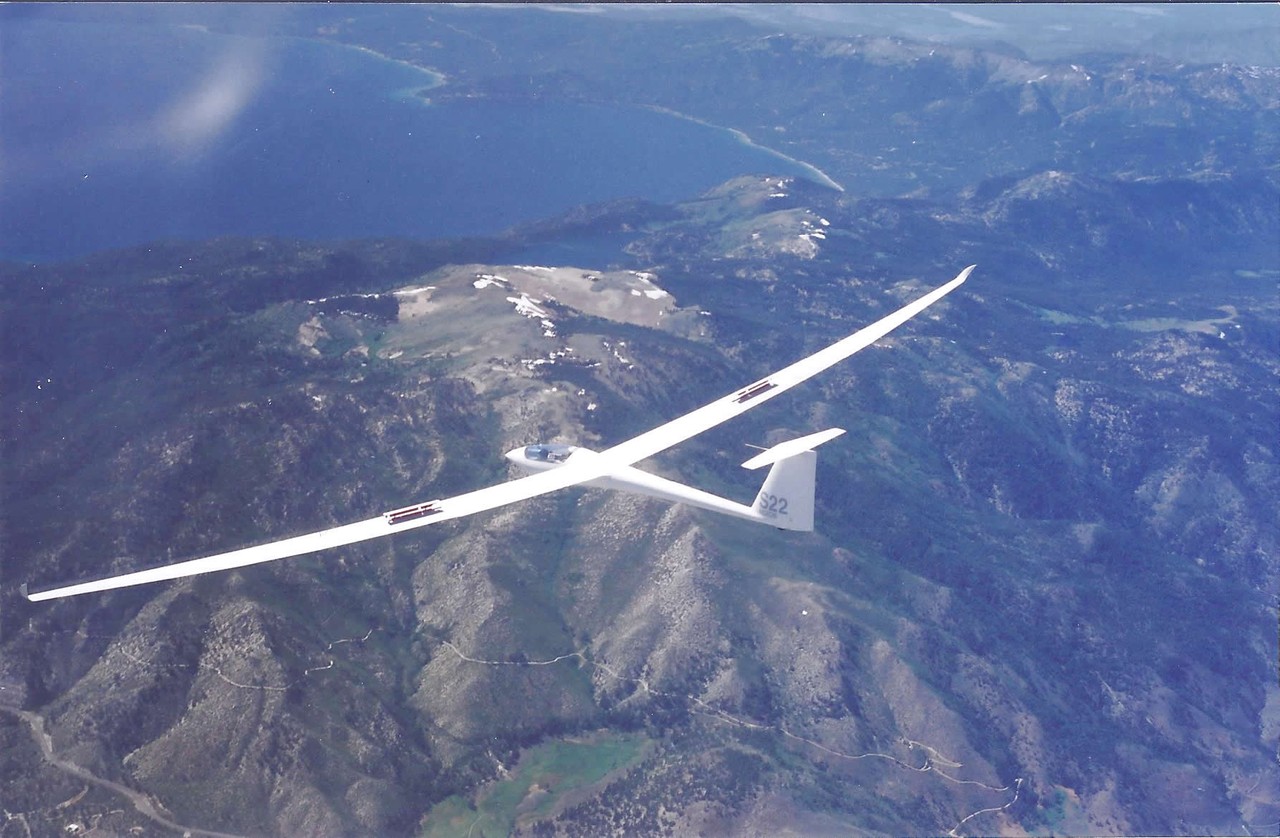
Competition Dominance
The ASW-22 family achieved remarkable success in international gliding competitions, with ASW-22 variants taking first place in six World Gliding Championships during the 1980s. Walter Neubert piloted the prototype to victory in the 1981 Baden-Württemberg regional championship, demonstrating the design's competitive potential from its earliest flights. In 1985, an ASW-22 established the world 750-kilometer triangle speed record, cementing the type's reputation as the premier Open Class sailplane of its era.
Design Innovation
Gerhard Waibel conceived the ASW-22 as a successor to the ASW-17, incorporating cutting-edge composite construction techniques and aerodynamic refinements. The design featured fiber-reinforced composites including carbon-fiber and Kevlar construction, representing a significant advancement in sailplane manufacturing. Waibel integrated Horstmann and Quast wing profiles with underwing high-pressure tubes and turbulator holes to maintain laminar airflow, while the retractable two-wheel undercarriage improved ground handling compared to conventional single-wheel systems.
The ASW-22M variant introduced self-launching capability through its Rotax 505A piston engine, eliminating dependence on ground-based launching equipment. This innovation allowed pilots to reach soaring altitude independently, then retract or shut down the powerplant for pure gliding flight. The motorized system proved particularly valuable for cross-country flights and operations from airports without specialized glider launching facilities.
Alexander Schleicher Legacy
Alexander Schleicher GmbH & Co manufactured all ASW-22 variants at their Poppenhausen facility from 1981 to 1985. Founded in 1927 by Alexander Schleicher, the company suspended civilian aircraft production during World War II, operating from 1939 to 1945 repairing training gliders for Hitler Youth programs at the Wasserkuppe soaring site. The firm pivoted to furniture manufacturing until aviation restrictions lifted in 1951, when Schleicher resumed glider production that continues today under family ownership.
The company produced exactly 36 base ASW-22 sailplanes, with total production across all variants reaching 87 aircraft including the motorized ASW-22M versions. Each aircraft required extensive hand-crafting due to the complex composite construction and precise aerodynamic requirements of Open Class competition sailplanes.
Technical Excellence
The ASW-22M's performance specifications reflected its Open Class pedigree, with a best glide ratio of 62:1 achieved at 95 km/h. Minimum sink rate measured 0.41 meters per second at speeds between 67 and 85 km/h, while the aircraft could carry up to 235 kilograms of water ballast to optimize performance across varying atmospheric conditions. Maximum wing loading ranged from 33.4 to 45 kg/m², depending on ballast configuration.
Structural limits allowed for positive 5.3g and negative 2.65g loading, enabling aggressive thermal flying and competition maneuvering. The sailplane's never-exceed speed of 280 km/h provided adequate margin for high-speed inter-thermal flights, while stall speed of 65 km/h allowed safe operation in weak lift conditions.
Pilot Experience
Pilots praised the ASW-22M's predictable handling characteristics and exceptional soaring performance in competitive environments. The flaperons system, introduced on later variants, provided precise control authority throughout the speed range while optimizing wing camber for different flight phases. The spacious cockpit accommodated pilots during extended cross-country flights, with instrumentation layouts designed for competition flying requirements.
The Rotax 505A engine installation maintained the aircraft's excellent gliding characteristics while providing reliable self-launch capability. Pilots could extend flight opportunities by launching independently rather than waiting for ground crew or suitable atmospheric conditions for winch or aerotow operations.
Production Impact and Current Status
The ASW-22's design influence extended beyond its own production run, with the AS-22-2 prototype first flying on September 20, 1984, serving as a developmental aircraft for the two-seat ASH-25. The ASH-25 shared wing technology with the ASW-22, transferring the single-seat aircraft's aerodynamic advances to the two-seat training and cross-country market.
Several ASW-22M aircraft remain active today, registered with private owners and gliding clubs worldwide. The type continues to appear in vintage glider competitions and cross-country soaring events, with examples like the Danish-registered OY-XOI (built in 1984) maintaining airworthiness decades after production ended. The ASW-22M's combination of pure gliding performance and self-launch capability ensures continued relevance for serious soaring pilots seeking Open Class performance with operational independence.