
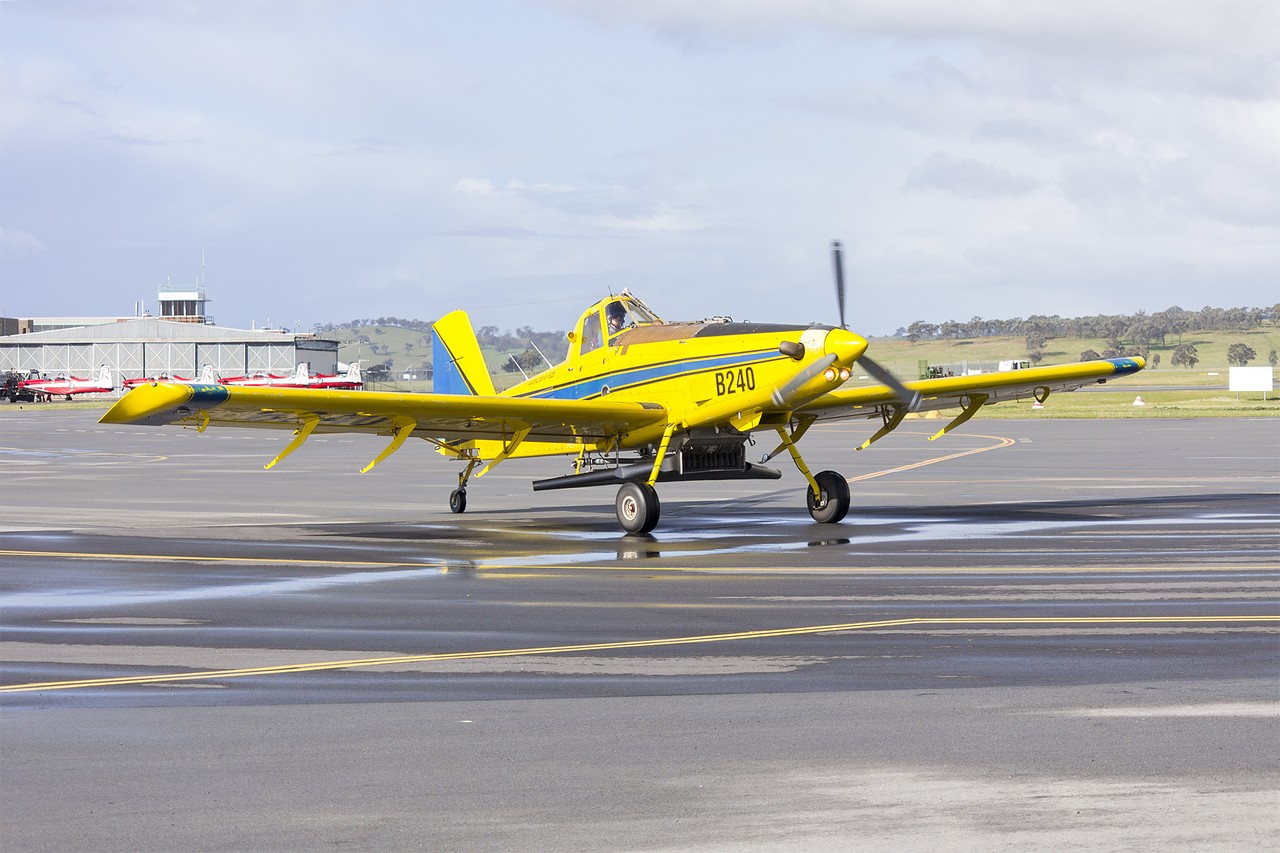
Commercial Dominance
The AT-502 achieved remarkable commercial success, becoming the definitive aircraft in Air Tractor's AT-500 series. By the end of 2002, exactly 208 AT-502 aircraft had been delivered worldwide. The AT-502B variant dominated the global agricultural aviation market from 2011 through 2018, recording 388 deliveries and claiming the title of world's top-selling agricultural aircraft during this period.
The aircraft entered commercial service in 1988 with cotton spraying operations in Australia, quickly establishing its reputation for reliability and efficiency. The combined AT-500 line, anchored by the AT-502's success, ranked among the world's most popular single-turboprop aircraft families, exceeded in deliveries only by the Pilatus PC-12 and Cessna 208 Caravan between 2011 and 2018.
The Manufacturer
Air Tractor Inc. was founded by Leland Snow, who left Rockwell to pursue his vision of superior agricultural aircraft design. Construction of the company's first aircraft began in 1972 with the AT-300, later designated AT-301. The company introduced its first turbine-powered model, the AT-302, in 1977, establishing the foundation for future turboprop designs.
Based in Olney, Texas, Air Tractor expanded its manufacturing facilities after delivering its 1,100th airplane. The company continues operations today, producing aircraft across multiple capacity lines including 400, 500, 600, and 800-gallon variants, maintaining its position as a leader in agricultural aviation.
Design and Development
Leland Snow's engineering team developed the AT-502 as a stretched version of the successful AT-401, focusing on increased capacity and enhanced performance for agricultural operations. The design required extending the wingspan by 50 inches and stretching the fuselage by 22 inches compared to the AT-400 series, accommodating a substantially larger chemical hopper of 1,892 liters.
The prototype AT-502, registered N7314D, completed its maiden flight in April 1987. Federal Aviation Administration certification followed rapidly, granted on June 23, 1987, with commercial operation approval achieved in February 1988. This swift certification process reflected the design's maturity and Air Tractor's engineering expertise.
Engine and Performance
The original AT-502 utilized the 507-kilowatt Pratt & Whitney Canada PT6A-15AG turboprop engine, though certification also permitted installation of the more powerful 559-kilowatt PT6A-34AG variant. The AT-502A, which first flew in January 1992, featured the substantially more powerful 821-kilowatt PT6A-45R engine paired with a slow-turning five-blade Hartzell propeller system.
The AT-502B variant, introduced with its first flight in July 1992, employed the 560-kilowatt PT6A-34AG engine, providing an optimal balance of power and operational economy. These Pratt & Whitney Canada PT6 engines were selected for their exceptional reliability, fuel efficiency, and proven suitability for the demanding requirements of agricultural operations requiring extended loiter periods over target areas.
Operational Characteristics
The AT-502's design prioritized operational efficiency for agricultural missions. With a maximum speed of 154 miles per hour and range of 800 miles, the aircraft typically exhausted its chemical load before consuming its fuel supply, enabling extended time on station for comprehensive field coverage. The 500-gallon chemical hopper capacity represented a significant improvement over earlier agricultural aircraft.
Multiple seating configurations addressed diverse operational requirements. Standard variants featured single-seat operation optimized for agricultural spraying, while specialized versions offered widened seats for observers or tandem configurations for training missions. The AT-504 trainer variant, introduced in 2009, incorporated side-by-side seating with full dual controls for pilot instruction.
Versatile Applications
Beyond primary agricultural roles, the AT-502 demonstrated remarkable versatility across multiple mission profiles. The aircraft proved highly effective in aerial firefighting operations, with many examples converted to light air tankers for fire suppression duties. The robust airframe and reliable turboprop powerplant made it ideal for operations in challenging environments typical of both agricultural and firefighting missions.
Training applications expanded the aircraft's utility, with instructor variants enabling safe and effective pilot education in turboprop agricultural techniques. The combination of forgiving handling characteristics and professional-grade systems provided an ideal platform for transitioning pilots from smaller piston-powered agricultural aircraft.
Production Legacy
By December 2002, the complete AT-500 series had achieved 549 total deliveries, with the AT-502 representing the largest single variant at 208 aircraft. Combined AT-500 line production from 2011 through 2018 reached 470 deliveries, demonstrating sustained market demand and the design's enduring relevance.
The AT-502's commercial success established Air Tractor as the dominant force in turboprop agricultural aviation. The aircraft's longevity in production and continued operational service worldwide validates the original design philosophy emphasizing reliability, capacity, and operational efficiency. Today, AT-502 variants continue serving agricultural operators globally, maintaining their reputation as the standard for professional crop spraying operations.