
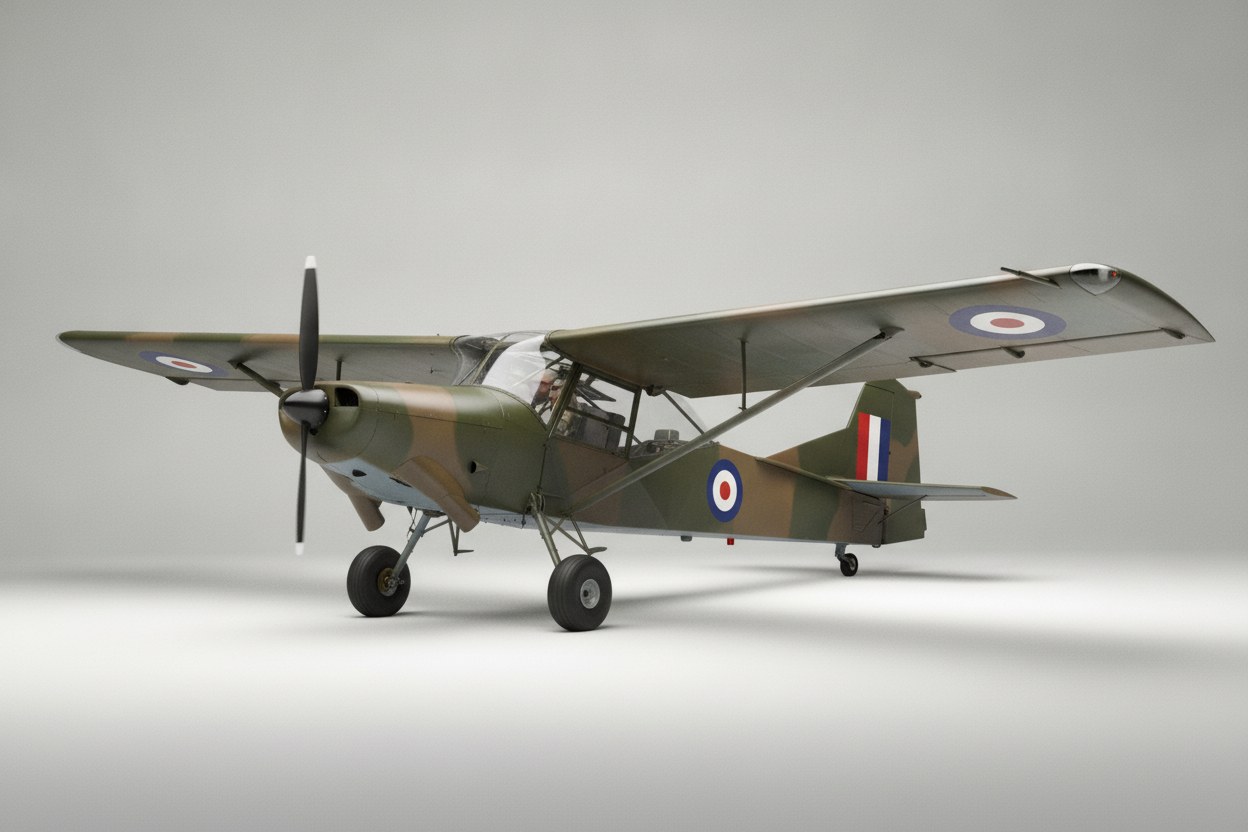
The Final Chapter of Fixed-Wing Military Observation
The AOP.11 emerged at a pivotal moment in military aviation history when helicopter technology was rapidly displacing traditional fixed-wing observation aircraft. By 1961, when the single prototype took to the air, the role that Air Observation Post aircraft had filled since World War II was being assumed by helicopters, which offered superior hovering capability and maneuverability for artillery spotting and liaison missions.
Design Evolution and Technical Specifications
The AOP.11 represented a substantial upgrade from its immediate predecessor, the AOP.9, which had appeared in March 1954 with a 180-horsepower Cirrus Bombardier engine. The new prototype featured a Continental IO-470-D engine producing 260 horsepower, a 44 percent increase in power that promised improved performance and payload capacity. This horizontally-opposed, air-cooled engine was manufactured by Continental Motors and had proven reliable in general aviation applications.
The aircraft maintained the high-wing configuration that had characterized the entire AOP series, providing excellent visibility for observers and short takeoff and landing capabilities essential for operations from improvised airstrips near the front lines. The design philosophy emphasized pilot visibility and structural strength, lessons learned from the highly successful AOP.5 variant, of which 790 examples had been produced.
The Legacy of Auster Aircraft Limited
The AOP.11's manufacturer, Auster Aircraft Limited, had a distinguished but brief history spanning just over two decades. The company originated as Taylorcraft Aeroplanes (England) Limited in 1938, producing aircraft under license from the American Taylorcraft company. On March 7, 1946, the firm changed its name to Auster, derived from the Roman name for the south wind, when production relocated to Rearsby aerodrome in Leicestershire.
Auster Aircraft Ltd was formally established in 1945 when the original Taylorcraft license expired, enabling the company to pursue independent development and production. The timing proved fortuitous, as military demand for observation aircraft remained strong in the immediate post-war period. However, by 1961, the same year the AOP.11 prototype flew, Auster Aircraft Limited ceased operations entirely, making the AOP.11 both the company's final military design and its technological swan song.
Military Heritage of the AOP Series
While the AOP.11 never entered operational service, the broader AOP family had compiled an impressive military record across multiple air forces. The Royal Australian Air Force operated 56 de Havilland Gypsy Major-powered Auster Mark III aircraft through No. 16 AOP Flight and No. 17 AOP Flight, supporting Australian Army operations in the Pacific Theatre from October 1944 until the war's end. During service at Bougainville in 1944-45, RAAF pilots flew these aircraft with Army artillery officers serving as observers to direct fire and provide reconnaissance.
The AOP.9 variant had seen service with British, Indian, and South African forces, demonstrating the international appeal of the Auster design philosophy. These aircraft performed artillery observation and liaison missions, with pilots and artillery observers working in close coordination to direct fire support and gather battlefield intelligence.
Technical Innovation Cut Short
The AOP.11's Continental IO-470-D engine represented the most significant technical advancement in the aircraft's specification. This powerplant was part of Continental's successful IO-470 series, known for reliability and widespread adoption in general aviation. The substantial power increase over previous AOP variants would have provided improved climb performance and payload capacity, potentially extending the aircraft's operational versatility.
However, this technological advancement came too late to influence military procurement decisions. By 1961, helicopter manufacturers were demonstrating capabilities that fixed-wing observation aircraft simply could not match, particularly the ability to hover for extended periods and operate from extremely confined spaces.
Historical Significance and Legacy
The AOP.11 holds unique historical significance not for what it accomplished, but for what it represented—the end of an era in military aviation. Its status as an unevaluated prototype makes it a fascinating might-have-been in aviation history, embodying the final attempt to modernize a concept that military technology had already surpassed.
The broader Auster AOP family's legacy proved more enduring. The AOP.5 variant, with its production run of 790 aircraft, became the definitive AOP Auster, and many examples survived to join the civilian aircraft register. These surviving aircraft serve as flying reminders of an important chapter in military aviation when fixed-wing aircraft provided the eyes and ears of ground forces before helicopter technology transformed battlefield observation forever.
The AOP.11's brief existence thus marks a crucial transition point in military aviation history, representing both the culmination of fixed-wing observation aircraft development and the beginning of the helicopter age in tactical military operations.