
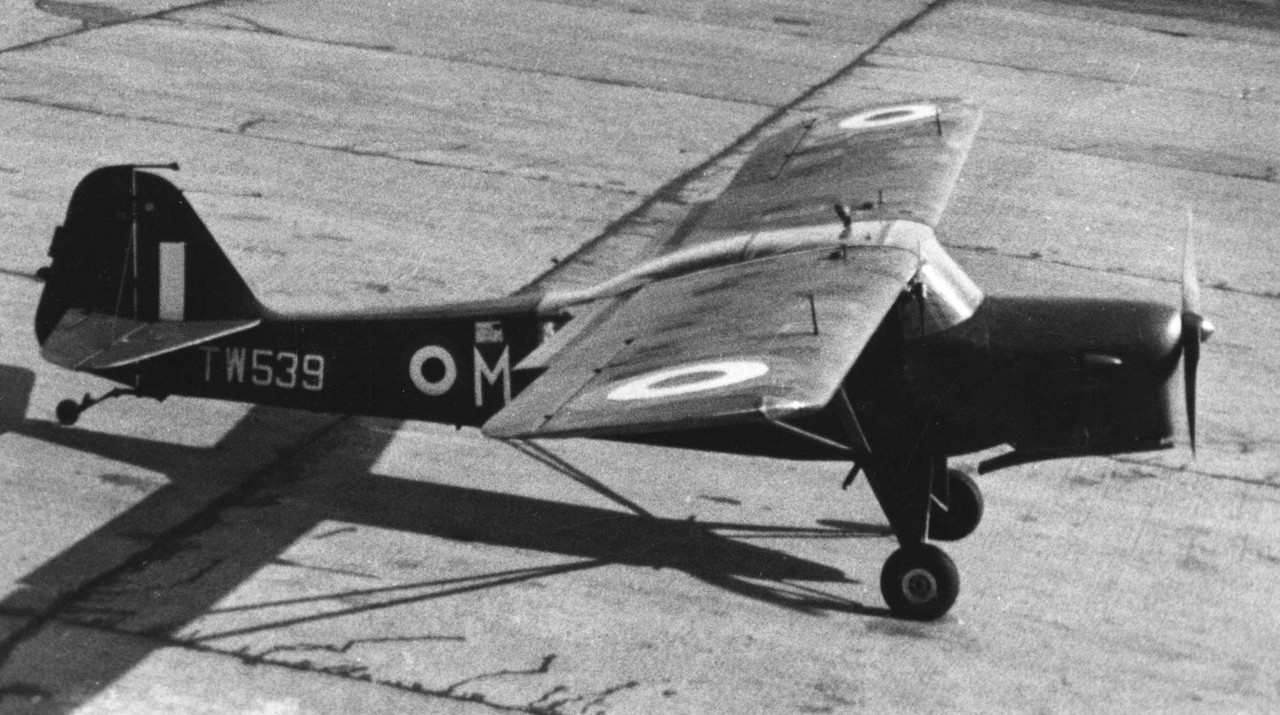
Military Service and Global Operations
The AOP.6 became the backbone of Commonwealth artillery observation squadrons throughout the late 1940s and 1950s. The Royal Air Force received the largest allocation with 296 aircraft delivered in the initial 1949 production run, followed by an additional batch through 1952 that brought total RAF deliveries to approximately 400 units. Beyond British service, the aircraft equipped the Royal Canadian Air Force with 36 examples delivered in 1948, while the South African Air Force and Royal Hong Kong Auxiliary Air Force operated the type in smaller numbers.
During the Korean War, British forces employed the AOP.6 to scout enemy positions and coordinate artillery strikes, proving the aircraft's effectiveness in forward battle areas. The Belgian Air Force received 22 aircraft diverted from RAF orders, operating them until 1957, while Jordan's Arab Legion Air Force utilized the type for border patrol and reconnaissance missions across the Middle East.
Auster Aircraft Limited Heritage
Auster Aircraft Limited emerged from the dissolution of the original Taylorcraft licensing agreement in 1945, inheriting a wartime legacy of producing the Taylor Cub under English license. The company had distinguished itself during World War II by designing and mass-producing the Taylorcraft Auster V, establishing expertise in light observation aircraft that directly influenced the AOP.6's development.
The AOP.6 represented Auster's transition from wartime expedients to purpose-built military aircraft. Engineers strengthened the fuselage structure, increased maximum takeoff weight to 2,160 pounds, and specified the more powerful 145-horsepower de Havilland Gipsy Major 7 engine—a significant upgrade from earlier variants using 130-horsepower Lycoming powerplants.
Design Innovation and Technical Specifications
The prototype's May 1, 1945 first flight revealed several design improvements over wartime predecessors. Engineers lengthened the landing gear struts to accommodate a larger propeller diameter, while external non-retractable aerofoil flaps provided enhanced short-field performance essential for operations from improvised forward airstrips.
The four-cylinder air-cooled inverted inline Gipsy Major 7 engine produced 108 kilowatts, enabling a maximum speed of 122 mph and economic cruising speed of 108 mph. With 23 imperial gallons of fuel capacity, the aircraft achieved a 260-mile range while maintaining an empty weight of just 1,413 pounds. The high-wing configuration provided excellent ground visibility for observation duties, while the robust landing gear withstood operations from rough terrain.
Operational Characteristics and Pilot Experience
Pilots praised the AOP.6's docile handling characteristics and forgiving flight envelope, essential qualities for low-level reconnaissance work over hostile territory. The aircraft's ability to operate from short, unprepared strips measuring less than 500 yards made it invaluable for forward deployment with ground forces. Two-seat accommodation allowed for dedicated observer duties, with the rear occupant equipped with maps, radio equipment, and observation instruments.
The type's reliability and ease of maintenance proved crucial during extended field operations. Ground crews could perform routine servicing with minimal equipment, while the robust Gipsy Major engine demonstrated exceptional durability under harsh operating conditions.
Transition to Civilian Service
As military requirements evolved, surplus AOP.6 aircraft found new life in civilian hands. The first conversion variant, designated Auster 6A, retained the military airframe while accommodating private pilot operations. Later examples underwent more extensive modifications to become the Beagle A.61 Terrier, reflecting changing ownership as Auster Aircraft eventually merged into the Beagle Aircraft organization.
One documented example, serial VF987, illustrates the type's post-military career trajectory. Delivered to Belgium in 1947, it served with the Belgian Air Force until 1957 before passing through multiple English civilian owners over subsequent decades.
Legacy and Replacement
By 1955, the AOP.6 faced obsolescence as the Royal Air Force introduced the Auster AOP.9, featuring all-metal construction and a more powerful 180-horsepower Cirrus Bombardier engine. The Royal Canadian Air Force began replacing its Auster fleet with Cessna L-19 Bird Dog aircraft in 1954, striking the last example from strength in May 1958.
Today, surviving examples reside in aviation museums and private collections worldwide. The Canada Aviation and Space Museum preserves AOP.6 VF582 (manufactured 1948) in its Reserve Hangar, while the Belgian Aviation Preservation Association actively restores former Belgian Air Force aircraft for static display. These preserved examples represent an important evolutionary link between World War II observation aircraft and the specialized helicopters that eventually assumed the artillery spotting role.